

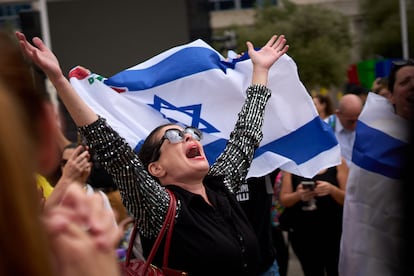
Two years, 67,000 deaths, and much suffering later, Israel and Hamas signed the agreement on the first phase of Donald Trump's plan for Gaza this Thursday in the Egyptian town of Sharm el-Sheikh. They did so with great discretion and without media coverage, despite its importance: it will trigger the release—in the coming days—of the last 48 Israeli hostages and the release of some 2,000 Palestinian prisoners, the withdrawal of Israeli troops from half of the Strip, and a massive influx of humanitarian aid that Israel had been preventing. And it is, above all, the first step toward putting a definitive end to the invasion that Israel launched two years ago Tuesday, following the attack by the Islamist militant group. Scenes of jubilation have taken place in both Gaza and Israel since the US president announced it in the early hours of the morning. However, it will not come into force until 24 hours after it is approved by Benjamin Netanyahu's government, in principle, without difficulty. It meets at 6:00 p.m. local time (5:00 p.m. in mainland Spain).
The agreement was signed this morning in the Egyptian town of Sharm El Sheikh, as confirmed by both parties. Negotiating delegations were working on final details until Thursday morning, according to Egyptian official media.
There is still no precise date for the release of at least 20 Israeli hostages still alive, the preparation of which (they are scattered in secret locations and some are in the hands of militias other than Hamas) will take at least two days. It is estimated to take place between Saturday and Monday, around the time Trump will address the Israeli Parliament at Netanyahu's invitation.
The ceasefire will only take effect in Gaza 24 hours after Netanyahu's government approves it, allowing troops to leave urban areas and retreat to the agreed-upon front line, around half of Gaza, said Tal Heinrich, a spokesman for the Israeli prime minister's office. At least 20 Palestinians have died in Gaza since early this morning, according to Palestinian health sources.
A Hamas spokesman, Hazem Qassem, accused Netanyahu of manipulating the dates, lists, and some already agreed-upon procedures and measures. “There was talk of implementing a ceasefire at noon today, but the occupation [Israel], for internal reasons, is postponing the announcement to other dates,” Qassem protested. “We are in contact with the mediators to force him to comply with what was agreed upon and not allow him to postpone it,” he said.
A senior Palestinian militia official, who responded to EL PAÍS's questions in a message on condition of anonymity, also criticized Netanyahu, claiming that"he is trying to evade compliance with the decisions [provided for in the agreement] to stop the genocide." According to this Hamas representative, the Israeli prime minister"has not yet given his army the order to stop the bombing."
Hamas has signed the pact, and"it's now up to Trump" to tell the group "when he will force Netanyahu to begin implementing it."
The Israeli government will vote in two parts, as is typical in these cases. First, in a smaller cabinet, the security cabinet, and then, the full government. The ministers will not vote on the 20 points of Trump's plan, but on the first phase: the release of the remaining 48 hostages in exchange for the release of nearly 2,000 Palestinian prisoners, 250 of them serving at least a life sentence for participating in or organizing attacks in the Middle East conflict.
Approval in Israel doesn't appear to be at risk because it requires a simple majority, and Netanyahu's Likud has it. He can also count on the ministers of New Hope, the party of Foreign Minister Gideon Sa'ar, with which he is merging. In any case, none of the ultranationalist or ultra-Orthodox partners have announced a vote against it.
The most critical, Finance Minister Bezalel Smotrich, has simply stated that he has"mixed feelings" about the matter and will therefore not speak in favor of it. He feels, on the one hand,"great joy" at the return of the hostages, but, on the other,"immense fear of the consequences of emptying the prisons and releasing the next generation of terrorist leaders who will do everything possible to continue shedding rivers of Jewish blood." Smotrich has insisted that the agreement not become what it truly is: "the hostages in exchange for stopping the war." He wants the State of Israel to continue "immediately after they return home" to "make every effort to truly eradicate Hamas."
The prisoner list remains a stumbling block. The agreement was signed without including it, and a senior Hamas official has accused Israel in recent hours of going back on its commitments in this regard. Mahmoud Mardawi, a member of the political wing, claimed on the social network X that Netanyahu “is trying to sabotage” the pact “before its implementation, retracting the prisoner lists in an attempt to undermine the understanding.”
The interpretation of the agreement has been a clear exercise in realpolitik since Trump and Netanyahu presented it on the 19th at the White House. Neither the deadlines nor the entry into force have been as promised. Nor was it a two-phase plan, but it has been treated as such, making it easier for Netanyahu to push it forward with his ultranationalist partners: Religious Zionism, Smotrich's party, and Jewish Power, the party of National Security Minister Itamar Ben Gvir. The bulk of the challenges are concentrated in the second phase, such as the disarmament of Hamas or the establishment of a Palestinian technocratic government.
Egypt, for its part, has continued to push for authorization to allow bulldozers into Gaza to facilitate the delivery of humanitarian aid. Its president, Abdel Fattah al-Sisi, welcomed the Sharm el-Sheikh agreement"after two years of suffering and misfortune" in a message posted on social media. He also considered that it not only closes the chapter of war, but also"opens the door of hope" in the region for a future "defined by justice and stability." On Wednesday, the Egyptian president had invited Trump to attend the signing of the agreement in Egypt, but the heads of the US negotiating delegation, which includes the president's special envoy for the Middle East, Steve Witkoff, and his son-in-law Jared Kushner, very active in regional diplomacy during his first term, are scheduled to travel to Israel on Thursday, according to Israeli media.
The agreement came after an intense day of indirect negotiations that began Wednesday morning in Sharm el-Sheikh between Egyptian and Qatari mediators and the Hamas delegation, led by its leader abroad, Khalil al-Hayya. In the afternoon, the Egyptian and Qatari mediators met with the US and Israeli delegations, which included the presence of the head of their negotiating team and Minister of Strategic Affairs, Ron Dermer, a close ally of Netanyahu. In the evening, a new extended session was held, which lasted until early Thursday morning, when Trump finally announced it, and the two parties arrived, while the rest of the mediators joined the chorus of celebrations.