
Breaking up Europe with the aim of"making it great again." And to do so requires the help of those countries that can act as leverage to spread nationalism, conservatism, and"recovery of traditional European lifestyles." Which ones? Austria, Hungary, Poland, and above all Italy. The new American National Security Strategy had not spared fierce criticism of the Old Continent, predicting its cancellation if it did not reverse its current course on immigration and the protection of values. But what was not said is that a draft plan for this upheaval has already been put down in black and white in the classified version of the document released by Defense One, an American newspaper specializing in security and defense.
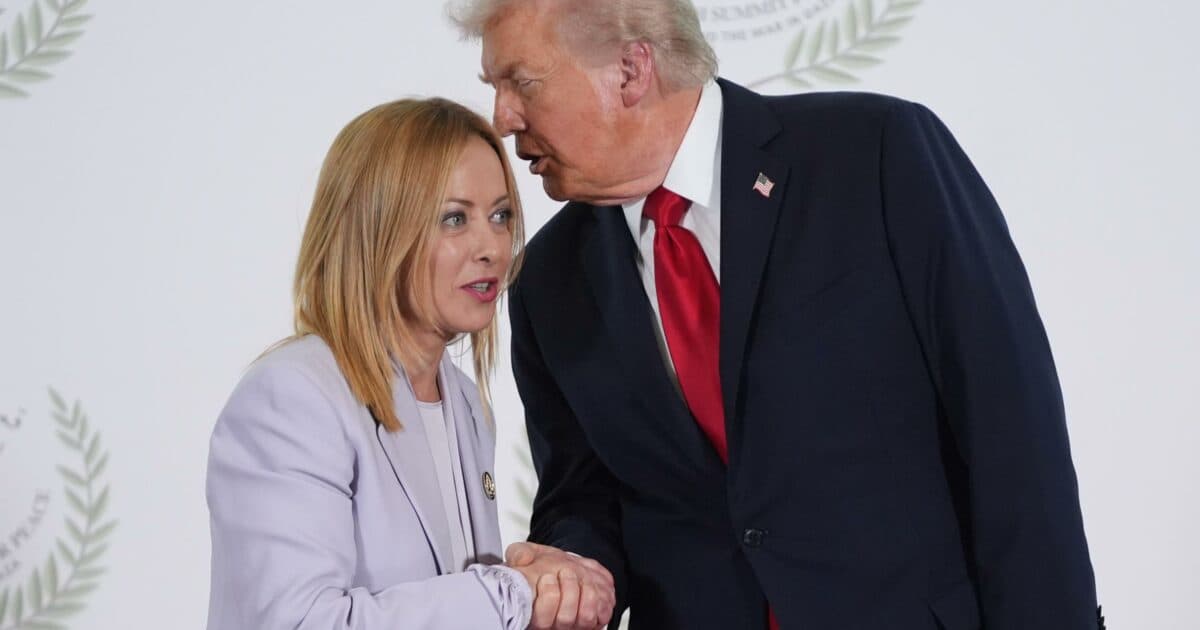
Make Europe Great Again is the motto Maga that the White House has also chosen for its policies towards the European Union, which must follow those already adopted on the other side of the Atlantic. Starting from the assumption that Europe is facing the"erasure of its own civilization" due to its immigration policies and the"censorship of free speech", the extended version of the National Security Strategy requires Washington to focus its efforts on European countries close to the positions of the current administration to realize the White House's plans on the Old Continent. And among the governments closest to the tycoon's positions, such as those of Poland, Hungary, and Austria, Giorgia Meloni's Italy also stands out. It carries much more weight than the others, being a founding state of the EU and a member of the G7. These are, it says, countries with which the US should"collaborate more with the aim of distancing them from the European Union. And we should support the parties, movements, and intellectual and cultural figures who seek sovereignty and the preservation/restoration of traditional European ways of life, while remaining pro-American."
The Italian government fully meets the required requirements and is therefore perceived as a Trojan Horse that would allow the United States to exercise its interference in Europe. This objective is part of a broader plan to reorganize a new world order that takes into account the rise of powers such as China and India and recalibrates its international influence capabilities according to a model that the document has dubbed C5, which would include China, India, Russia, the United States, and Japan. Items on the agenda of this new group would be security in the Middle East, in particular the normalization of relations between Israel and Saudi Arabia.
This system would represent the compromise Trump would be willing to accept after realizing the end of American hegemony."Hegemony is the wrong thing to desire and was unattainable," the document reads. This realization rewards the Russian-Chinese strategy, which, at the outbreak of the war in Ukraine, aimed precisely at challenging the unipolar system in favor of a multipolar one, which would bring to the top countries that until recently were considered developing countries but which today represent global economic and military powers."After the end of the Cold War, American foreign policy elites became convinced that permanent US dominance over the entire world was in our country's best interests," the document continues."Yet the affairs of other countries concern us only if their activities directly threaten our interests." The text then moves on to a critique of American international policies of recent decades, including, albeit subtly, the"exportation of democracy" so beloved by neoconservatives, but not only:"The Trump administration has inherited a world in which weapons of war have destroyed the peace and stability of many countries on many continents. We have a natural interest in ameliorating this crisis." It is not up to the United States to do everything alone, they add, but China and Russia should not be allowed to replace American leadership. For this reason, it suggests collaborating with"regional champions" to help maintain stability: "We will press and encourage governments, political parties, and movements in the region that broadly share our principles and strategy. But we must not neglect governments with different perspectives, with whom we nevertheless share interests and who wish to collaborate with us."
After this story was published, the White House denied the existence of any version of the National Security Strategy other than the one published online.