
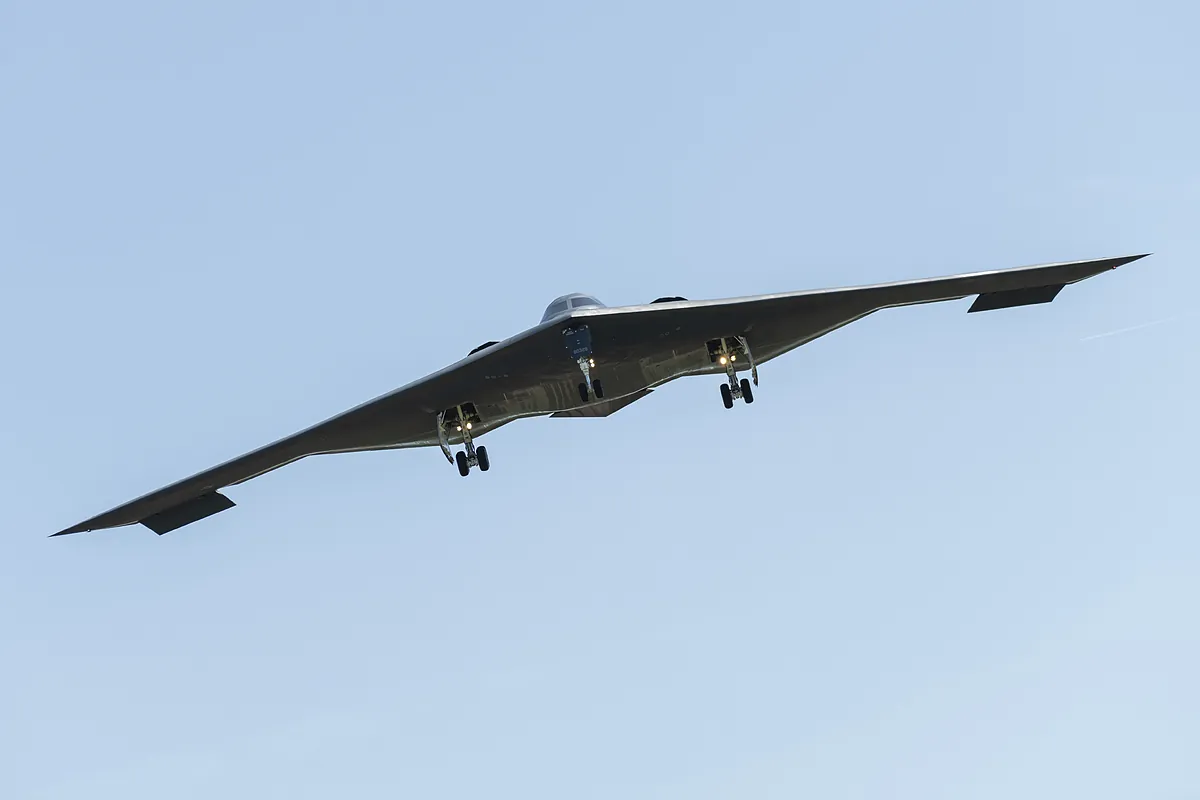
Up to 125 aircraft, Ghost Fighters, a submarine, numerous mid-air refueling missions, diversionary flights across the Pacific, and 75 penetrating weapons, 14 of them 15,000-kilogram superbombs that had never been used in combat. These were the main elements of 'Midnight Hammer,' the operation with which the United States attacked Iran last night in an attempt to destroy its nuclear facilities and put an end to its program. A large-scale attack, coordinated with troops across the globe, which met with no resistance, according to US Secretary of Defense Pete Hegseth, explained this Sunday morning, Washington time.
The Pentagon chief, accompanied by General Dan Caine, chairman of the Joint Chiefs of Staff, gave details of a plan"that required months of positioning and preparation so that we would be ready when the president of the United States announced it. It involved precision, distraction, and maximum operational security. Our B-2s entered and left the center of these nuclear sites, without the world knowing. It was historic, an attack that included the longest mission of the B-2 Spirit bomber since 2001, after 9/11, and the first operational use of MOPs, massively munition penetrating bombs. As President Trump has stated, The United States does not seek war, but we will act quickly and decisively when our people, our partners, or our interests are threatened," the military high command stated.
Those in charge, insisting that it was not a declaration of war, that they are not seeking regime change, and warning sternly of possible retaliation, have detailed the details of an attack that involved more than 125 aircraft, including B2 bombers, the only ones capable of carrying such heavy bombs, dozens of tanker planes positioned along the planned route to ensure there would be no pauses, spy planes and satellites, and fighter jets to clear Iranian airspace. And the decoy bombers, which left the U.S. heading west over the Pacific to avoid detection. The largest such bombing raid in U.S. history and the second-longest such mission ever flown, surpassed only by those in the days after 9/11." President Trump said he would not tolerate nuclear weapons. He seeks peace, and Iran should follow that path. Last night he expressed a truth: Any retaliation by Iran against the United States will be met with far greater force."

The seven B2s that carried out the attack departed from the East Coast and crossed Europe from southern Iberia, refueling several times. At the same time, another squadron was moving in the opposite direction, seeking to create confusion. In recent weeks, the Pentagon had moved other aircraft to bases in the Pacific and Indian Oceans, and its eyes were focused there, not on the other flank."At midnight Friday and early Saturday morning, a large B2 attack package of bombers was launched from the continental United States as part of a plan to maintain tactical surprise. Part of the package was directed westward and into the Pacific as a decoy, a deception strategy known only to an extremely small number of key planners and leaders here in Washington and Tampa," the general explained.
The"primary strike package" comprised of seven B2s, each with two crew members, proceeded with minimal communications during the 18-hour flight to the target area. The B2s linked up with escort and support aircraft in a complex, tightly paced maneuver requiring exact synchronization among multiple platforms in tight airspace, all accomplished with minimal communications. At approximately 5:00 p.m. Washington time, just before the strike package entered Iran, a U.S. submarine launched more than two dozen Tomahawk land-attack cruise missiles at key surface infrastructure targets in Isfahan as the Operation Midnight Hammer strike package entered Iranian airspace.
During that phase, the United States employed various deterrence tactics, including decoys,"as fourth- and fifth-generation aircraft advanced in front of the strike package at high altitude and high speed, sweeping the front of the package for enemy fighter and surface-to-air missile threats. While approaching Fordow and Natanz, the U.S. protection group employed high-speed suppression weapons to ensure the safe passage of the package. As of this time, we are not aware of any shots fired at the U.S. strike package during its arrival at approximately 6:40 p.m.," the chief of staff said.
At approximately 6:40 p.m., US time, and 1:40 a.m. in Spain, the lead B2 dropped two GBU 57 Massive Ordnance Penetrator weapons at the first of several target points at Fordow. The remaining bombers also hit their targets, bringing the total number of massive penetrator bombs dropped to 14. The three Iranian nuclear infrastructure targets were hit between 6:40 p.m. and 7:05 p.m., around 2:10 a.m. local time in Iran. The Tomahawk missiles were the last to strike Isfahan to ensure the element of surprise was maintained throughout the operation. Following the weapons launch, the midnight strike package left Iranian airspace and began its return home.
According to the Pentagon, Iranian fighter jets did not fly and Iranian surface-to-air missile systems did not detect us during the mission. In total, US forces employed approximately 75 precision-guided weapons during this operation, including the fearsome 14 superbombs, each weighing nearly 15,000 kilos, and 57 massive artillery penetrators,"the first operational use of this weapon in history. Analysis of the final combat damage will take time, but initial assessments indicate that all three sites suffered extremely severe damage and destruction," said the military man, more cautious than the president and vice president, who spoke of a"destruction" or "Pulverization " and a "final blow to the program."