

The text originally appeared in The Washington Post.
Los Angeles was already on the brink of collapse. First, a series of raids targeting immigrants sparked a wave of fear in one of the largest illegal immigrant communities in the US, resulting in protests. Then, US President Donald Trump bypassed the California state government and deployed the National Guard to the city. This sparked further unrest, which in some places turned violent.
The situation intensified on Monday when Trump welcomed the idea of arresting California Democratic Governor Gavin Newsom, followed by the mobilization of hundreds of Marines to reinforce National Guard members.
In a city under the federal government's scrutiny, the unrest can be seen as a personal matter. Local leaders accuse the Trump administration of fomenting the crisis for political gain, and residents of the sprawling metropolis denounce what they see as an attack on the very fabric of the city.
“I think he’s waging a war against us, the people of Los Angeles,” said D. J. Yoon, who drummed at the protest outside City Hall. “He’s messing with the wrong people.”
People are not sleeping.
Los Angeles and California in general have long been a favorite target of Trump, who delights in portraying them as hellish places controlled by Democrats. The Trump administration is also considering cutting off federal funding to California, an unprecedented move that would decimate the state's budget.
But the weekend exchanges marked a significant escalation of tense relations. No president in 60 years has activated the state's National Guard without the governor's request, a move that has sparked a tumultuous political standoff.
Newsom called Trump's actions a"step toward authoritarianism," and the state of California sued the federal government on Monday for mobilizing the National Guard.
Meanwhile, Trump and other administration officials have continued to describe the events of recent days in extreme terms. The US president said Los Angeles had been attacked and occupied, while Deputy Chief of Staff Stephen Miller compared the protests to an uprising.
Los Angeles Mayor Karen Bass — a Democrat who has personally urged White House officials not to send the National Guard to California — said Trump's actions were deliberate and that the president wanted to sow chaos in Los Angeles. Accusations that Los Angeles had descended into widespread lawlessness were false, she added.
And indeed: despite chaos in some downtown neighborhoods on Sunday, the streets of Hollywood were filled with Pride parades; people paddled boats on Echo Park Lake; and Dodgers fans drank beer on bar terraces during the baseball team's game.
Los Angeles County covers an area of 4,000 square miles and is the most populous county in the country, with nearly ten million residents. It is home to 88 cities, of which Los Angeles is just one, and the city is large enough to accommodate the normal rhythm of daily life even with increased national interest.
Nevertheless, the work week began with concerns about what might come next.
Jaime Valdivia sat outside a cafe at Mariachi Plaza in the eastern Boyle Heights neighborhood and lamented how empty the popular spot was on Monday. Few people were out enjoying the sun. No musicians were playing.
Valdivia, a 46-year-old U.S. citizen of Mexican descent, works at Mariachi Plaza, where he plays guitar and trumpet. He said repeated raids by Immigration and Customs Enforcement (ICE) have hurt his business. Some businesses have canceled performances because they fear the music will attract ICE officers to their meetings.
"You feel helpless and sad," Valdivia said in Spanish.
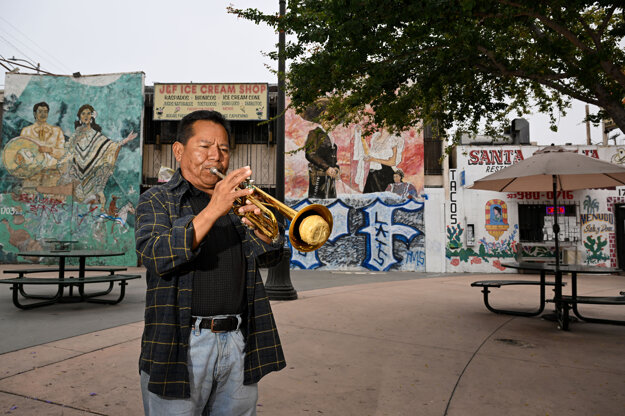
The cafe owner said business has slowed since the ICE raid in the area last week, as people have started avoiding the plaza. Only a few musicians have come for breakfast tacos.
"People aren't sleeping. They're afraid to go to the market," said Minerva Villa, 46."I miss all those customers. Look how quiet it is here."
Rumors of more raids continued to circulate on Monday. Villa and her son came across reports — later proven false — of ICE activity at a nearby school.
Wrong state
Twelve kilometers west, customers at the Original Farmers Market in Fairfax County were horrified this morning by the US president's reaction, which they consider hostile and excessive.
“I’m ashamed of him and what he’s doing to the country,” said MaryAnne Kennedy, 82, who moved to the United States from Canada in 1980 and later became a U.S. citizen — a decision she has been questioning lately. “I feel pretty depressed here.”
For Ken and Sandy Yamashiro, Japanese Americans and lifelong residents of Los Angeles, the ongoing immigration raids and National Guard presence are a reminder of a dark era in U.S. history.
"My family was put in internment camps," said Sandy, 70."It's similar - based on what you look like, the color of your skin, they take you away. It's very scary."
Ken, a 72-year-old retiree, took aim at the US president's threat to cut state funding, despite California paying $80 billion more in federal taxes than it receives in federal aid. The implications of such a move, Ken said, would resonate far beyond Los Angeles.
"Now everyone is a target," he said."He's only been in office for six months. We've got three and a half years left. He could come after anyone."
Although Los Angeles County remains a bright blue Democratic stronghold, Trump saw a surge here in last year's election, winning 44,000 more votes than in 2020.
James Young, a 57-year-old Panamanian living on the city's east side, supports Trump's decision to deploy the National Guard. Young was horrified as he watched the protests on Sunday, shocked by images of burning cars and protesters throwing rocks at police.
"People protesting are everywhere," he said."If no one is there, they'll just destroy things. This might discourage them."
But he is concerned about some of ICE's repressive measures, which he says should be limited to prosecuting convicted criminals rather than targeting workplaces.
“That’s the wrong way to do it,” Young said. “Nobody’s going to like it.”
That view has been prevalent in recent days, as Los Angeles residents denounce what they see as attacks on neighbors, co-workers and family members.
Stephanie Mendoza, 30, attended Sunday's protest with three friends, all of whom are children of immigrants. All of them grew up in Los Angeles and feel a sense of duty to stand up for their parents.
“We are all citizens, but we are here for the people we know and those who are not,” said Mendoza, whose family emigrated from Honduras and who works at a local nonprofit helping refugees.
She has loved ones who remain in the U.S. undocumented. “I still carry within me the fear that my family is currently experiencing,” she added.
On Monday, traces of Sunday's protest were still visible in downtown Los Angeles: glass from the windows of City Hall and the Los Angeles Police Department was broken on the street, vulgar anti-ICE graffiti covered the walls of several buildings, and helicopters circled overhead.
Chants of"Si se puede!" (translated as "Yes, it's possible!") (a term used by various movements during immigration reform marches or political campaigns – ed.) could be heard from a nearby gathering.
David Madrick, an actor who lives downtown, was just outside with his Italian greyhound, but he was bracing for more unrest - uncertain and frustrated by the escalating military presence.
"This is not normal," said Madrick, who has appeared in TV series such as Black-ish and Ruthless."What's going on? It's all very exhausting."
He moved to Los Angeles from New York six years ago, but he's been here long enough to know that illegal workers are an important part of the community and the economy.
"They're providing lighting, food supplies... Everything is working," Madrick said. He hopes Trump understands the protesters' message:"He's not intimidating anyone. He picked the wrong state to do that."