

The Israeli defence minister has warned that “Tehran will burn” if Iran continues firing missiles at Israel.
The warning from Israel Katz came after at least three people died and dozens were wounded following a wave of Israeli attacks on Tehran’s nuclear programme and its armed forces.
Speaking after a meeting with the army’s chief of staff, Mr Katz said Iran will pay a heavy price for harming Israeli citizens.
“If [Iranian Supreme leader Ayatollah Ali] Khamenei continues to fire missiles at the Israeli home front, Tehran will burn,” he said.
Iranian state television reported that air defence systems were firing in the cities of Khorramabad, Kermanshah and Tabriz, signalling the start of what could be a new Israeli attack.
Footage from Tabriz showed black smoke rising from the city, according to a video posted by an affiliate of Iranian state TV.
Israel’s army said on Saturday that it had killed nine senior scientists and experts involved in Iran’s nuclear project.
Iran’s UN ambassador said 78 people were killed and more than 320 wounded in the attacks.
Tehran retaliated by launching waves of drones and ballistic missiles at Israel, where explosions lit the night skies over Jerusalem and Tel Aviv and shook the buildings below.
The Israeli military urged civilians, already rattled by 20 months of war in Gaza sparked by Hamas’s October 2023 attack, to head to shelter for hours.
Israel and Iran said their attacks would continue, raising the prospect of another protracted Middle East conflict.
Iran has warned the United States, United Kingdom and France that their military bases and ships will be targeted if they help block the Iranian missile and drone retaliation over Israel’s attack, threatening to widen an already bloody conflict over Tehran’s nuclear programme.
US president Donald Trump has said the United States will help defend Israel, and American officials have been quoted in news reports saying that US forces have already helped shoot down Iranian drones and missiles as they approached Israel. French president Emmanuel Macron also said on Friday that his country would help defend Israel against Iranian reprisals.
The British government has said its forces had not provided any military assistance to Israel.
Tehran is seeking to deter western support for Israel’s defence at a time most of the missiles and drones it fires at Israel are being intercepted before they reach their targets. However, following through on the threat, delivered on Saturday through state media, would be an enormous gamble for Iran, drawing western forces into the conflict when it is already reeling under the force of sustained Israeli bombing.
Speaking at a session of the UN security council on Friday, US diplomat McCoy Pitt warned: “No government proxy or independent actor should target American citizens, American bases or other American infrastructure in the region. The consequences for Iran would be dire.”
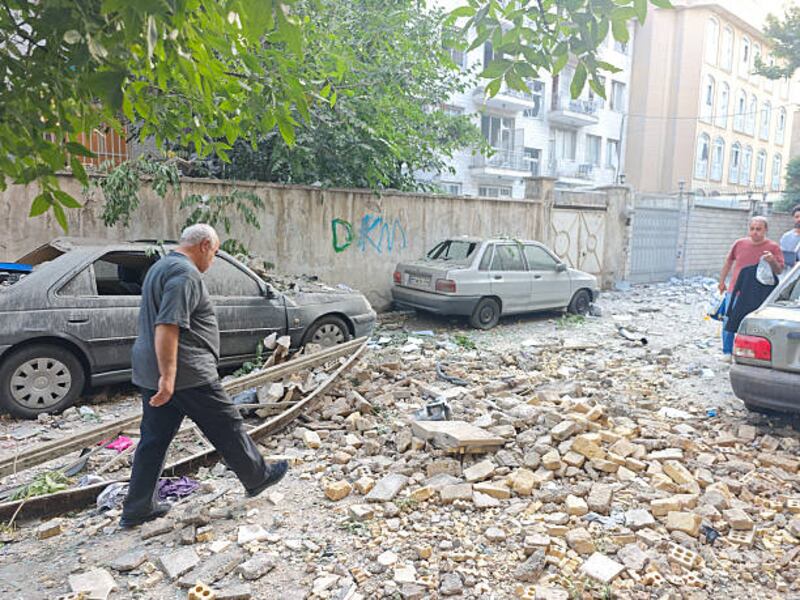
On Saturday, Israeli planes focused bombing sorties on Tehran while Iran sought to hit back with salvoes of missiles and drones as the aerial war entered its second day.
Israel Defense Forces (IDF) said that dozens of its warplanes struck targets in the Iranian capital, focusing on its air defences.
The Iranian government also confirmed limited damage at its uranium enrichment plant at Fordow, the second enrichment facility bombed by the Israeli air force. On Friday, the IDF claimed to have inflicted “significant damage” at the plant at Natanz. The International Atomic Energy Agency (IAEA) confirmed the above-ground part of the Natanz plant had been destroyed but noted no apparent damage to its underground chambers.
An IAEA report said that attacks caused radiological and chemical contamination in the Natanz facility, but that it was manageable and there was no sign of higher radiation in the area around the plant. Iran also said there had been attacks on its nuclear site in Isfahan, which houses a uranium conversion plant, a fuel production unit and other facilities.
The IAEA reminded Israel that attacks on nuclear sites were illegal.
Israelis in Tel Aviv and other cities spent the dawn hours on Saturday in shelters as a new barrage of Iranian missiles headed towards them. The worst casualties from the incoming missiles were in the West Bank, where five Palestinians, including three children, were killed, according to the Palestinian Red Crescent, reportedly by a projectile fired by Houthi forces in Yemen, who are Iranian allies.
Over the first 24 hours of the conflict, three Israelis were also killed, two in Rishon LeZion and one in nearby Tel Aviv, with dozens injured and extensive damage to buildings.
[ Iranians react to Israel’s strikes with anger and fear: ‘We can’t afford not to respond’Opens in new window ]
Before Israel’s attack, Iranian and US negotiators had been due to meet in Oman on Sunday to discuss a peaceful solution to the nuclear programme impasse, but those talks in Muscat will now not take place, said Omani foreign minister Badr Albusaidi on X. Oman has been mediating the talks.
There was every sign on Saturday morning that the conflict was far from over. Overnight Israel’s prime minister, Binyamin Netanyahu, vowed that a lot more Israel attacks were “on the way” while Mr Khamenei pledged that Israel would be brought to “ruin”.

In Tel Aviv on Friday night, one missile hit a high-rise residential building near the heart of Tel Aviv, causing significant structural damage.
Israel’s ambulance service said 34 people were injured on Friday night in the Tel Aviv area, most with minor injuries. Police later said one person had died. Another two people were confirmed killed in a direct missile strike on central Israel on Saturday morning.
The Israeli leadership and the IDF, meanwhile, have insisted that their offensive against Iran, called Rising Lion, would continue until Tehran’s nuclear programme was destroyed.
Addressing the UN security council, IAEA director general Rafael Grossi warned of the potentially disastrous consequences of such attacks.
“I have repeatedly stated that nuclear facilities must never be attacked ... Such attacks have serious implications for ... international peace and security,” he said.
The US role in the Israeli operation remains opaque. In the run-up to the Israeli 200-plane attack, Mr Trump had publicly urged Israel to give diplomacy more of a chance, before US-Iranian talks that were planned for Sunday. On Friday, the US president insisted he had been well informed of Israel’s plans, and described the Israeli attack as “excellent”.
Asked by the Wall Street Journal what kind of heads-up the US had been given, Mr Trump responded testily: “Heads-up? It wasn’t a heads-up. It was, we know what’s going on.”
Speaking separately to ABC News, he praised the attacks and linked the timing to a 60-day ultimatum he had given Tehran in the spring to negotiate a deal. “I think it’s been excellent. We gave them a chance and they didn’t take it ... And there’s more to come. A lot more,” said Mr Trump.
On his own Truth Social online platform, Mr Trump urged Iran to make a deal.
ABC quoted a “source familiar with the intelligence” as saying the US had provided “exquisite” intelligence and would help defend Israel as needed. – AP/Reuters