
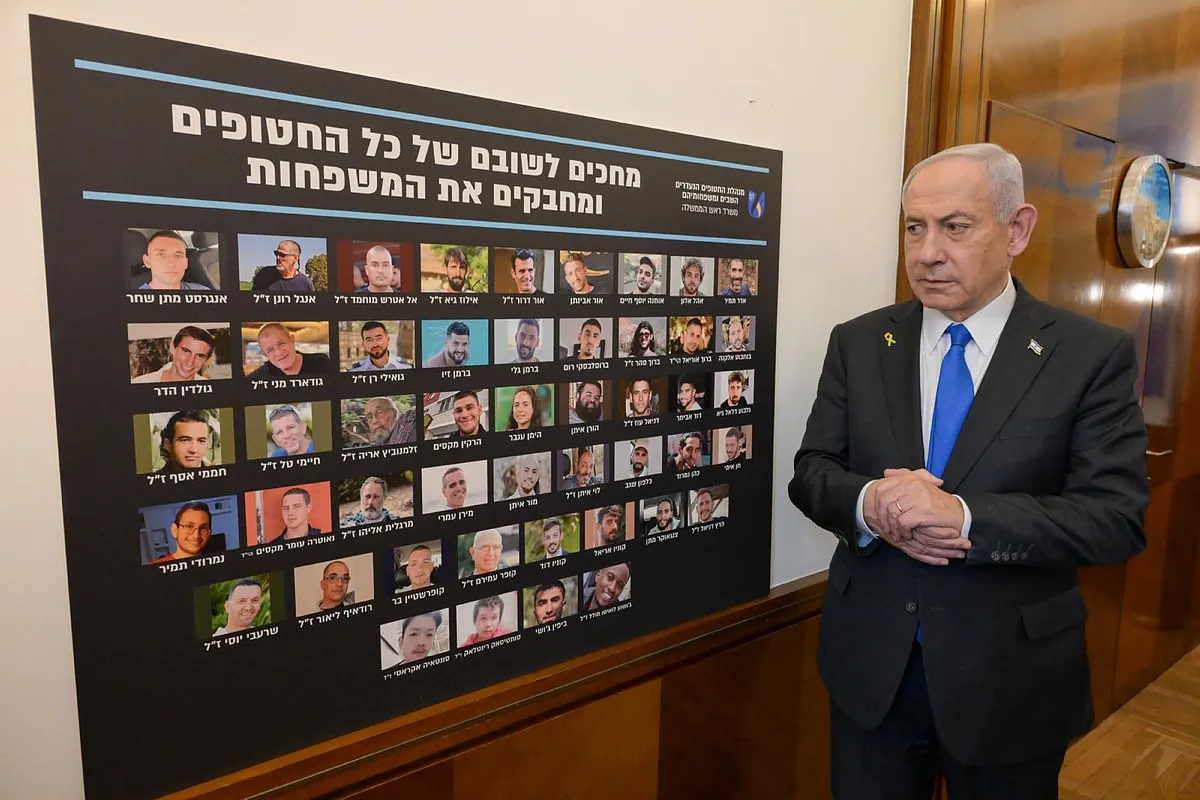
The Israeli army completed the first phase of its withdrawal from Gaza on Friday morning. This withdrawal opens a 72-hour window for the Islamist movement Hamas to release hostages in an exchange for Palestinian prisoners.
Certification of that movement on the ground came via Steve Witkoff, Trump's special envoy."The US military's Central Command confirmed that the Israeli army completed the first phase of its withdrawal toward the yellow line at 12:00 local time," he wrote on X." The 72-hour period for the release of hostages has begun," he added, specifying the time frame for the news that the Israelis are waiting for.
The ceasefire had already been put into effect."The ceasefire agreement came into effect at 12:00 noon" (11:00 a.m. in Spain), the Israeli army announced, noting that its troops are positioned along the new lines in accordance with the withdrawal from the Gaza Strip agreed upon in the truce plan and the return of hostages."Army forces from the Southern Command are deployed in the area and will continue to act to remove any immediate threat," it added.
And shortly after, Netanyahu released a video message in which he specified that the next stages of the plan include Hamas handing over its weapons and the demilitarization of the Gaza Strip, including through the use of force."We are cornering Hamas from all sides in preparation for the next stages of the plan, in which Hamas will be disarmed and Gaza will be demilitarized. If this is achieved by fair means, so be it. If not, it will be achieved by foul means," the prime minister argued.
Netanyahu also expressed his gratitude to his negotiating team, led by Foreign Minister Ron Dermer, and especially to Donald Trump and his special envoy for the Middle East, Steve Witkoff.
Earlier, at 1:20 a.m., Netanyahu's office had announced the government's approval of the agreement for the return of the hostages.
The truce
With rain as an unusual guest, Israelis and Palestinians woke up this Thursday to the news they have been eagerly awaiting and urgently need: a truce between Israel and Hamas. The former hoped it would allow the return of the hostages this Monday after two years of captivity and put an end to their longest war. The latter hoped it would bring calm back to the long-suffering Gaza Strip under an unprecedented offensive launched in response to the jihadist attack of October 7, 2023.
Driven by the plan and especially by pressure from Trump, who exerted enormous influence on key players in the region, the Israeli government and Hamas began the first phase of the ceasefire, in which they agreed to exchange 48 hostages (20 alive) for 250 Palestinian prisoners serving life sentences and 1,700 Gazans detained since October 7, including 22 minors, a partial Israeli military withdrawal, and an increase in the flow of humanitarian aid to 600 trucks per day, as in the previous truce. After officially confirming the agreement, noting, for example, that the Rafah crossing (with Egypt) would be open in both directions, Hamas leader Khalil Al-Jayya said that the mediators and the US government had given them guarantees that"the war is completely over." Following Trump's announcement, which caused indescribable relief in Israel and Gaza, all eyes turned first to Sharm el Sheikh
, where the final details were being ironed out, and then to Jerusalem, where the government announced in the early hours of the morning that it had"approved the plan for the release of all hostages, both alive and dead." Before then, Netanyahu had met with Trump's two representatives in the negotiations,Steve Witkoff and Jared Kushner, who exceptionally joined the government at the beginning of the meeting.
The two ultranationalist leaders, Itamar Ben Gvir and Bezalel, voted against the move but remain in the coalition, waiting to see whether Hamas is subsequently dismantled. For now, as ministers, they will be watching Trump's speech in the Israeli Parliament, which awaits him like a hero this Sunday or Monday as part of a lightning visit or triumphant return to the region.
With the pessimism that is typical in these parts, their agreement seems more likely to hold than the other two reached since the Hamas terrorist attack two years and two days ago triggered a massive offensive that devastated the Gaza Strip and escalated on several fronts, including the first direct and open war between Iran and Israel. This ended as the Gaza war seems to end. That is, with an announcement from Trump.
The Israeli army has begun the withdrawal agreed upon with Hamas for the first phase of the plan. Pending the complex negotiation of a much broader withdrawal on the"day after" established in Trump's text, it will maintain control over 53% of the strip. In this way, the troops will reposition themselves on the so-called"yellow line," abandoning Gaza City and the Netzarim axis in the Palestinian enclave, where the news from the White House was received with great relief.
Even if it claims victory, the agreement isn't good for Hamas if the plan is strictly adhered to, whether in terms of relinquishing control of Gaza or, above all, its weapons. It is good for Gazans, at least in the short term, as it halts the dynamics of bombing and displacement.
With a single paragraph on his social media account, Trump managed to elevate the families of the 48 hostages from desperate anxiety to the euphoria they were unable to contain while waiting for their loved ones.
Since the kidnapping of his son Omri Miran (48) in Kibbutz Nahal Oz, Dani Miran has grown a white beard that has grown like his anguish. Today in Tel Aviv he looked like someone being congratulated on becoming a father."I have a divine feeling that I cannot explain. After so much time, my son is back. I feel as if I have a new son," he said. Later, interviewed by an emotional Israeli newscaster, he said:"I have received calls from many who could not speak because they were crying with emotion, like you now."
Israelis applaud the agreement because it puts an end to the tragic hostage situation in the Hamas tunnels, as well as to the longest-running war that began with the most support at both domestic and international levels and became controversial, causing domestic protests and an unprecedented international tsunami (diplomatic, public opinion, etc.) against Israel.
The uncertainty surrounding the hostages, the daily deaths and injuries of soldiers in the Gaza Strip, the lack of understanding in the face of the growing isolation, and the distrust of government decisions have created a state of weariness among many Israelis. The offensive to take control of Gaza City last month has increased internal divisions, as polls show that the majority prioritized saving the hostages over killing the militants. Army chief Eyal Zamir opposed an operation that he ultimately led with heavy firepower but was intentionally slow, awaiting Trump's intervention in the negotiations.
Around 2,100 Israelis have been killed (including 1,200 on October 7, when Hamas kidnapped 251 people, while nearly 500 soldiers were killed in the ground offensive in the Gaza Strip) and thousands more wounded over the past two years. This has seen the Israeli rearguard and its defensive shield battle over 30,000 ballistic missiles, drones, and projectiles fired by various pro-Iranian militias in the region.
The"12-Day War," which began in June with the Israeli attack on Iranian military and nuclear targets, was another major turning point in a period that has transformed the Middle East.
Israeli officials say their forces have killed more than 20,000 armed personnel in the Gaza Strip. According to the Hamas-controlled Health Ministry, in what it calls a"war of extermination," more than 67,000 Palestinians have been killed and nearly 170,000 wounded in Israeli air and ground attacks.
"I'm not the only one who's happy. The whole Gaza Strip is happy, all the Arab people." Thank God for the ceasefire, the end of the bloodshed and the killing," Palestinian Abdul Majeed Abd Rabbo told Reuters from the southern part of Khan Yunis as others called for an "end to the nightmare." The big question now is not whether the truce will begin, but how long it will last.
Gazans prayed and sometimes demonstrated in defiance of the Islamist regime, calling for a ceasefire that has caused the greatest level of destruction seen in this enclave in the last 100 years under the control of Great Britain, Egypt, Israel, the Palestinian National Authority and, since 2007, Hamas. Their leader, Yahia Siwnar, never dreamed of inflicting such extensive damage on his powerful enemy, nor that the latter would mount such an extensive, devastating and prolonged response in an enclave with many parts turned into ruins and a dramatic humanitarian situation with around 90% of the more than two million inhabitants displaced.
Unlike the truce in effect from the last week of November 2023 and from January 19th to mid-March this year, the cessation of the operation Israel launched to destroy the jihadist group does not revolve solely around the return of the hostages in captivity. Trump's text, supported by Arab and Muslim countries, outlines the present and future of the Gaza Strip, managed by a body of Palestinian technocrats under the umbrella of an Arab-international commission.