

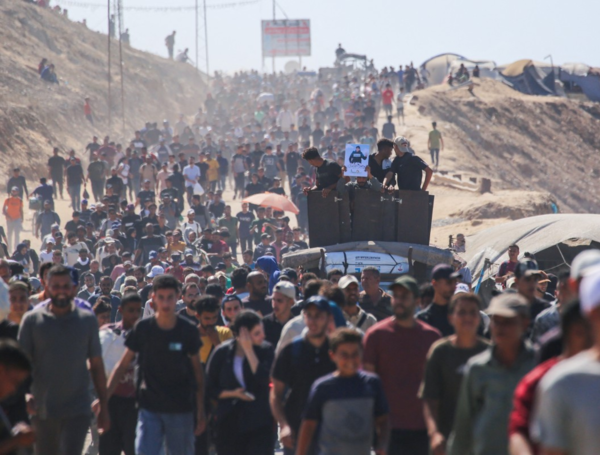
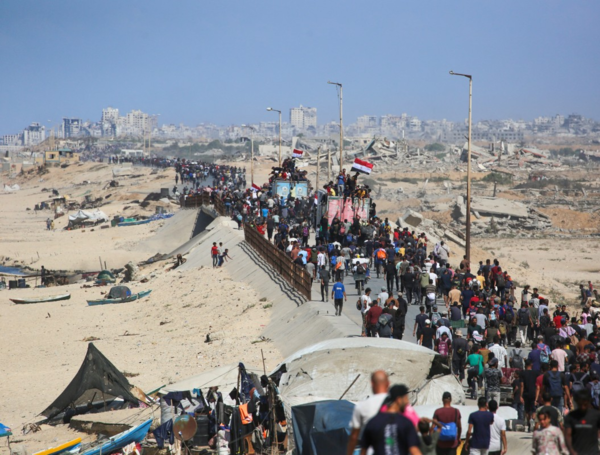
Friday dawn brought, for the first time in two years, a distinct silence to Gaza. It wasn't the calm of peace, but rather the pause of a respite. After the ceasefire agreed between Israel and Hamas under Donald Trump's plan came into effect, dozens of Gazan families walked through the rubble toward what had once been their homes."I thought I would never see my street again," said Maha Al-Qudra, a teacher from Khan Younis who returned with her three children in the first hours of the truce.
According to the UN Office for the Coordination of Humanitarian Affairs, more than 20,000 people were able to return that first day to areas in the center and south of the Strip, where the Israeli army began its partial withdrawal. In parallel, the government of Benjamin Netanyahu approved the release of 250 Palestinian prisoners sentenced to life imprisonment and 1,700 Gazans arrested since October 2023 as part of the exchange provided for in the first phase of the agreement, although it did not include any of the emblematic figures of the Palestinian armed struggle against Israel.
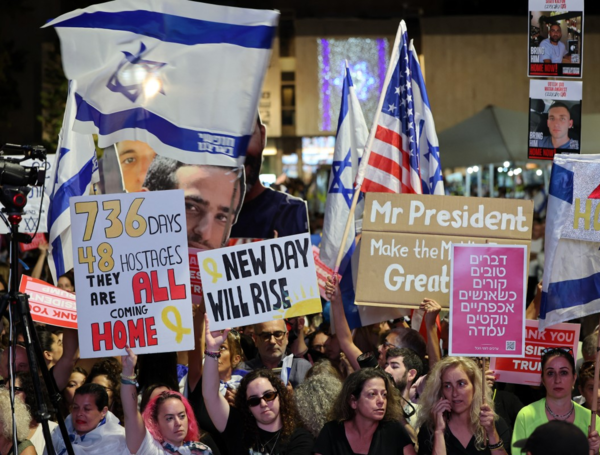
The agreement stipulates that, within 72 hours of the truce taking effect at noon on Friday, Hamas must release the 48 hostages, of whom an estimated 20 are still alive. According to the Islamist group, the release would take place on Monday morning, which is why President Donald Trump will travel to the region.
The first phase of the agreement also includes a 40-day, renewable ceasefire, the opening of three humanitarian corridors supervised by the UN and Qatar, and the entry of 500 trucks daily with food, medicine, and basic supplies. However, its implementation faces technical and political obstacles that are already generating tensions.
“Israel and Hamas did not sign a peace treaty, they signed a truce,” warns Pamela Urrutia, a researcher at the School of Peace at the Autonomous University of Barcelona, highlighting that, while “it is an important step, it is temporary and does not resolve the structural causes of the conflict: the occupation, the blockade and the lack of a legitimate Palestinian authority in Gaza.”
"Trump is trying to show off a quick achievement, but on the ground there is enormous complexity. Verification mechanisms are weak, there are no guarantees of compliance, and local actors have different motivations," explains Michelle Pace, a professor at Roskilde University in Denmark.
From the analysts' perspective, the pact acts as a"test of the day": If the exchange phase works, it could generate momentum for subsequent phases. But if it breaks down, it will deepen skepticism and could further exacerbate the conflict.
"Israel has gone from being a victim to being questioned for its offensive, and Hamas, although weakened, remains a real power in Gaza," Urrutia maintains, emphasizing that"both know that their political survival depends on the narrative they build around this truce."
Michelle PaceProfessor at Roskilde University, Denmark.
The 'gray areas' of the peace agreement
Although the agreement is one of the most structured and internationally supported, with defined phases, guarantor actors, and humanitarian commitments, analysts, along with other experts, agree that there are several"gray areas" that make it difficult to say with certainty that the agreed truce is credible in the long term.
Doubts persist over the timeline for Hamas's disarmament, which on Saturday warned it was"ready to fight" if the war in Gaza resumes and rejected the proposed plan that would expel its members from the Palestinian territory. This was stated by Hosam Badran, one of the group's political leaders, who also announced that they would not attend the signing of the peace agreement in Egypt.
Also unresolved are the extent of the Israeli withdrawal and the mechanisms for reconciliation between Israelis and Palestinians."This ambiguity leaves room for delays or non-compliance," warns Urrutia, who believes that leaving these points for later stages risks causing the negotiations to stall or be sabotaged.
Another factor that raises doubts is that the sustainability of the pact depends on multiple external factors, starting with the role of the key mediators: the United States, Qatar and Egypt , mainly, whose role will be decisive in exerting pressure, ensuring compliance and arbitrating disputes, but will also maintain the influence and resources to carry it out.
"The United States, the Gulf countries, Egypt, Jordan, Qatar, Turkey, and the European Union will each have their own agendas and interests that will weigh heavily within the pact, and we don't know if they will prioritize the entry of humanitarian aid and verification of the ceasefire," says internationalist Manuel Camilo González.
American soldiers, experts in logistics, began arriving in Israel yesterday to support and supervise the agreement.
Regarding Qatar's role, Diego Arias, a conflict and peace analyst, notes that it is playing a"regional stabilizing role." "Its focus is on maintaining open channels with all actors. But its scope of action will depend on Hamas respecting the truce and Israel not resuming operations in the event of minor provocations."
Under this array of actors, the UN—which said it was ready to assist the population of Gaza with 170,000 tons of humanitarian aid in a 60-day plan, but warned that without a fundamental political solution, the cycle of violence will inevitably resume—faces its own dilemma, finding itself in an ambiguous and weakened position.
The United States, the Gulf countries, Egypt, Jordan, Qatar, Turkey and the European Union will each have their own agendas and interests that will weigh within the pact and we do not know if they will prioritize the entry of humanitarian aid and the verification of the ceasefire.
Manuel Camilo GonzálezPolitical scientist and internationalist
“The United Nations faces challenges such as bureaucracy and the criteria for allocating aid,” González acknowledges. However, “it should be the one leading these types of scenarios,” adds Juliana Bustamante, a lawyer specializing in international law.
Something that in practice seems complex, given that Trump himself is a staunch critic of the organization. Furthermore, the Republican did not mention in his plan the possibility of resuming the two-state solution, something that Arab countries like Egypt, Jordan, and Saudi Arabia, some from the European bloc, and others like Canada, have insisted on.
Mutual distrust between Israel and Hamas
“The political will of Netanyahu and the Israeli coalition to adhere to the agreement, without reversing decisions under internal or strategic pressure, is being tested, given that Hamas’s reaction to any non-compliance could lead it to decide to stop cooperating and any subsequent phase could collapse,” explains José Lev Álvarez, an American-Israeli academic and military officer, who was part of the special combat forces in Gaza and is skeptical of the return of the hostages.
“There are 500 kilometers of tunnel in Gaza, of which Israel has managed to destroy a third, but it hasn't been able to penetrate the area where the hostages are being held. I think that, militarily speaking, everything has been left unfinished. Added to this is the fact that Hamas knows it won't be able to get everything it wants, so it won't hand over everything it has,” Álvarez points out, considering that of the 62,000 Israeli soldiers deployed in Gaza, 80% have been in the territory for two months.
"This entails a brutal drain on troops, while Israel must continue to strengthen its other four war fronts (Lebanon, Syria, Yemen, and Iran) at a very high military, economic, and social cost."
Skepticism also dominates the streets. “People are happy not to hear bombing, but no one believes this will last,” says local journalist Yousef Salem from Rafah, who is covering the return of displaced people. “There is no electricity, no drinking water, no government. Only ruins and hunger.”
The magnitude of the humanitarian damage partly explains the urgency of the truce: more than 67,000 dead, 140,000 wounded, and 1.9 million displaced after two years of war, according to the UN.
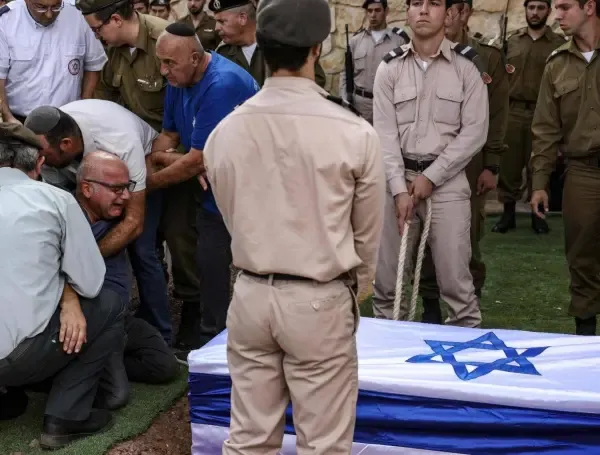
On the other side, in Israel, society remains marked by the tragedy of October 7, 2023, when Hamas attacks left 1,200 dead and 251 kidnapped. A collective trauma that continues to influence Israeli politics.
A recent poll by the Israel Democracy Institute found that 64% of citizens support a ceasefire, but only 27% believe a lasting peace with the Palestinians is possible. On the Palestinian side, 63% are wary of any negotiations that involve recognition of Israel, according to the Palestinian Center for Policy and Survey Research.
“After so much pain, the hardest thing is to believe again,” says Dana El Kurd, an analyst at the Arab Center in Washington. “Israel fears another October 7th; the Palestinians feel like no one is protecting them. The agreement may stop the bombs, but not the psychological wounds or the resentment,” she adds.
Among experts, there is consensus that the main challenge will be determining who will govern Gaza once the transition phase ends. The text of the agreement proposes a temporary civilian administration supported by international actors, without the direct participation of either Hamas or the Palestinian National Authority (PNA).
“This creates a dangerous vacuum,” warns Hugh Lovatt of the European Council on Foreign Relations. “If there is no legitimate structure to represent the Palestinians, reconstruction will be impossible and the conflict could flare up even more.”
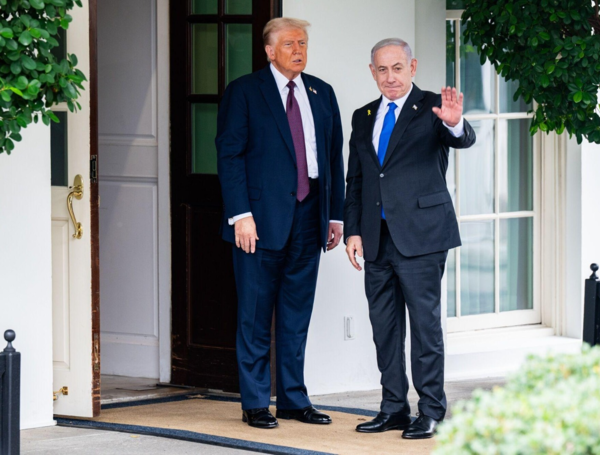
Despite the tensions, European diplomats describe the moment as a"fragile but historic opportunity." France, Germany, and Spain offered financial support for the reconstruction of the enclave, while Turkey announced it would act as a political guarantor of the ceasefire. The United States, for its part, stressed that"the success of the agreement will depend on both parties' compliance."
Still, most analysts agree that the pact is more of a pause than an end. “It’s a necessary respite, but not a peace agreement,” summarizes Michelle Pace. “Without justice, accountability, and mutual recognition, the truce will be merely a timeline before the next war.”
In Gaza, meanwhile, the return of families is progressing slowly. More than 500,000 people have returned to Gaza City since Friday, according to the Civil Defense. Among the rubble, a girl named Nour was collecting the remains of a school notebook. “I just want to go back to school,” she told a local journalist. Her statement, as in the numbers and warnings surrounding the agreement, sums up the paradox of this moment: a truce that offers hope, but also the certainty that peace remains a long road, fraught with conditions and mistrust.