One year ago, on December 8, 2024, Islamist rebels made a dramatic arrival in Damascus. The Syrian capital had fallen after a lightening offensive by Hayat Tahrir al-Sham, HTS, that forced president Bashar al-Assad to flee the country.
Hours later, rebel leader Abu Mohammed al-Jolani, the architect of Assad’s ouster, made a triumphant appearance at the capital’s Umayyad Mosque. The symbolism was clear: Assad’s brutally oppressive regime was over after 13 years of civil war.
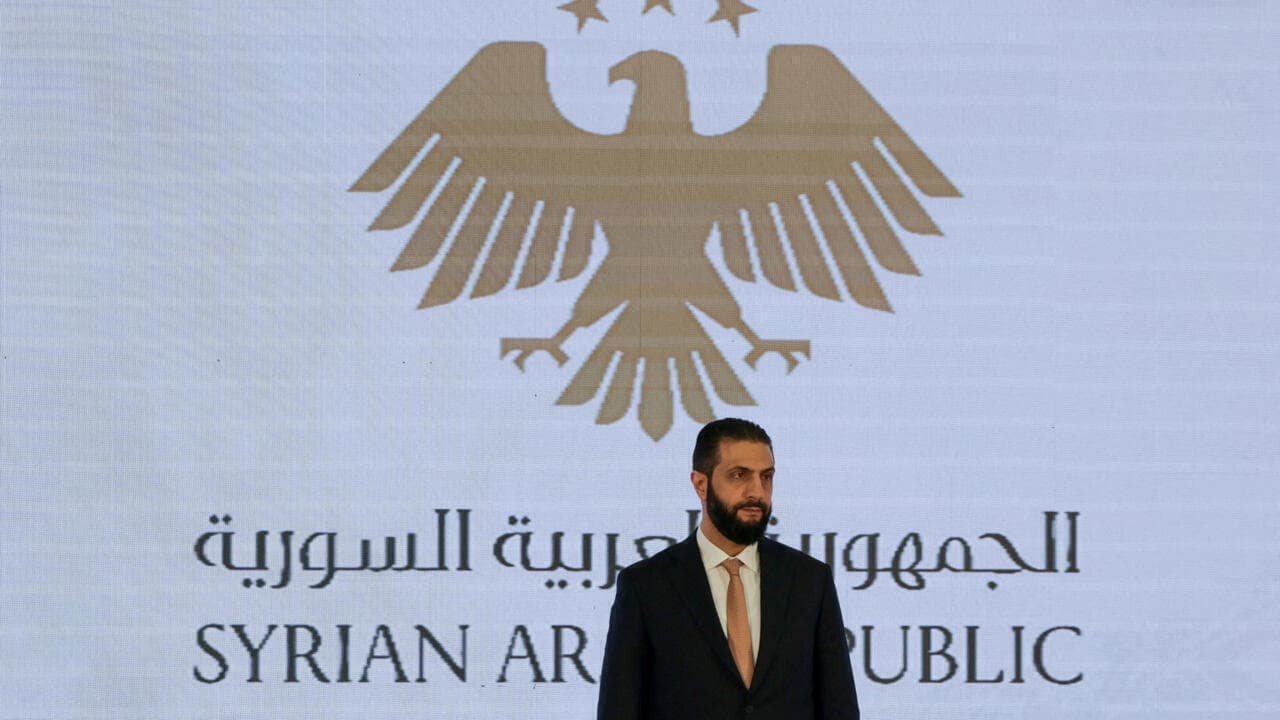
From this point, Jolani set about cultivating his image from feared warlord into something more moderate. He swapped military fatigues for a suit and replaced his war-time moniker with his civilian name: Ahmed al-Sharaa.
Sharaa’s first interviews with international media as Syria's transitional president provided proof of a measured tone and carefully chosen words, but the country's new leader was a divisive figure and remains so, 12 months later.
“Optimists who hoped to see democracy take hold in Syria would say the past year has been a disaster,” says Benjamin Fève, a Syria specialist and senior advisor at political consultancy Karam Shaar Advisory Limited.
"But pessimists... [actually] see something more positive,” he adds. Those who predicted Syria would meet a similar fate to Libya – which has been divided between two rival governments since the overthrow of former ruler Muammar Gaddafi – have been proven wrong.
“Without wanting to exaggerate, Syria is doing quite well. It has regained its place among the international community and [been] brought out of diplomatic, political and economic isolation, and that is a very positive thing,” Fève says.
Sharaa: From jihadist to president
In the past year, Sharaa has made multiple visits to the West, starting with France in May, before becoming the first Syrian president since 1967 to address the United Nations in New York in September.
In his speech, he promised to hold those responsible for the worst of the war’s bloodshed to account but also to respect human rights. He also cited the progress of Syria’s new government in establishing new institutions and planning to hold elections.
On November 6 the UN Security Council took the key step that Sharaa had lobbied for of lifting economic sanctions on Syria, hailing a “new era” for the country.
“From the first days that he took power, Sharaa’s priority was to show the international community that he was ready to work together, if it would lift economic sanctions,” ¨says Aghiad Ghanem, a researcher in international relations at Sciences Po University in Paris.
“He is a very pragmatic person and clearly very capable when it comes to interacting with major world leaders,” he adds.
In November, Sharaa – who at one point had a $10 million bounty placed on his head by the FBI – met with US President Donald Trump at the White House.
There, Trump promised to suspend sanctions placed on the Syrian government under the 2019 Caesar Act, which banned Syria from using the international banking system or making transactions in dollars.
Under the poverty line
However, US congress has yet to fully repeal the legislation, leaving Syria in economic limbo.
“It was only suspended for 180 days. That means that there is not enough time to start investment projects in the energy sector, which can take months or years,” Fève says. “Potential investors and not going to risk their capital knowing that sanctions could potentially be reimposed. Especially when we know how dynamic US policy is under Trump, and how quickly he can change his mind.”
As the same time the Syrian banking sector, which was completely isolated under Assad’s regime, has not yet rebuilt its international ties.
As such, “it is very difficult to send money to Syria”, Fevè says. “It is practically impossible to finance imports and exports, and without these interbank links it will take some time for the economy to recover.”
As it is currently impossible to revive industry or agriculture, the market in Syria is flooded with international products.
“It is easy for Turkish and Chinese products, including smuggled gasoline, to enter the Syrian market,” says Fabrice Balanche, a specialist in Syrian geopolitics and lecturer at the University of Lyon II. “Industry has been at a standstill since December because, with only a few hours of electricity per day and [international] competition, it’s not worth trying to produce anything. It would be too expensive to sell.”
For many Syrians, daily life is still a struggle. “There are still the same shortages,” says Ghanem. “Access to electricity has improved a little, but the increase in its price is absolutely catastrophic.”
As a result, he says, many Syrians have been cut off from this improved electricity provision, since they cannot pay their bills. Today more than 90 percent of the population live below the poverty line.
“More and more Syrians fell beneath the poverty live in 2025 as part of a hangover from Assad,” Ghanem says. “In recent years, the economy has been based on capturing the few resources that do enter Syria despite the war and international sanctions. Shopkeepers were harassed and the authorities made sure that Syrians were without work, without income, without electricity while they endured inflation and terrible shortages. That has continued.”
Since the fall of Assad’s regime, the Syrian pound, which lost 99 percent of its value during the war, has stabilised at around 13,000 pounds to €1. But few banknotes are in circulation.
“People don’t have the right to take out more than $20 or $30 worth of Syrian pounds per week,” Balanche says, noting that this is creating an artificial shortage.
A centralised or federal state?
New banknotes – without the image of Assad on them – entered into circulation on December 8.
Meanwhile, the state coffers are desperately empty. “GDP has fallen to a third of what it was, the country doesn’t trade with anyone, and the state budget is barely two billion dollars. That’s nothing,” Fève says.
It is only thanks to aid from Qatar and Saudi Arabia that the state can afford to pay its civil servants.
“Salaries have jumped from $20 to $80 a month, but the state has let go half of its work force,” says Balanche. He adds, however, that “They have committed to paying them for a year or two to stabilise the country.”
The World Bank estimates that the reconstruction of Syria will cost $216 billion. But before Damascus can make a start on this colossal task it must ensure the country’s security – notably from jihadist groups.
“Domestically, the issue of combating highly radical non-Syrian factions, which are still in the country, is beginning to generate a great deal of frustration,” says Ghanem. “Sharaa has to respond.”
And he has, in what Ghanem describes as his typical, “pragmatic” approach.
During his visit to Washington, Sharaa announced that Syria would join a US-led, anti-Islamic State group coalition that could help the president kill two birds with one stone.
“It’s proof of his political and diplomatic intelligence;” says Fève. “Syria’s authorities have information to share with the Americans to help fight the Islamic State group, and the Syrian government will be able to consolidate its power by eliminating the Islamic State group as a threat. It's a win-win situation.”
The agreement is perhaps also a way for Sharaa to protect his remaining allies and subdue opponents.
In the wake of Assad’s ouster, the US launched an unprecedented number of strikes in Syria’s Idlib governate, which was previously Sharaa’s stronghold. In this context, “Sharaa doesn’t want to see rival groups develop or grow stronger”, adds Fève.
Since Sharaa – who is a Sunni Muslim and member of Syria’s largest religious group – became interim president, he has been unable to get Syria’s Kurdish and Druze populations to accept his government.
The massacres committed against the Alawite minority, to which Assad belongs, have made the Kurds suspicious of Sharaa's willingness to guarantee the rights of Syrian minorities, and the Kurds have advocated for a federal system in Syria.
Mazloum Abdi, leader of the Syrian Democratic Forces (SDF) – a Kurdish-led coalition supported by the US – withdrew from the March 10 agreement providing for the Kurds integration into a centralised state.
“Sharaa’s goal is to dissolve the Syrian Democratic Forces (SDF), on whom the US relies in its the fight against ISIS (the Islamic State group),” Balanche adds.
Freedom of speech
Syria’s authorities have faced similar tensions with the Druze community, as Damascus has failed to grasp opportunities to “innovate politically and break out of this centralised or federalised state argument,” says Ghanem.
“The Druze built a form of autonomy,” he adds. “Perhaps it would have been better to negotiate to see how that could have been included in the new Syrian system, rather than forcing everyone to choose between a strong centralised state or a federal state, both of which are pretty pointless. Neither will provide a way out of the current tensions."
There are fears that Sharaa may lean towards a strong-armed response. In March, the interim president signed a temporary constitution that seemed to reinforce individual rule. While it guaranteed equality, it omitted democratic safeguards, the separation of powers and checks and balances.
“Sharaa has not uttered the word 'democracy' since he came to power, and it does not seem to be among his priorities at all,” Ghanem says. “Nor does the promise of democracy seem to be a requirement of Western partners as it may have been in the past [under Assad].”
At worst, some developments in the last year could be “reminiscent of the dark days of Syria's past”, Ghanem adds. “The Assad regime tended to have, on the one hand, regular armed forces that could behave fairly well, and on the other, obscure security services, intelligence agencies, factions, and militias that committed the worst abuses."
Although the new constitution guarantees the right to form political parties, the framework law has yet to be implemented.
“Today, it is impossible to create a pluralistic, cross-community party. If the government does not take political divisions into account, the protest movement will eventually express itself in violent identity-based conflicts and weigh on the transition,” Ghanem adds.
For now, opposition to Syria’s government is a less-organised, but still novel, pursuit.
Pluralism may not yet be a reality – despite indirect parliamentary elections in October 2025 – but Syrians have regained a certain degree of freedom of speech.
“Syrians are coming together in informal Facebook groups,” Ghanem says. “They discuss what it means to be Syrian today. There are meetings in restaurants and cafés.”
“Every day in Damascus, people get together and discuss and criticise the new government,” adds Fève. “This is unprecedented in 70 years.”