

The world awaited Iran’s response on Sunday after US president Donald Trump said the US had “obliterated” Tehran’s key nuclear sites, joining Israel in the biggest western military action against the Islamic Republic since its 1979 revolution.
With the damage visible from space after 30,000-pound US bunker-buster bombs crashed into the mountain above Iran’s Fordow nuclear site, Tehran vowed to defend itself at all costs. It fired another volley of missiles at Israel that wounded scores of people and flattened buildings in Tel Aviv.
But perhaps in an effort to avert all-out war with the US, Iran had yet to follow through on its main threats of retaliation against the US itself – either by targeting US bases or trying to choke off global oil supplies.
Speaking in Istanbul, Iranian minister for foreign affairs Abbas Araghchi said Tehran would consider all possible responses. There would be no return to diplomacy until it had retaliated, he said.
“The US showed they have no respect for international law. They only understand the language of threat and force,” Mr Araghchi said.
Mr Trump, announcing the strikes in a televised address, called them “a spectacular military success”.
“Iran’s key nuclear enrichment facilities have been completely and totally obliterated. Iran, the bully of the Middle East, must now make peace. If they do not, future attacks would be far greater and a lot easier,” Mr Trump said.
Still, his administration stressed that no order had been given for any wider war to overthrow the hardline Shiite Muslim clerical establishment that has ruled Iran since 1979.
“This mission was not and has not been about regime change,” US secretary of defence Pete Hegseth told reporters at the Pentagon. “The president authorised a precision operation to neutralise the threats to our national interests posed by the Iranian nuclear programme.”
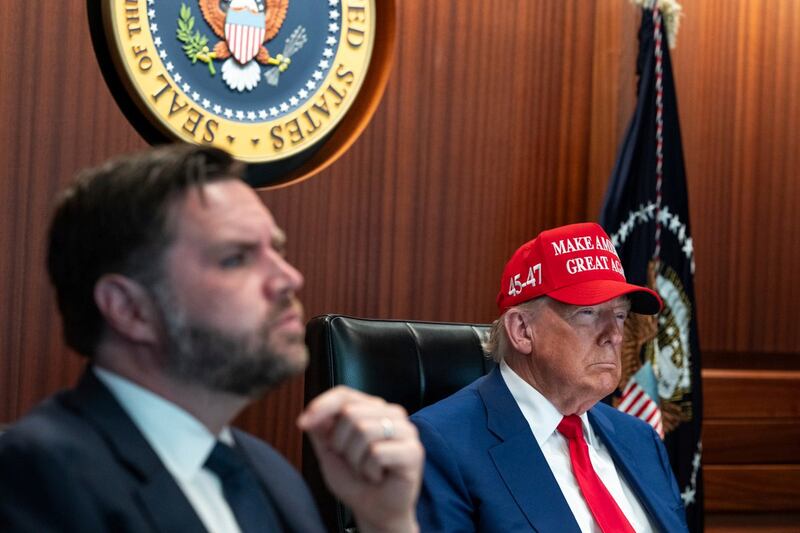
US vice-president JD Vance said Washington was not at war with Iran but with its nuclear programme, adding this had been pushed back by a very long time due to the US intervention.
In a step towards what is widely seen as Iran’s most effective threat to hurt the West, its parliament approved a move to close the Strait of Hormuz, the entrance to the Gulf where nearly a quarter of the oil shipped around the world passes through narrow waters that Iran shares with Oman and the United Arab Emirates.
Iran’s Press TV said closing the strait would require approval from the Supreme National Security Council, a body led by an appointee of supreme leader Ayatollah Ali Khamenei.
Attempting to choke off Gulf oil by closing the strait could send global oil prices skyrocketing, derail the world economy and invite almost certain conflict with the US navy’s massive Fifth Fleet, based in the Gulf and tasked with keeping it open.
US secretary of state Marco Rubio, in a Fox News interview, warned Iran on Sunday against retaliation for the US strikes, saying such action would be “the worst mistake they’ve ever made”.
Mr Rubio separately told CBS’s Face the Nation talkshow that the US has “other targets we can hit, but we achieved our objective”. He later added: “There are no planned military operations right now against Iran unless – unless they mess around.”
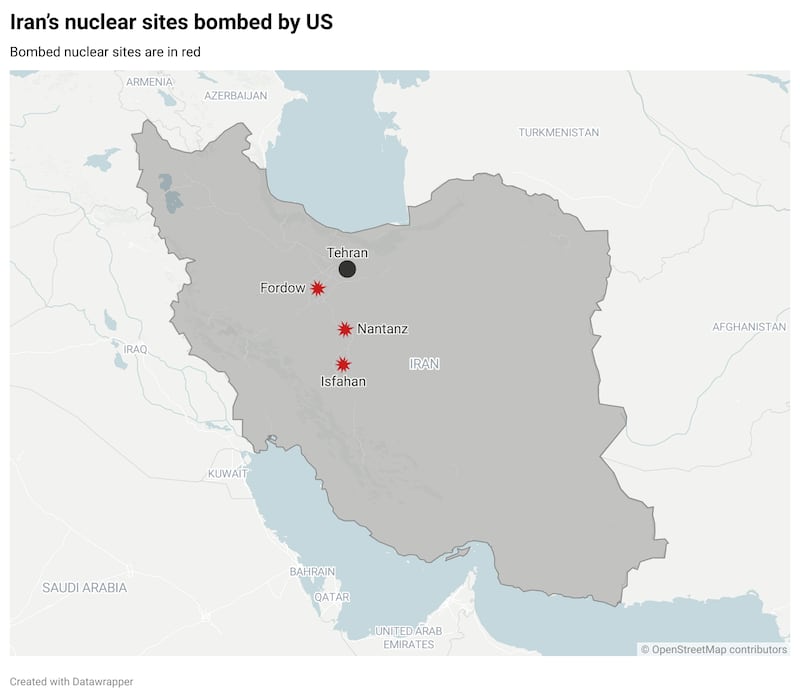
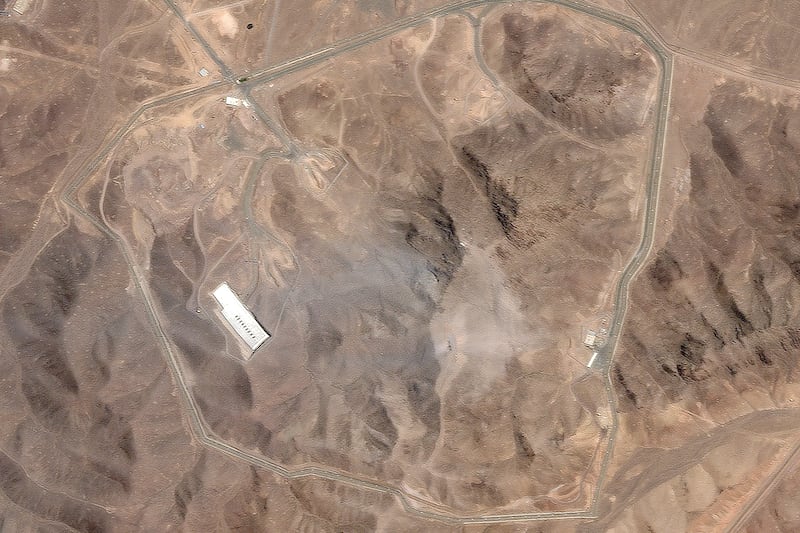
Israel, which started the war with a surprise attack on Iran on June 13th, has long said its aim was to destroy Iran’s nuclear programme. But only the US possesses the massive 30,000-pound bombs – and the huge batwing B2 bombers that drop them – designed to destroy subterranean targets like Iran’s uranium enrichment plant at Fordow, built beneath a mountain.
Satellite images obtained by Reuters following the attack appeared to show damage both to the mountain above the site and to entrances nearby.
The UN nuclear watchdog, the International Atomic Energy Agency (IAEA), said no increases in off-site radiation levels had been reported after the US strikes. A senior Iranian source told Reuters that most of the highly enriched uranium at Fordow had been moved elsewhere before the attack.
While it is clear that US air strikes had hit the Fordow site, it was not yet possible to assess the damage done underground there, IAEA director general Rafael Grossi told CNN.
Iranians contacted by Reuters described their fear at the prospect of an enlarged war involving the US.
“Our future is dark. We have nowhere to go – it’s like living in a horror movie,” Bita, a 36-year-old teacher from the central city of Kashan, said before the phone line was cut.
Much of Tehran, a capital city of 10 million people, has emptied out, with residents fleeing to the countryside to escape Israeli bombardment. Iranian authorities say more than 400 people have been killed since Israel’s attacks began, mostly civilians.
[ This is the moment when we find out just how mad a king Donald isOpens in new window ]
Iran has been launching missiles back at Israel, killing at least 24 people over the past nine days, the first time its projectiles have penetrated Israel’s defences in large numbers. The elite Revolutionary Guards said they had fired 40 missiles at Israel in the latest volley overnight.
Air raid sirens sounded across most of Israel on Sunday, sending millions of people to safe rooms.
In Tel Aviv, Aviad Chernovsky emerged from a bomb shelter to find his house had been destroyed in a direct hit. “It’s not easy to live now in Israel [right now], but we are very strong. We know that we will win,” he said.
During the past nine days of war, Israel killed much of Iran’s military leadership with strikes that targeted bases and residential buildings where senior figures slept. Prime minister Binyamin Netanyahu has spoken openly of the possibility of pressing on until the Islamic Republic’s clerical rulers are toppled, while denying that was his primary objective.
[ How Iran could hit back at the US and what that could meanOpens in new window ]
Mr Trump had veered between offering to end the war with diplomacy or to join it, at one point musing publicly about killing Iran’s supreme leader. His decision ultimately to join the fight is the biggest foreign policy gamble of his career.
Mr Netanyahu congratulated Mr Trump on a “bold decision”. Israeli opposition leader Yair Lapid also praised Mr Trump, saying the world was now a safer place. – Reuters