
The US military conducted unprecedented strikes overnight Saturday on three Iranian nuclear sites without a shot being fired at any of its assets, according to US military and defense officials.
“Iran’s fighters did not fly, and it appears that Iran’s surface-to-air missile systems did not see us. Throughout the mission, we retained the element of surprise,” Chairman of the Joint Chiefs of Staff Gen. Dan Caine told reporters early Sunday morning.
Just 48 hours before the strikes, US President Donald Trump publicly stated he would decide within two weeks whether to hit Iran’s nuclear sites. But according to officials and sources familiar with the matter, he had already made up his mind when he made that announcement. In Washington and abroad, however, his remarks were interpreted as a signal of possible deescalation.
Meanwhile, reports on Saturday said that Vice President JD Vance had a tense phone call with the Israeli prime minister earlier in the week, during which he warned that the US should not be drawn directly into military action against Iran, accusing Israel of trying to pull the United States into war.
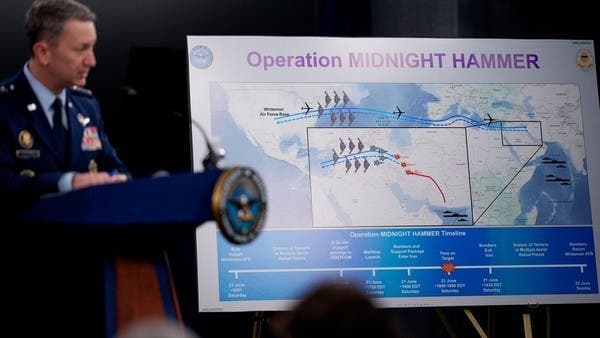
Operation Midnight Hammer
Here is a breakdown of how “Operation Midnight Hammer” was conducted, according to a slide provided by the Pentagon, which included more than 125 aircraft, a guided missile submarine, dozens of aerial refueling tankers and other assets.
Early Saturday morning, several B-2 stealth bombers departed Whiteman Air Force Base in the US state of Missouri. They flew west over the Pacific, something US officials confirmed to journalists in Washington at the time.
However, officials revealed Sunday morning that it was part of a deception campaign by the Trump administration to maintain the tactical surprise.
After those B-2s were seen departing Missouri to the west, seven B-2s quietly flew eastward for 18 hours with minimal communication to avoid detection. They were refueled in the air several times.
Caine said the deception effort was only known to an “extremely small number of planners and key leaders” in Washington and in Tampa, the headquarters of the US Central Command (CENTCOM), which is responsible for US military operations in the Middle East.
Just before entering Iranian airspace, a US-guided missile submarine fired over 24 Tomahawk land attack cruise missiles against Esfahan. In addition, fourth- and fifth-generation fighter jets whizzed through at a high altitude to sweep for Iranian fighter jets and surface-to-air missile threats. They also shot “preemptive suppressing fire” against potential Iranian surface-to-air threats, Caine said. No shots were reported to have been fired at the strike package.
The next phase of the operation was when the lead B-2 bomber dropped two GBU-57 Massive Ordnance Penetrator (MOP) bombs on the first of several points at Fordow.
The remaining 12 hit their targets, Caine said, bringing the total GBUs used in Saturday’s attacks to 14.
Tomahawk missiles also struck Esfahan after the B-2s conducted their strikes “to ensure we retained the element of surprise throughout the operation,” Caine said.
The attacks on the three Iranian nuclear sites were carried out between 6:40 PM EST and 7:05 PM EST.
The bombers and jets immediately left Iranian airspace and began their journey back. “We are unaware of any shots fired at the package on the way out,” Caine said.
The B-2 bombers were again refueled on their way back to their base in the United States. “This was those largest B-2 operational strike in US history, and the second longest B-2 mission ever flown, exceeded only by those in the days following 9/11,” Caine said, referring to the US response to the Sept. 11, 2001 attacks on the World Trade Center.