
Washington and New York. Donald Trump and his security team assured this Sunday that the United States is not at war with Iran after dropping mega-bombs and Cruise missiles against that country in coordination with Israel, and that he is not seeking regime change in that nation, while an unusual chorus of liberal and conservative voices accuse that it was an unconstitutional action that could lead to another endless US war.
“We are not at war with Iran, we are at war with Iran’s nuclear program. We have no interest in a protracted conflict. No interest in having boots on the ground,” Vice President J.D. Vance asserted on several newscasts Sunday morning. He added, “I empathize with Americans who are exhausted after 25 years of foreign entanglements in the Middle East. I understand the concern, but the difference now is that back then we had dumb presidents. Now we have a smart president.”
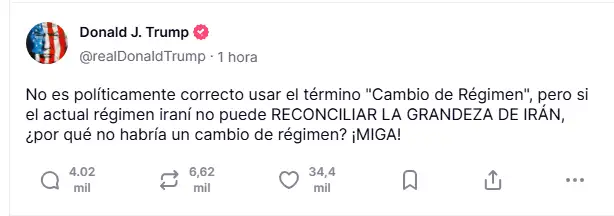
But later on Sunday, in a vague social media post, Trump indicated that regime change might be welcome if Tehran doesn't submit to Washington's demands, asking,"Why wouldn't there be regime change?"
But not everyone shared this assessment (not of the president's mental capacity, but of the conflict itself). At a rally in Oklahoma, Senator Bernie Sanders characterized the new war as"grossly unconstitutional." He noted that "the only entity that can take this country to war is the United States Congress. The president does not have that right," to which his audience of thousands chanted "No more wars." For her part, progressive U.S. Representative Alexandria Ocasio Cortez declared that Trump's decision to attack Iran"clearly provides the basis for his impeachment."
Far-right Republican Rep. Thomas Massie said,"This is not constitutional," a comment Trump immediately condemned as "weak and ineffective." Another far-right Rep. Marjorie Taylor Greene had already declared shortly before the bombing that"every time America is on the brink of greatness, we get involved in another war... There wouldn't be bombs falling on the people of Israel if (Israeli Prime Minister Benjamin) Netanyahu hadn't bombed the people of Iran first."
Influential conservative commentator Tucker Carlson and former Trump strategist Steve Bannon have been warning against the United States joining the war against Iran, though on Sunday they were more cautious in attacking the figure they helped elect twice. “What you don’t want to do is get sucked deeper into this thing,” Bannon said on his podcast War Room. “You could say I’m limiting this war, I’m not part of the regime change thing that Israel wants, but there will be a lot of pressure to do more,” he warned.
Polls before Saturday's military action showed that a majority of more than 60 percent of the American population opposed the U.S. military's involvement in Israel's war with Iran, and, even more significantly, a majority of Republicans in the president's party were opposed. Perhaps that's why Trump must insist that this war isn't a war.
But most Republican politicians disciplinedly expressed support for their leader, as did several Democrats. Opponents from both parties have pushed a bill to require congressional approval for any war, but for now, that won't succeed at this juncture. The White House justifies not needing congressional approval to launch a military strike under the constitutional exception in an emergency where the country is under threat of attack by pointing out that Iran has declared"death to America" and was indeed close to having a nuclear weapon to do so.
Despite the president's triumphant claim that the attack had completely destroyed Iran's nuclear facilities, the US military leadership was more cautious. Chief of Staff Dan Caine stated Sunday that initial reports indicate"severe damage and destruction" to Iran's nuclear program, but cautioned that it will take time to assess how much has been achieved against that country's nuclear capabilities.
Few here believe this will be a short-term war. “Trump probably allowed Israel to drag him into a long war, although its intensity could vary,” said Trita Parsi, an expert on US-Iran relations and negotiations and executive vice president of the Quincy Institute for Responsible Statecraft. “Even if Trump wants to end it after a more or less symbolic retaliation by Iran, the Israelis will pressure him to continue bombing Iran because the nuclear program has not been truly destroyed. And even if it is destroyed, they pressured him to attack Iran’s missile program, and then Iran’s conventional forces, and that will continue. And we have seen that Trump is, at the end of the day, quite vulnerable to Israeli pressure.”
Media reports here confirm that Trump asked Israeli Prime Minister Benjamin Netanyahu to bomb the Islamic Republic's anti-aircraft missiles before the US strikes, further evidence of the close military coordination between the two countries. Experts believe it is unlikely that the US strike eliminated Iran's nuclear program and, therefore, that this conflict will be prolonged.
In fact, one long-term consequence of the US bombing of Iran is that it could mark the end of the international effort to control nuclear weapons globally, several experts noted. “Two nuclear-armed states have bombed a non-nuclear-armed state, without being attacked. This will shock the world, with more countries concluding that they will need nuclear weapons to deter states that already have nuclear weapons,” Parsi notes.
Trump remained at the White House on Sunday, and in comments to reporters warned Iran that “any retaliation against the United States of America will be met with far greater force than was witnessed [Saturday].”
Veteran political analyst Robert Kagan, writing in The Atlantic before Trump ordered Saturday’s attack, opined that “I can’t think of anything more dangerous to American democracy right now than going to war. Think of how Trump might use a state of war to strengthen his dictatorial grip at home. Trump declared a national emergency in response to a nonexistent ‘invasion’ by Venezuelan gangs—imagine what he’ll do when the United States is actually at war with a real country, one that many Americans fear. Will he tolerate dissent in a time of war?”
Kagan concluded: “Today, the United States itself is at risk of becoming a military dictatorship. Its liberal democratic institutions have been crumbling. The founders’ experiment may be coming to an end. A war with Iran will likely hasten its demise.”