
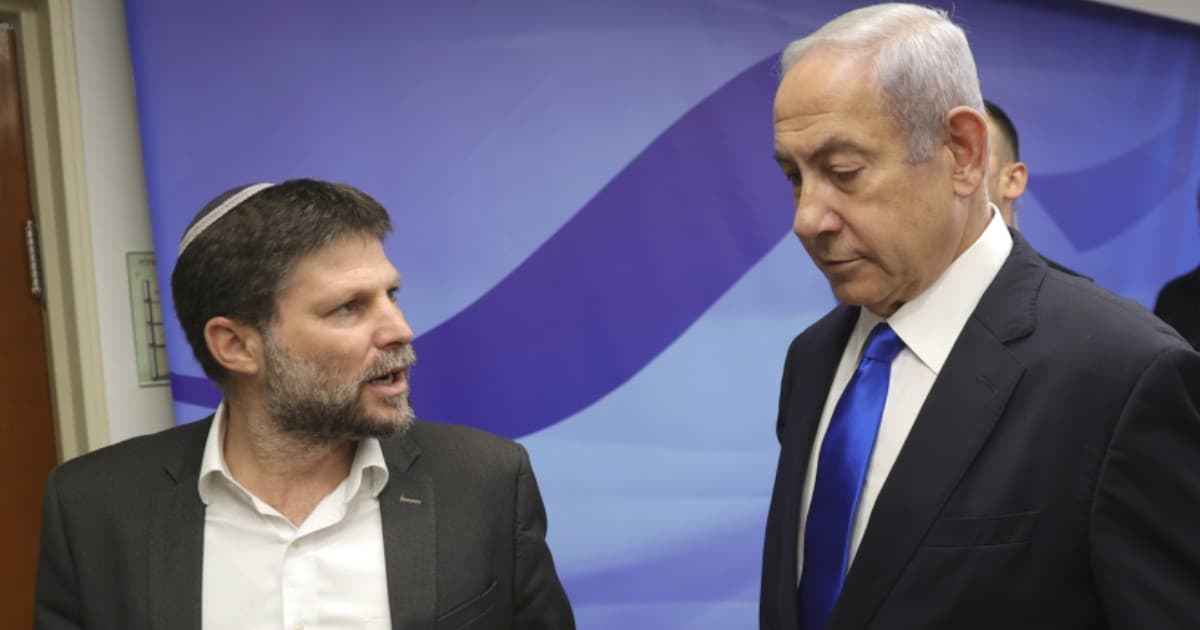
"There is great fear of the consequences of emptying the prisons and releasing the next generation of terror leaders, who will do everything to continue shedding rivers of Jewish blood, God forbid. For this reason alone, we cannot join in short-sighted celebrations or vote in favor of the agreement." While Israel, in particular the families of the hostages, and the Palestinians welcome the agreement on the peace plan, the one reacting in the opposite direction is the Minister of Finance and exponent of the Israeli far right, Bezalel Smotrich, who has made it known that he will not vote in favor of the agreement on the basis of the 20-point plan proposed by Donald Trump. Smotrich, together with the Minister of National Security Itamar Ben Gvir, makes up the most extremist wing of the executive led by Netanyahu . His reaction was widely anticipated: already in recent days, when the parties were working to finalize the text, it was clear that the two nationalist exponents would be opposed. In any case, the green light strengthens Netanyahu , and the possible ousting of the far-right from the government would be compensated by the support of the opposition. Not to be forgotten, then, is the encouragement of Israeli President Herzog, who in recent days had already declared that he was considering the possibility of pardoning the prime minister in the corruption trial (he is accused in three cases, but denies any wrongdoing and maintains that all the charges were fabricated during a political coup led by the police and the state prosecutor's office, ed.). In effect, an offer of guarantees to the head of government.
Although Smotrich stated that he did not want to sign the agreement, he nevertheless said he was experiencing “mixed” emotions. “Immense joy at the return of all our kidnapped brothers! Great fear of the consequences of emptying the prisons and releasing the next generation of terror leaders, who will do everything to continue shedding rivers of Jewish blood, God forbid,” he wrote on X. Smotrich added that we must not return to the “ Oslo path ” (the 1993 agreements that led to the establishment of the Palestinian National Authority) and the “mistaken ideas of October 6th.” “Let us not again become dependent on an artificial calm, diplomatic embraces and smiling ceremonies, mortgaging the future and paying horrible prices,” he concluded. On the Palestinian front, however, Palestinian Authority President Mahmoud Abbas expressed satisfaction: he"welcomes" the agreement and "expresses hope that these efforts can serve as a prelude to reaching a sustainable political solution that will end the Israeli occupation and lead to the establishment of a Palestinian state along the June 4, 1967 borders." Abbas thanked US President Donald Trump and all the mediators,"offering them assistance in ensuring the success of the agreement," and stressed the importance of all parties "promptly committing to signing the agreement and releasing all hostages and prisoners."
The creation of a Palestinian state has always been intransigently opposed by the Israeli far right and the Netanyahu government, which has so far supported a massive expansion of settlers in the West Bank. At the end of May, in addition to recognizing existing illegal settlements, Netanyahu also gave the green light to the construction of new centers, precisely to prevent"the creation of a Palestinian state." "The Israeli government," commented Lior Amihai, director of Peace Now,"no longer pretends otherwise: the annexation of the occupied territories and the expansion of settlements are its main objective." An occupation celebrated in August by the prime minister and the settlers, sitting together at dinner while outside, in the streets of Israel, 350,000 people called for an end to the war in Gaza .