
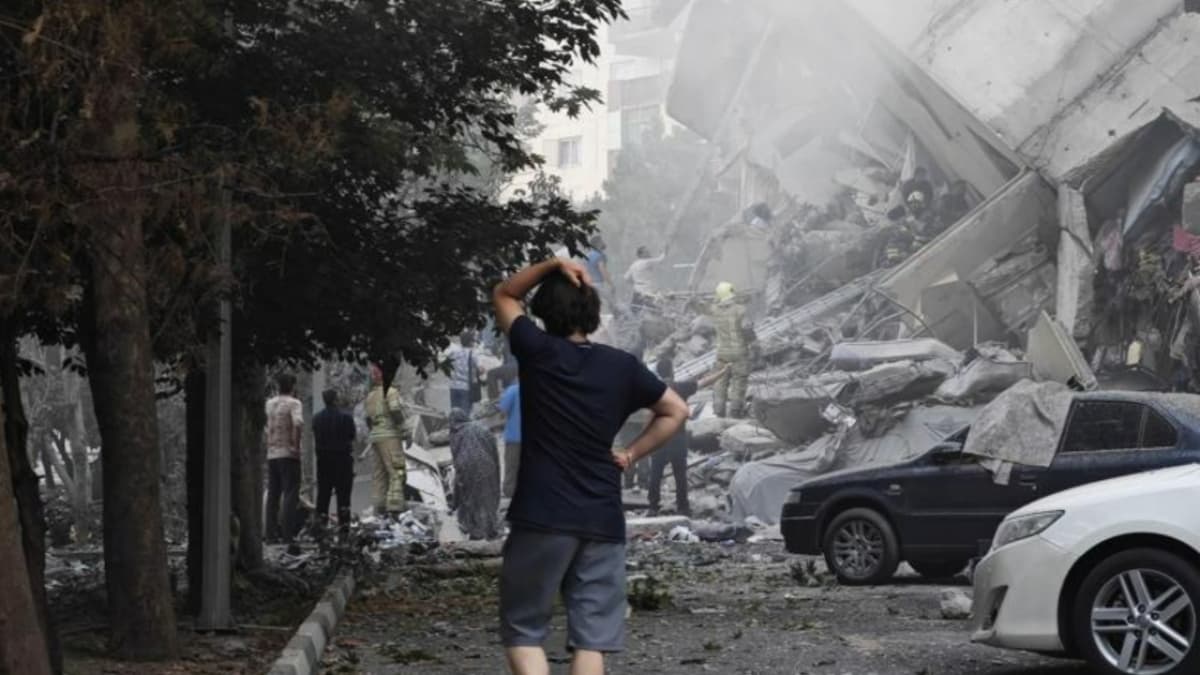
They are the nine scientists killed between Thursday and Friday night in the Israeli attack that jolted Iran awake. From Tehran to the uranium sites: the strikes slow down the atomic program
At the roll call: Fereydoun Abbasi, Mohammad Mehdi Taranchi, Akbar Matalizadeh, Saeed Barji, Amir Hassan Fakhi, Abd al-Hamid Minouchehr, Mansour Asgari, Ahmad Rida Zoelfakri Dariani, Ali Boukai Katrimi. They are the top experts in chemical, nuclear and mechanical physics engineering in Tehran. They are the nine scientists killed between Thursday and Friday night in the Israeli attack that startled Iran.
The names are given by the Israeli army. As with the generals of the Revolutionary Guards, with surprising precision, Benjamin Netanyahu's jets went to hunt them down in their quarters, bed by bed. Simultaneously they were surprised and eliminated. The nine men were among the heads of the Iranian nuclear program, its destruction is the primary reason that led the prime minister of the Jewish state to open another war front with Operation Rising Lion. Tsahal says: The attack was possible thanks to precise intelligence. Their elimination represents significant damage to the regime's ability to obtain weapons of mass destruction. They followed them for a year. They studied their moves and their roles.
These experienced men were holders of valuable knowledge and secrets for the Islamic Republic, some of them the successors of Mohsen Fakhrizadeh, the one called the father of the ayatollahs' nuclear project, who was killed — it is believed — by Israel in 2020. The Israeli government has a long history of assassinating Iranian nuclear scientists. It has always eliminated them in individual, top-secret, almost undeclared operations, as part of a shadow war that has lasted decades. In 2010, Abbasi — one of the nine and the former head of the Atomic Energy Organization of Iran — had already survived an attack: a bomb attached to his car.
We were in the 90th minute, Netanyahu explained, there was a race by Iranian teams to create nuclear bombs to destroy Israel. And so, to erase the ayatollahs' atomic threat, Bibi is moving on three different plans : he is bombing the uranium enrichment sites, he is killing the experts, he is destroying the research centers.
All agree that in the first 48 hours, the Israeli offensive against Tehran’s nuclear program hit home, inflicting heavy damage and, in some cases, total destruction of nuclear infrastructure. Air strikes on the Natanz site — the hub of the program, which also consists of underground buildings — likely destroyed a significant number of centrifuges and the above-ground enrichment pilot plant. Four critical buildings at the Isfahan plant were severely damaged on Friday, explosions were reported in Arak yesterday, and buildings related to the nuclear program in Tehran were hit.
But the real enigma remains under the mountain. The fortified Fordow facility, hidden 500 meters in the bowels of the earth, has remained intact, protected by armor that only the latest-generation bunker busters, owned by the United States but not supplied to Israel, could penetrate. Without those bombs, the Israelis must be patient. They could try to destroy Fordow by weakening the Iranian defense system west of the facility and by sending commandos there. A difficult operation but within their reach, comments Saeid Golkar, of United Against Nuclear Iran.
In these hours we are wondering whether Israel will really be able to stop the ayatollahs from building the atomic bomb. The fear is that, faced with this very hard blow, Iran will react by accelerating its nuclear program and throwing behind every international constraint. The prospect of a withdrawal from the Non-Proliferation Treaty and the expulsion of the inspectors of the International Atomic Energy Agency - who are already struggling to shed light on Tehran's hidden activities - risks becoming an ominous shadow not only for the Middle East. The latest IAEA report is clear: Very close to the atomic bomb. Golkar is more confident: We have to wait for the next few days. I think Israel will do everything possible to ensure that its archenemy can no longer be a threat. They will continue with the attacks on nuclear sites and I don't even think that the remaining scientists can rest easy. Again according to the IAEA, after the strikes, the level of radioactivity remained at normal values.