
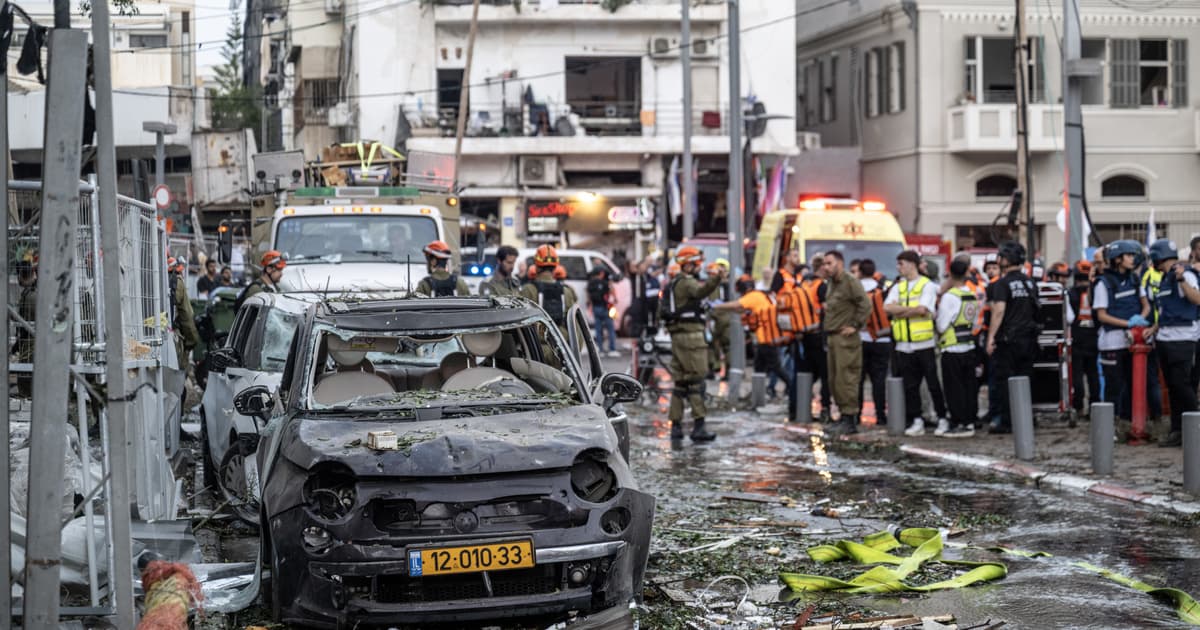
The Israeli prime minister, who initiated the war, justified the attack by saying that they could not wait any longer because Tehran, with its forced nuclear program, was within arm's reach of producing a working atomic bomb. And the Jewish state could not stand by and watch this, because it posed a mortal threat to the country's security. Benjamin Netanyahu therefore identified facilities related to the Iranian nuclear program as primary targets.
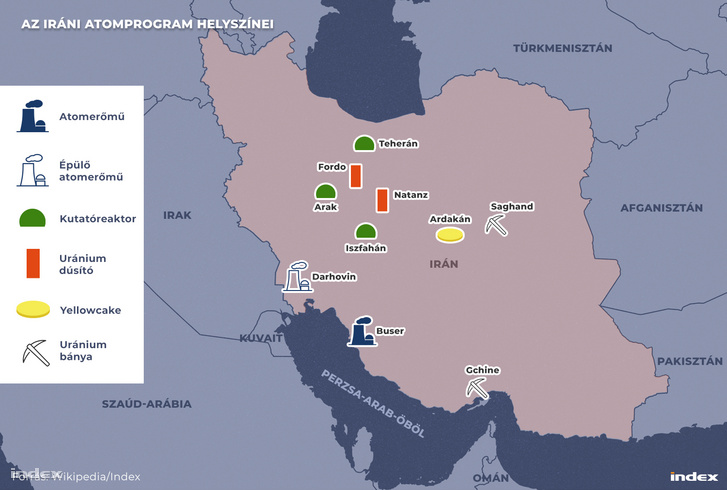
The map below shows the most important elements of the program. Of these, the operating Bushehr power plant was avoided by the invading fighter jets, but the areas around Natanz and Fordow were bombed. The name Yellowcake shown in the graphic needs some explanation. Without going into the details of uranium extraction, we need to know that the mined uranium-containing rock is ground into powder in special “mills” and then dissolved in sulfuric acid, thus extracting the uranium. First, the rock material is filtered off, and then the uranium is precipitated from the solution in the form of uranium oxide. The resulting yellowish powder is pressed into cakes, and this is called yellow powder or yellow cake in the jargon.
Since Iran has a nuclear power plant and uranium enrichment facilities, we cannot ignore the radioactive danger of bombing or exploding them. Security policy expert Anton Bendarzhevsky recalled on his community page that the International Atomic Energy Agency has created a special action group due to the danger, which is constantly monitoring the situation 24 hours a day. Interestingly, however, the European public has not been alarmed now, although a few years ago, when fighting broke out around the Zaporizhzhia power plant in Ukraine, there was quite a lot of fear.
What if Israel cannot nullify Iran's nuclear program?
So back to the basic question: what if Israel does not succeed in destroying the Iranian nuclear program? By killing a few nuclear scientists, it has not yet nullified Iran's expertise and know-how, which it has accumulated in this field over the past decades. It may be that these targeted actions will finally convince the Iranian leadership to acquire nuclear weapons at all costs in order to ensure complete deterrence in the future. And if this happens, Israel will not hold back and will attack Iran again and again in order to disarm and nullify its nuclear capabilities.
It is also dangerous and indicative that Tehran has now announced that it will withdraw from the Nuclear Non-Proliferation Treaty, which was established to prevent the spread of nuclear weapons and entered into force in 1970 and was accepted by 191 countries. In other words, it does not consider the agreement that guarantees self-restraint in the field of nuclear weapons, which is still in force, to be binding on it in the future, and it does what it wants.
Will America be dragged into the conflict?
Despite the constant rhetoric in Washington, it is clear that the Americans knew what Israel was planning, even if they did not actively participate in its preparation. The independent Israeli military decisions are clearly demonstrated by the fact that President Trump only had influence over the attack not to eliminate Ali Khamenei, the Iranian supreme leader. This also makes it clear that the Israelis did not only want to eliminate the Iranian military leadership.
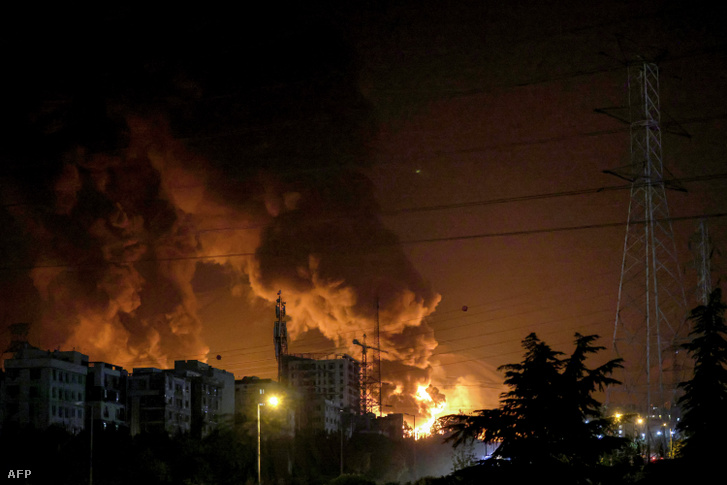
At the same time, the US is aware that Iran can easily strike American targets in the Middle East at any time, such as special forces camps in Iraq, military bases in the Gulf states, or simply embassies and consulates.
Although Hamas and Hezbollah, among the proxy armed organizations built over many years and with a lot of Iranian money, have been almost completely bled out in the past year, the well-trained Shiite militias in Iraq have remained intact. It is no coincidence that the number of American soldiers in the region was reduced in the days before the Israeli attack, and President Trump warned Iran that there would be serious consequences if it attacked American interests in the Middle East.
But what happens if an American citizen is killed in one of the attacks in Israel, or perhaps in one of the neighboring states? Then President Trump must step in. It is no coincidence that the Israeli prime minister is trying to involve America in the war. After all, only the American army has bombs that can penetrate and explode bunkers deep underground. And such a bunker system is also found in the area around Fordow.
At the same time, Donald Trump has promised his voters that he will not drag the United States into another endless war in the Middle East. However, among Republicans, there are many supporters of the Israeli government and the idea that now is the time to overthrow the ayatollah himself.
Will neighboring or Gulf Arab states be involved?
There are also opinions that emphasize that if Iran cannot bring Israel to its knees with its constant barrage of missiles, it may look for easier targets. Such could be the Gulf Arab countries that Tehran says have aided and abetted the enemies of the Shiite state. A number of sensitive energy and infrastructure targets could be in the crosshairs.


There have been attempts before. Tehran was accused of attacking Saudi oil facilities in 2019, and its Houthi allies fired on targets in the United Arab Emirates in 2022. But there are also countries where US air bases are located. If they are attacked, then US aircraft will have to come to their defense, which again points to the US somehow entering the conflict.
Will they take out the oil gun?
The conflict has only been going on for a few days, but oil prices have already jumped by a few percent. On the first day of the week - in response to the Iranian missile barrage during the night - the Israelis struck the South Pars gas field, hitting natural gas processing facilities. (One of the world's largest natural gas fields is located around South Pars.) Then it emerged that Iran was considering closing the Strait of Hormuz. This would be a big problem because a fifth of the world's oil production ships through it to the world market.
Although the US Fifth Fleet is present in Bahrain, which would certainly not sit idly by if the strait were closed, the Iranians could make it difficult for foreign tankers to get through by simply mining the waterway. Then there is the other side of the Arabian Peninsula, where their most loyal allies, the Yemeni rebel Houthis, could blockade the commercial shipping route in the Red Sea, at the Bab el-Mandeb Strait, making access to the Indian Ocean impossible.
This would be very bad for world trade. In many parts of the world, the inflation and energy prices that have soared in the wake of the war in Ukraine are causing a livelihood crisis. If the price of oil runs out and trade supply chains are disrupted, it will again trigger inflation globally, not to mention the higher tariffs imposed by Trump.
Let's not forget that if the price of oil rises, only Russian President Vladimir Putin will be happy about it, because the various major consumer states will compete for cheap crude oil, thus ensuring that the Russians can finance their war.
Will they overthrow the Iranian regime?
The Israeli prime minister not only wants to destroy Iran's nuclear program with the current strikes, but he has already called on the Iranians to take control of their destiny into their own hands and remove the Shiite clergy from leading the country.
When asked by the Index, József Kis-Benedek believed that there was no talk of a regime-change mood in Iran. At the moment, there is no internal tension that would trigger revolutionary movements, and in fact, the Israeli attack on the country has somewhat united the Iranians. According to the security policy expert, it is also clear that Donald Trump clearly wants to stay out of the conflict.
It cannot be ruled out that in such a situation, similar processes would start in Iran as happened in Libya or Iraq. When a strong, central authority suddenly ceases, it can often - at least in the two countries mentioned- push the society that has suddenly undergone change to the brink of civil war and into chaos.
At present, it is not yet possible to see exactly in which direction the latest Middle East conflict will move. What is certain is that the possibility of a quick and/or peaceful resolution is not even close.