
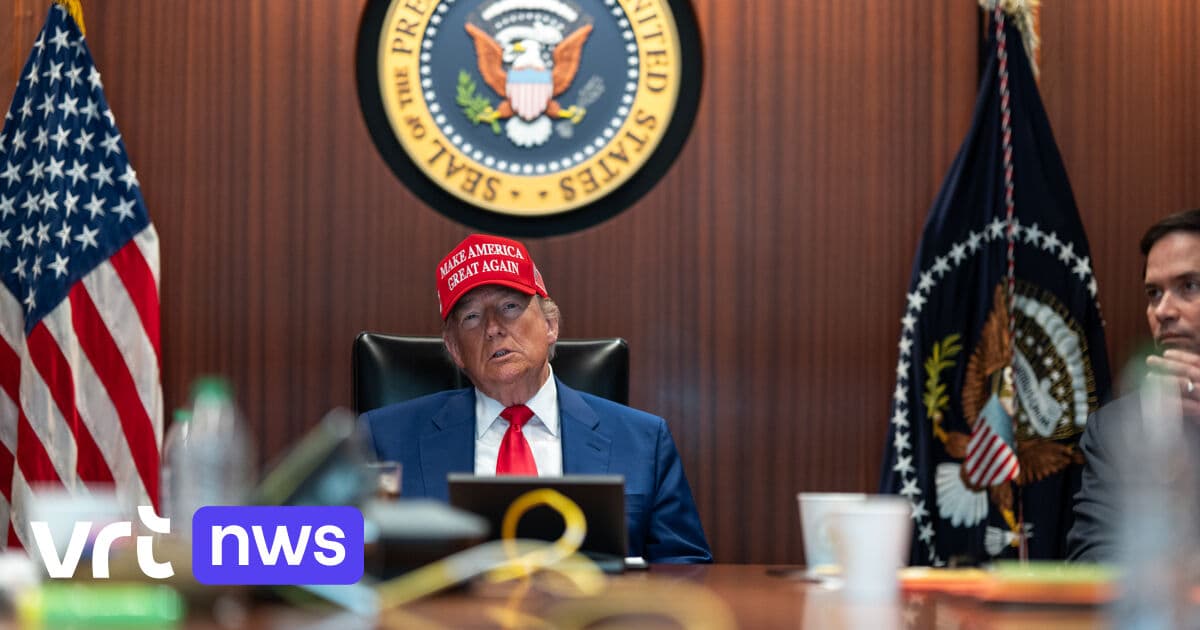

The United States has carried out bombings on 3 nuclear sites in Iran last night. With this, President Donald Trump is now effectively intervening in the conflict between Israel and Iran. Which targets have been hit? And is the situation likely to escalate further?
Want to stay up to date with all the latest updates on the US attack on Iran? Follow everything in our live blog.
Which Iranian targets has the US attacked?
The US military bombed 3 nuclear complexes last night:
- Fordow is the best-known site and is located near Qom, built into a mountain. American assistance was needed to hit this site because it is so deep underground.
- Natanz is located about 250 kilometers south of the capital Tehran. It is said to be the largest Iranian uranium enrichment site. The centrifuges used to convert uranium are said to be developed and assembled there.
- Isfahan is the country's largest nuclear research complex. Several thousand scientists are said to work there, mainly conducting research.
The US deployed B-2 bombers during the attack on the Fordow site, the only ones that can carry the so-called 'bunker bombs' or 'bunker busters'. It is the first time that these particularly heavy bombs are used. They make it possible to penetrate deep into reinforced concrete, estimated to be up to 60 meters deep. Only the US has these bombs.
Trump said the strikes were"a spectacular military success" that "completely and totally destroyed Iran's major nuclear enrichment facilities." Iran confirmed that the three sites were attacked, but played down the damage."Fordow was not seriously damaged. Most of the affected areas were above ground and can be fully restored," it said in Iran.
For now it is unclear how big the damage actually is. More clarity will be provided later today.
Why is the US bombing Iran? And why now?
The Americans join Israel, which had begun attacks on Iran more than a week ago. According to the Israeli government, Iran is very far along in developing a nuclear weapon and attacks are necessary to prevent that.
Trump supported the Israeli attacks but hesitated to deploy the American army to carry out bombings. There was much discussion about this within his party and the MAGA movement. On Friday, Trump said he would decide within 2 weeks whether he would join the conflict. The attacks tonight came relatively unexpectedly.
The US's active participation in the conflict has major consequences. Now a world power is directly involved in the battle between Israel and Iran.
LOOK AT
Trump:"Iran, the bully of the Middle East, must make peace now"

Whether America will carry out more bombings remains to be seen. Trump says he is not looking for war, but is using threatening language towards Iran."This cannot continue: either there will be peace, or there will be a tragedy for Iran, much greater than we have seen in the last 8 days. Remember, there are still many possible targets," he says.
Israeli Prime Minister Benjamin Netanyahu has already thanked Trump for doing “what no other country in the world can do.” “Your courageous decision to strike Iranian nuclear facilities with the awesome and just power of the United States will change history,” he said in a speech.
How does Iran respond?
“This morning's events are scandalous and will have endless consequences,” Iran's foreign minister wrote on X.
"Iran considers it its right to defend itself with all its might against US military aggression," the Ministry of Foreign Affairs also said.
Hours after the US bombing of nuclear sites in Iran, the Iranian Revolutionary Guards fired rockets at Israel again. There were hits in cities such as Haifa and Tel Aviv. At least 11 people were injured. Israel also bombed Iran again.
How does the rest of the world respond?
Western leaders react cautiously and moderately. They do not condemn the American attack, but call for de-escalation and negotiations.
TheEuropean Unionis first and foremost stressing that Iran must never develop a nuclear weapon. Commission President Ursula von der Leyen is calling for respect for international law."This is the moment for Iran to seek a credible diplomatic solution. The negotiating table is the only place to end this crisis," she writes on X.
British Prime Minister Keir Starmer has been slightly more outspoken in his support for the US than the EU. He was also informed in advance about the US attack.
UN Secretary-General António Guterres speaks of a"dangerous escalation" and warns on X of an "increasing risk that this conflict will rapidly spiral out of control, with catastrophic consequences for civilians, the region and the world".
Dmitry Medvedev, former president of Russia and deputy chairman of the Russian Security Council, says Trump has started a new war after attacking Iran, a Russian ally.
The Middle East is also reacting to the attacks. Saudi Arabia, for example, says it is following developments in Iran"with great concern." Gulf state Oman, which is acting as a mediator between Israel and Hamas and in nuclear talks between Washington and Tehran, says the American attack on Iran"threatens to widen the war" and is a violation of international law. Iraq - Iran's neighbor and archenemy of the United States - denounces the"military escalation" that threatens "peace in the Middle East."
The extremist Palestinian organization Hamas has aligned itself with its ally Iran. The pro-Iranian Houthi rebels in Yemen also call the U.S. attacks"brutal and cowardly aggression."
Will the conflict now escalate further?
There is a chance. The situation in the Middle East has been particularly unstable since the war in Gaza. The events of last night and the past few weeks have only increased the tension. Further escalation will depend mainly on the Iranian strategy and the American response to it.
Iran can decide not to respond militarily (for the time being). But in recent weeks, the Iranians have made it clear that they would indeed retaliate strongly if America intervenes in the conflict.
It can do that in the Middle East itself. The US has several troops and military bases in the region, mainly in the Gulf States.
It could get help from allies in the region such as the Houthi rebels in Yemen or Hezbollah in Lebanon, although they are currently weak.