
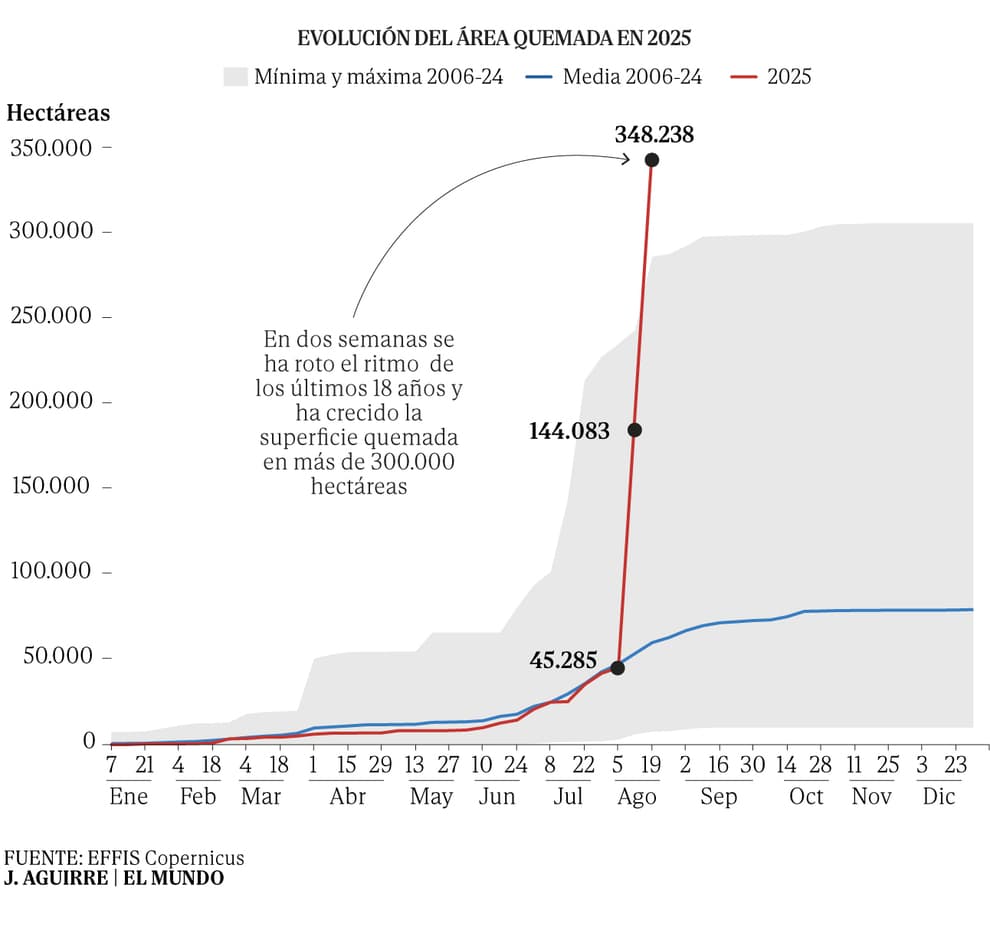
Forest fires continue unabated across half of Spain. With more than 30,000 people evacuated since last Tuesday and almost 350,000 hectares devastated so far in 2025, the national record for the area burned since the European Forest Fire Information System began recording (2006) has been broken. In eight months, more fires have burned than in the whole of 2022, which was the worst year, and with half as many fires (224). It is estimated that more than 160,000 hectares have been destroyed in the last week. There are 23 fires that remain active in operational status 2 and 31 people have been arrested, although another 92 are being investigated for their alleged involvement in the start of the fires.
There are more records. The Government boasts of having received"the largest contingent of international aid in history," in which seven EU countries (France, Italy, the Netherlands, Slovakia, the Czech Republic, Germany, and Finland) are collaborating through the European Civil Protection Mechanism, activated on the 11th. Furthermore, resources from Catalonia, the Basque Country, the Valencian Community, Madrid, Navarre, and Castilla-La Mancha have been incorporated. In parallel, all state resources have been mobilized, with 1,400 EMU soldiers deployed in direct attack, 2,000 in support missions, and 450 resources, in addition to 500 soldiers from the Army, 100 from the Navy, and a battalion with 8 helicopters and 150 personnel. The Ministry for Ecological Transition has provided 56 aircraft and 10 helicopter brigades with 640 forest firefighters. The operation is complemented by more than 5,000 Civil Guards, 350 National Police officers, and more than 200 Civil Protection personnel.
GALICIA AND CASTILLA Y LEÓN. Until the outbreak last Sunday of the large fires in Castile – which caused great concern in the area of El Bierzo, with particular impact in municipalities such as Yeres and the area around Las Médulas, and the Sierra de la Cabrera in Zamora, where the Molezuelas fire devastated towns in a matter of minutes -, all eyes were on Galicia. A community in which, now, statistics show that the different fires – which affect natural environments of great importance such as Os Ancares or O Teixadal – have caused almost 10% of the province of Orense to have already burned (62,000 hectares). The largest fires are in O Barco de Valdeorras, Pobra de Trives, and Chandrexa de Queixa (already considered the most voracious in the history of the autonomous community), but the number of active fires has risen to 13, and smoke has reached some cities such as Lugo, 130 kilometers from the nearest outbreak. Fires have also been detected in areas such as Melide and Culleredo.

Os Ancares is ravaged on both sides by the same wildfire, affecting municipalities such as Vega de Valcárcel and Pedrafita do Cebreiro. Already in León, fires are being reactivated in municipalities in the Cabrera Baja region that were already evacuated early last week, such as Yeres, Carucedo, Espinoso de Compludo, and Llamas de Cabrera.
EXTREMADURA. The Jarilla fire that started a week ago caused by a lightning strike in the mountains has devastated more than 12,000 hectares, with several homes evacuated in the Jerte Valley and the confinement of the inhabitants of Hervás. After devastating 4,000 hectares, the Aliseda fire is considered under control, which has an intentional" origin due to "economic interests", according to the Regional Government of Extremadura. In just one week, 30,000 hectares have burned in this region. This Tuesday, Pedro Sánchez will visit some of the affected areas.

PICOS DE EUROPA. The protected species of the Picos de Europa National Park - shared by Castile and León, Asturias and Cantabria - are in danger due to the fire that broke out this weekend in Barniedo de la Reina (León) and quickly spread to the León area of the Park due to the wind and high temperatures. It later crossed the regional border with Cantabria, where the situation was raised to level 2, and to Asturias, where the situation improved this Monday with the arrival of rain, the drop in temperature and the increase in humidity, although there is still concern about the arrival of new fires.

The State Meteorological Agency (Aemet) has recommended "not letting our guard down," although it is hopeful that the third longest-lasting heat wave on record will begin to subside in the coming hours. The forecast is for a drop in temperatures this Tuesday, which will primarily affect the northwestern half of the peninsula, and an increase in relative humidity, which will help"control the spread of large fires." According to Javier Rodríguez, head of the Aemet Production Department,"this should help control the large fires in Orense and the area of León and Zamora that borders Galicia and Asturias. This is not the case in other areas of the peninsula, such as Cáceres, where the humidity has not yet fully recovered" due to the wind.