When media mogul Vincent Bolloré appointed a far-right editor to run the “Journal du Dimanche” (JDD) in the summer of 2023 – triggering a weeks-long strike at France’s best-known Sunday newspaper – the beleaguered newsroom appealed to President Emmanuel Macron not to let their paper “die in silence”.
“When the JDD, the newspaper of temperance and balance, goes on strike, it means the situation is truly bleak,” the striking journalists wrote in a letter to Macron, framing their tussle as part of a wider battle for press freedom. “Beyond the JDD, what is at stake is the independence of the press and the journalists who produce it – a pillar of democracy,” they said.
The JDD has duly lurched to the right under chief editor Geoffroy Lejeune, whose previous tenure at far-right magazine “Valeurs Actuelles” included a conviction for publishing racist hate speech.
Two years on, the addition of the JDD to Bolloré’s arch-conservative media empire has come back to haunt the French president, undermining his stated push to combat disinformation and the spread of fake news on social media.
The French president has made waves since he publicly called for a “labelling system created by media professionals”, designed to distinguish news outlets that comply with journalistic ethics standards from those that do not.
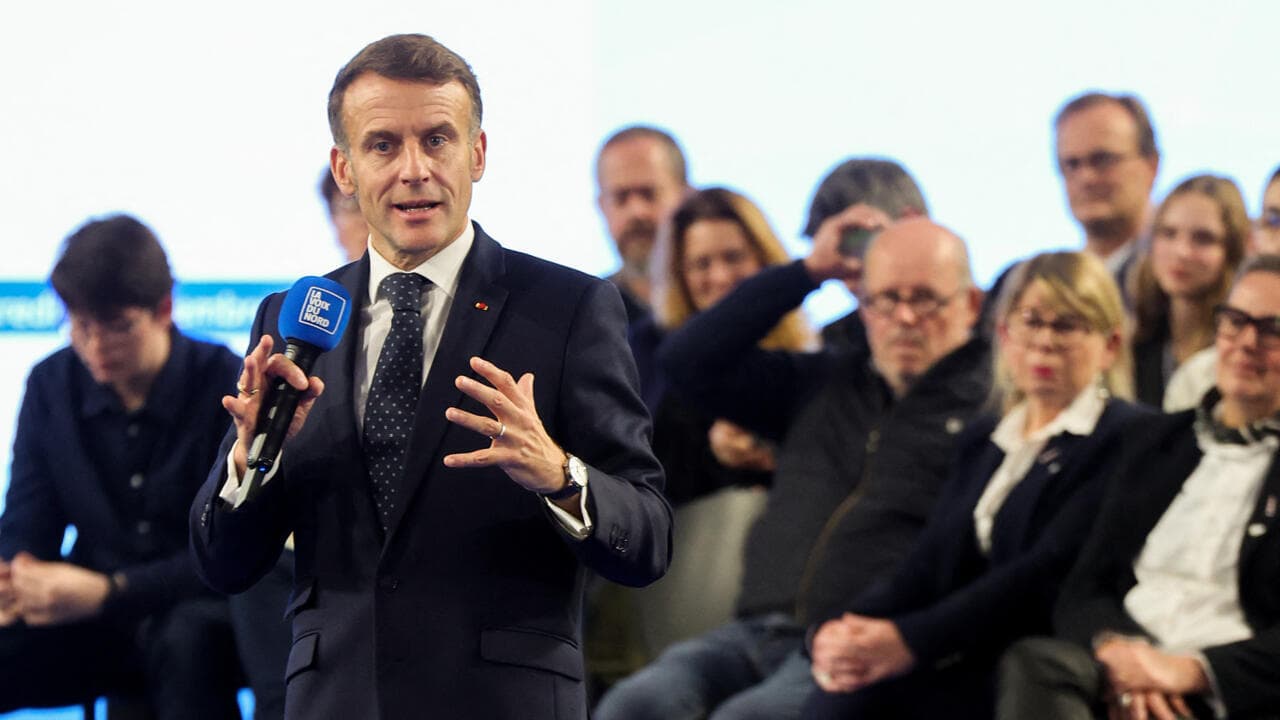
Speaking at a Q&A session with readers of a local French newspaper on November 19, Macron stressed that such a label would be based on peer review and not attributed by the state, adding that the state’s role “should never be to say, ‘This is true or false’”.
The reaction on the right has been scathing.
The JDD ran a front-page story on Sunday describing Macron’s campaign against disinformation as an attempt to “control information”. Its warning against the establishment of an Orwellian “Ministry of Truth” fired the opening salvo in a right-wing campaign that has elicited a firm riposte from the Élysée Palace.
Between Pravda and Ministry of Truth
Other right-wing outlets owned by Bolloré – dubbed the “French Murdoch” due to his sprawling media stable and conservative politics – soon jumped on the JDD’s bandwagon, accusing Macron of attempts to muzzle the press.
Pascal Praud, the star anchor of Bolloré-owned broadcasters CNews and Europe 1, lambasted a “president unhappy with his treatment by the media and who wants to impose a single narrative”. He quipped that Macron was seeking a “middle ground” between the Soviet-era Communist Party newspaper “Pravda” (Truth) and the Ministry of Truth from George Orwell’s “1984".
Right-wing politicians quickly followed suit.
Speaking on CNews, far-right National Rally (RN) leader Jordan Bardella blasted the “authoritarian temptation” of a president “who has lost power and seeks to maintain it by controlling information”. Former interior minister Bruno Retailleau, who heads the conservative Les Républicains (LR) party, warned in a post on X that “no government has the right to filter the media or dictate the truth”.
Both Les Républicains and a splinter party led by hardliner Éric Ciotti have launched online petitions, with Retailleau’s party accusing Macron of undermining freedom of speech “under the guise of fighting fake news”.
Catch-22
The Élysée Palace has responded to the barrage head-on, in line with its recent practice of going public to call out fake news. Taking aim at Praud from CNews in a fact-checking video posted on its X account, Macron’s office lamented the fact that “talking about the fight against disinformation itself causes disinformation”.
The riposte mirrored past attempts to challenge the spread of fake news on social media, including unfounded rumours about the purchase of an Aston Martin and the false claim – pushed by pro-Russian bloggers – that Macron took cocaine with German Chancellor Friedrich Merz and UK Prime Minister Keir Starmer while on a train travelling to Kyiv.
“When fake news goes viral, we must go viral too,” French daily “Le Monde” quoted a Macron aide as saying earlier this week.
Analysts, however, have warned of a Catch-22 situation for the French president as he battles disinformation.
“It’s a constant dilemma: responding fuels the controversy, while remaining silent allows the rumour to flourish,” says Arnaud Mercier, a professor at Paris 2-Assas University, who has published a book on disinformation and manipulation in the media.
The French president and his wife Brigitte Macron have long been targeted by false online claims that she was assigned male at birth. Ten people went on trial in Paris in October, charged with online harassment of the French first lady, in the latest phase of a legal battle on both sides of the Atlantic.
Macron sees this fight as “a political and personal necessity in the face of the rise of false and manipulative content”, says Mercier. The trouble for the French president is that “he is so unpopular his words no longer carry the same weight”.
Strengthening trust in the media
The latest controversy comes as Macron has stepped up his push for greater regulation of social media, including calls for algorithm transparency and mechanisms to block fake news, as well as plans to ban social media for young people under 15 years old.
He is not the first to advocate for a “label” or professional certification to combat disinformation in the media. In fact, his remarks in November echoed the recommendations of a 2024 industry forum aimed at “strengthening public trust” in journalism.
Macron notably cited the Journalism Trust Initiative (JTI) promoted by advocacy group Reporters Without Borders (RSF). According to its website, the JTI was developed by “130 media organisations, journalists’ associations, editors’ associations, regulatory and self-regulatory bodies and other stakeholders of the news industry to promote independent, pluralistic and reliable information”.
More than 2,000 news outlets around the world have JTI certification. They include AFP, AP, BBC World News and FRANCE 24’s parent group France Médias Monde.
Macron-Bolloré divorce?
In an interview with French daily “Libération”, media historian Alexis Lévrier argued that Macron’s mistake was to “want to embody this push for quality journalism” – a stance Lévrier said inherently leads to “suspicions of interference with the media” and “reinforces the very conspiracy theories (Macron) claims to fight”.
The row over media “labels” also signals the apparent failure of Macron’s strategy to avoid confrontation with Bolloré’s sprawling media empire, which has actively pushed the nationalist right in recent years, precipitating a rightward shift in French politics.
When the head of Macron’s party in the National Assembly told lawmakers in 2023 to shun the JDD in the wake of Lejeune’s appointment, the French president refused to issue similar instructions for ministers. Instead, he encouraged ministers to flood Bolloré’s media outlets to counter the far right’s message.
As “Le Monde” wrote earlier this week, Macron notably cultivated ties with Praud to the point that he informed the CNews anchor of his ill-fated plan to call snap elections last year before his own prime minister.
Such efforts took a first hit in March when the Élysée Palace publicly denied a report in the JDD that alleged Macron was seeking to “scare” the French by playing up the threat from Moscow, amid growing concern about the pro-Russia stance espoused by several of Bolloré’s media outlets.
The latest row over disinformation has led “Le Monde” to ponder “whether the divorce between the president and the Bolloré media empire is now final”.
CNews, the JDD and other outlets in the Bolloré stable are now “exploiting the topic of freedom of expression in a cultural battle inspired by Trumpism and the alt-right, in which any regulation is denounced as an attack on fundamental freedoms”, says Mercier, describing it as a win-win strategy for the billionaire tycoon and his companies.
“If they end up getting some form of certification, they'll say they’re legitimate,” he explains.
“And if they don’t, they’ll pose as martyrs and rail against censorship.”