

Alaa Sbaih sends a photograph when EL PAÍS asks her what she expects from the agreement between Israel and Hamas, the first phase of which is expected to come into effect this Thursday in Gaza. The image shows the ruins of what was once an apartment. That house was hers. On Wednesday night, while the two enemies were agreeing to exchange 48 hostages for 2,000 Palestinian prisoners and a temporary technical withdrawal of Israeli troops, a military robot planted explosives in the building where this 25-year-old woman lived. The house stood in the heart of Gaza City, between the Rimal and Sabra neighborhoods.
In the hours that followed, this morning, another Gazan, Fidaa al-Araj, heard, as she had every night before,"distant bombing." She also heard the omnipresent drone of drones. With the weapons still not completely silent, and with the memory of the previous truce shattered by Israel in March, many of its inhabitants don't want to get their hopes up:"In Gaza, hope has been murdered too many times," laments this 40-year-old psychologist from Deir al-Balah, in the center of the invaded territory.
Gazans “no longer dare” to imagine a future in which “the genocide” has ended. This is not only due to the roar of bombs and the endless destruction—Israel bombed the Strip until the last second before the two previous, short-lived truces came to fruition. Their pessimism stems from “what has happened so far.”
This refers to Israel's unilateral breach of the ceasefire that had been reached in January and which was also intended, on paper, to put an end to the Israeli offensive. Benjamin Netanyahu's government then abandoned that truce, with the approval of the United States, precisely to avoid having to move on to the second phase of the plan, which would have opened the door to ending the attacks and the withdrawal of its army from Gaza.
Nor did it help much, Al Araj recalls, the release on May 13 of Edan Alexander, the only hostage with American (and Israeli) nationality still alive, which Hamas presented as a “gesture of goodwill” towards Trump.
That was one of the dashed hopes of Gazans whose memories are too vivid to allow them to indulge in enthusiasm for the moment.
Mohamed, a journalist in his thirties, speaks of these “broken promises” from the Nuseirat refugee camp in the heart of the enclave: “Now they've said they were going to stop the attacks, and yet they continue. I'm not optimistic,” explains this reporter. The last truce “was violated,” he continues. On the day the cessation of attacks was agreed upon, January 17, Mohamed's colleagues, such as Al Jazeera journalist Anass al-Sharif, symbolically removed their bulletproof vests and helmets in front of the cameras to celebrate the end of the Israeli offensive. On August 10, a bombing killed al-Sharif and four other reporters.
Misgivings
From the office where Fidaa Al Araj and her approximately 30 colleagues from the Oxfam organization, all Palestinians, continue to work, the aid worker affirms that the “capacity [of Gazans] to believe in a definitive ceasefire that will not be broken” is “very small.” Last Tuesday marked two years since the beginning of the attacks with which Israel responded to the Hamas attacks of October 7, 2023. The death toll in the Gaza Strip since then now exceeds 67,000 names.
“Hardly anyone believes that once the live hostages and the bodies of the remaining hostages are handed over to Israel, there will be a definitive ceasefire,” the psychologist says. She then asks aloud in an audio message: “What guarantees are there for this? What is the timetable [for the Israeli withdrawal]?”
This Palestinian hasn't completely given up hope:"If the first phase of the agreement [which includes the return of the 48 hostages and a slight technical withdrawal of Israeli troops initially outlined in the pact] is completed, then we'll start to believe in it. Until then, we're waiting," she says.
The misgivings of many Gazans are there. So too are the joy and relief of others. Or a mixture of both, describes Khalil Abu Shammala, former director of the NGO Addameer, who was displaced in the south of the territory after escaping his home in Gaza City. “People are happy and have celebrated by gathering in various areas. The joy they express is, in essence, that of having survived the genocide,” says Abu Shammala. He also advocates, however, maintaining “caution” due to the possibility that the war “could resume once the current truce ends.” Meanwhile, social media was filled with images of—for the first time in a long time—happy children dancing in the streets of the Palestinian territory.
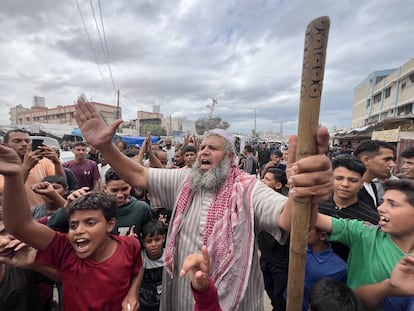
“There is a perception here that Netanyahu has already achieved many of his goals and that, in the next phase [of the agreement], he could try to achieve the rest by taking advantage of the reconstruction process to pressure Palestinians in Gaza and push them toward forced migration,” Abu Shammala emphasizes.
Like Faiza, many Gazans are waiting"with their fingers crossed" for the coming days. She is also"counting the seconds" until she can hug her children again, whom she managed to get out to Egypt before Israeli troops took control of the Rafah border crossing and that opportunity disappeared. This mother remembers the exact date she last saw them: April 24, 2024. For now, these are"dreams" that she is afraid to let fly in her imagination, for fear that the fall—if something goes wrong—will be more painful.
“We've forgotten how to express happiness. Or we're careful not to fall into the same trap again […] We've been disappointed several times, so we don't know how to feel this time. Happy, scared… Thinking about what comes next, where to go, and where to start,” she notes via text messages.
This prospect of leaving the Strip that Faiza envisions has much to do with the lack of alternatives. The Israeli bombings, she says, destroyed her home, her parents' home, her brother's home, and her sisters' home."That's what I mean by not knowing what the future holds. There will be no homes to recover, no family to reclaim. That's why I'm considering going to Egypt and starting from scratch." Israel will continue to control the passage, even if the bombing stops, but it's still unknown how entry and exit will work.
Alaa Sbaih, the young woman whose home was also destroyed by a robot—"on the last day," she sadly emphasizes—before Trump's plan went into effect, also has nowhere else to return. She then thanks God that Gazans like her have"survived these two years."