
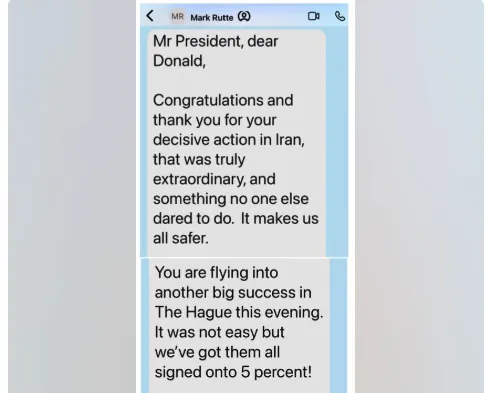
"Mr. President, dear Donald. Congratulations and thank you for your decisive action in Iran, it was truly extraordinary and something no one else had dared to do. It makes us all safer. You are soaring to another great success in The Hague this afternoon. It was NOT easy, but everyone signed on for the 5% [in defense spending]. Donald, you have led us all to a very, very important moment for America, Europe, and the world. You will achieve something NO other President in decades could do. Europe is going to pay BIG, as they should, and it will be your victory."
These words, part of a text message that the US president published on social media this Tuesday, are not from a member of his government or his party, although it is written in the same style they all use in public to kowtow to the leader. They are not from an admirer, a lobbyist seeking favors, or someone seeking a position. Not even from the Israeli government, euphoric at getting Washington to launch a bombing campaign against Iran after 30 years of asking. It is the message from NATO Secretary General, the Dutchman Mark Rutte. Someone famous for his self-proclaimed frankness, who over the decades forged a reputation as a hawk, orthodox, and frugal, the scourge of the southern countries during the worst of the Eurozone crises. Someone who had no qualms about offending or humiliating his colleagues with his direct style. Someone who, as prime minister of his country, never managed to get defense spending down to the 2% of GDP he himself had pledged in 2014.
The message puts the secretary general in a bad light. Applauded by diplomats and analysts for"doing what he has to do," but the target of ridicule and memes. Ironically, Trump never seeks to damage his reputation. Quite the opposite. The language used in the text, clearly inspired by the president's own style, is the same as that used by all his advisors, congressmen and senators, and ministers during meetings. For the president, this delivery is the norm, the one he expects, and therefore, the one he values.
In his first four years as president, between 2017 and 2021, Donald Trump shook up the global stage. He stormed into politics and international summits like an uncontrollable force, attacking, insulting, threatening, elbowing (literally), belittling, and humiliating rivals, friends, partners, and allies, including major world leaders. During all that time, only one person outside the United States seemed to have the right formula for dealing with him: NATO Secretary General Jens Stoltenberg.
The former Norwegian prime minister had a difficult role to play, as Trump toyed with the idea of leaving the Alliance, stopping funding it, or stopping protecting its members if they didn't spend at least 2% of GDP on defense. There were extremely tough, tense months, but Stoltenberg, playing a very discreet role, controlling every word as if he were a central banker (in fact, his aspiration was to become one by the end of his term, but NATO asked him so many times to extend his mandate that the opportunity ended up being lost), helped avoid tragedy. Working in the shadows, meeting constantly with Senators and Congressmen from both parties.
Stoltenberg never criticized Trump, never contradicted him, and refrained from any remotely controversial or conflicting comment. He always ceded the lead role to the American at major meetings; he refused to overshadow him. And it wasn't easy, given that he spent a decade speaking constantly to the press, up to three times a day during the summits. Not once did anything emerge that might irritate Trump, and for that, he was applauded by allied leaders. Hence, when the organization chose the Dutchman Mark Rutte as his replacement, many wondered if he was the right choice.
Rutte was confirmed last year, when it was uncertain whether Trump would return to power or not. It was a very real possibility, but an uncertain one. No one disputed his virtues: excellent English, vast international experience after more than a decade as prime minister and being the longest-serving leader of the European Council (along with Orbán), extensive knowledge of US history, and a powerful network of contacts. But the problem lay elsewhere: his personality.
Rutte was the prototype of the Dutch politician or citizen: proud of his direct, outspoken style, to a degree the rest of Europe considers impolite and rude. They pride themselves on speaking their minds, on being upfront, on not holding back. They defend their interests with complete aplomb. The Dutch in the EU are, without a doubt, among the most efficient and skilled at maneuvering, but also among the most hated for their arrogance and bravado. That enormous confidence in themselves, their country, and their influence. Someone like that, with very clear ideas about international politics, many thought, would hardly be able to get along with Trump.
Trump's social media post Tuesday, however, shows a more submissive, complacent, and sycophantic Rutte. Praise for the operation in Iran, which, while supported by key leaders, is a violation of international law and an act of war, is causing a lot of discomfort and fear among some allies, so Rutte hardly speaks for all of them when he thanks them and says the world is safer today.
Anyone involved in international relations today knows there's no appropriate formula for dealing with Trump, and that's why most world leaders have opted for a hybrid that includes lavishly praising the president for his victories, thanking him for his"leadership," congratulating him on his successes, and even expressing admiration for his unique taste in the White House. But there are limits. There's a small part of it in public. And a much more delicate part in private. But when it's the president who lays out what should happen next in a discreet location, it's hard not to be surprised by the tone and the absolute dedication. If the applause in private is like this, the unconditional surrender, it will be difficult to convince him that he's wrong on the rest. For example, on the Ukraine issue.