
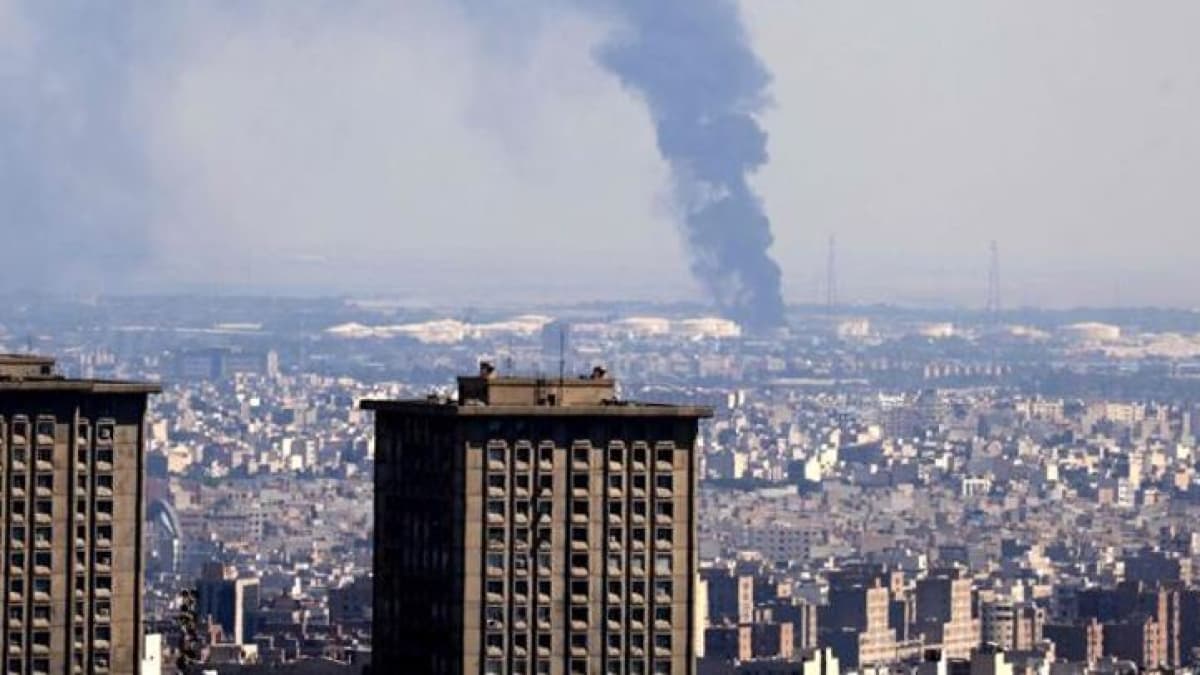
The American president (who spoke to the Israeli prime minister on the phone) convenes the National Security Council. German Chancellor Merz: Israel has the courage to do the dirty work for all of us
FROM OUR CORRESPONDENTS
TEL AVIV (CALGARY) - The last message Iranians may have seen appearing on their cell phone screens is the unconditional intimidation, issued in capital letters and with an exclamation point by Donald Trump. Minutes later, Israeli intelligence launched a cyber attack against the Islamic Republic’s electronic systems and the regime ordered all citizens to log off social media to avoid infiltration.
The US president's threats have been escalating since his sudden return to the White House, after having greeted in advance the international leaders gathered in Canada for the G7, explaining that he prefers to conduct emergency meetings in person rather than over the phone. We now have complete and total control of the skies above Iran, he said. The emphasis is on we: one of his advisers confirms that he means the United States and not a plural alliance with Israel. We know exactly where the so-called Supreme Leader is hiding. He is an easy target, but he is safe there, we will not eliminate him, at least for now. Emphasis on for now. Our patience is running out. Khamenei's response, as reported by Al Jazeera, comes on X: The battle begins.
After this series of bellicose posts, yesterday at lunchtime, the president called the National Security Council to the Situation Room where he remained for an hour and twenty minutes. It is the room in the White House — actually more than one in 460 square meters — where presidents install themselves to keep a check on crises, monitor other people's wars or decide to participate in one.
This is what Prime Minister Benjamin Netanyahu, who immediately spoke on the phone with the American president, and Israel Katz, the Minister of Defense, are hoping for - they are convinced of it: Trump is preparing to enter the conflict against Iran, the American bombers are the only ones capable of carrying and dropping the Gbu-57, with 14-ton explosive warheads that could penetrate the protections around the Fordow nuclear plant, dug into a mountain.
French President Emmanuel Macron had said the night before that Trump was trying to reach a ceasefire. The American president, still on the plane to Washington, immediately denied it: I did not say that I am seeking a ceasefire. That is what Emmanuel says, a good man, but he often does not understand. We are looking for something better than a ceasefire… An end, I want a real end, not a ceasefire, or to give up completely.
Something is going to happen, Trump had said equally vaguely moments before, declaring that the Iranians would be crazy not to accept a deal. Macron does not appear to be the only one having difficulty interpreting the president's strategy during the G7. British Prime Minister Keir Starmer, questioned by reporters on Tuesday morning, also said he had no doubt that the American president intended to stay out of the conflict between Israel and Iran: There is nothing the president has said to suggest that he is about to get involved in this conflict. On the contrary, the G7 statement is about de-escalation.
German Chancellor Friedrich Merz, who confirmed in a television interview that the United States is considering intervention in Iran, said that the decision could be imminent. We talked about it, he said: the decision depends on the regime's willingness to return to negotiations. We have to wait and see. Merz himself said that Israel has the courage to do the dirty work for all of us: if Iran does not back down, the complete destruction of the Iranian nuclear program is on the agenda, something that Israel cannot achieve alone.
For the operation ordered by Netanyahu on the night between Thursday and Friday to dismantle or at least slow down for a long time the development of the Bomb - a project that the Iranians deny, but that even the United Nations Atomic Agency now theoretically confirms - it is necessary to attack this site considered impregnable. Ehud Barak, the most decorated soldier in the history of Israel and strategist as Defense Minister of the first attack plans on Tehran, is skeptical about the total effectiveness of a US bombing. He is convinced - he explained to CNN - that the Pasdaran could restart development after a few months.
For this reason Netanyahu's proclamations have always included references to the option of regime change with calls to the Iranian people to rebel. And Trump orders total surrender, even if until Monday the president was still dreaming of the possibility of negotiating, of returning to negotiations with the emissaries of Ali Khamenei, the Supreme Leader, interrupted by the Tsahal offensive.