

The regime of Nicolás Maduro prevented the departure of Venezuelan Cardinal Baltazar Porras on Tuesday by canceling his passport at Maiquetía International Airport, as he was preparing to travel to Colombia and then to Spain to fulfill ecclesiastical commitments.
The measure was confirmed to EFE by sources close to the prelate and by the general coordinator of the NGO Provea, Óscar Murillo, who indicated that the religious man had to return to his residence in Caracas.
The immigration blockade occurred in a political climate marked by repression following the presidential elections of July 28, 2024, in which Nicolás Maduro was fraudulently declared the winner. According to Murillo, the passport retention is part of a scheme of systematic violations of fundamental rights that the Chavista regime consolidated after those elections.
Porras explained in a message to Venezuelan bishops that the immigration officer took his passport to"check" for alleged irregularities, and after a prolonged wait, a superior informed him that the document"had problems" and that he would not be allowed to travel. In his account, the cardinal detailed that a soldier constantly escorted him, even to the bathroom, and later told him that he was not authorized to board the flight.
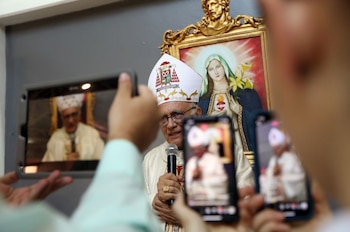
The prelate stated that he was taken to an area of the airport where he was forced to sign documents alleging a supposed “violation of travel regulations.” He said he tried to photograph the papers, but was denied this opportunity under threat of arrest. He also reported that his passport was not returned to him, preventing him from filing any formal complaint in Maiquetía.
In her statement, Porras said that upon leaving the airport's public area, she was left without information about the whereabouts of her document and without official guidance. It was an information desk employee who suggested she leave the terminal and return to Caracas to seek answers at the headquarters of Saime, the state agency that controls the issuance and management of passports.
The incident coincides with the day the Norwegian Nobel Committee awarded the Nobel Peace Prize in Oslo to María Corina Machado, who has been in hiding for eleven months and was unable to attend the ceremony. Her daughter, Ana Corina Sosa, confirmed that the political leader would be traveling to Norway “in a few hours,” amidst severe restrictions and threats from the Venezuelan regime.
The withholding of Porras's passport is not an isolated incident. In October, he reported that military personnel prevented him from traveling by land to the town of Isnotú, in Trujillo state, where he was to participate in a mass commemorating the birth of Dr. José Gregorio Hernández, Venezuela's first saint. According to his testimony, he was surrounded by armed officers after receiving an alleged notification of the cancellation of his originally scheduled flight.

The cardinal has maintained a critical stance toward the government for years. Days before Hernández's canonization, he declared in Rome that the country's situation was"morally unacceptable," referring to the erosion of freedoms, the rise in poverty, and the militarization of the government. His pronouncements have earned him constant attacks from the ruling party, both under Hugo Chávez and Maduro.
Throughout his career, Porras has held important positions within the Latin American Church: he presided over the Venezuelan Episcopal Conference between 1999 and 2006, was vice president of the Latin American Episcopal Council between 2007 and 2011 and served as apostolic administrator of Caracas from 2018. He was appointed metropolitan archbishop of the capital in January 2023 and held the position until 2024.
The incident in Maiquetía has revived concerns about the use of the immigration system as a tool for political control. Human rights organizations maintain that the arbitrary restriction of passports has become a recurring tactic to limit the mobility of opposition members, journalists, human rights defenders, and other public figures. The Porras case once again exposes this practice and raises questions about the regime's escalating repression at a time of growing international attention.