
interview
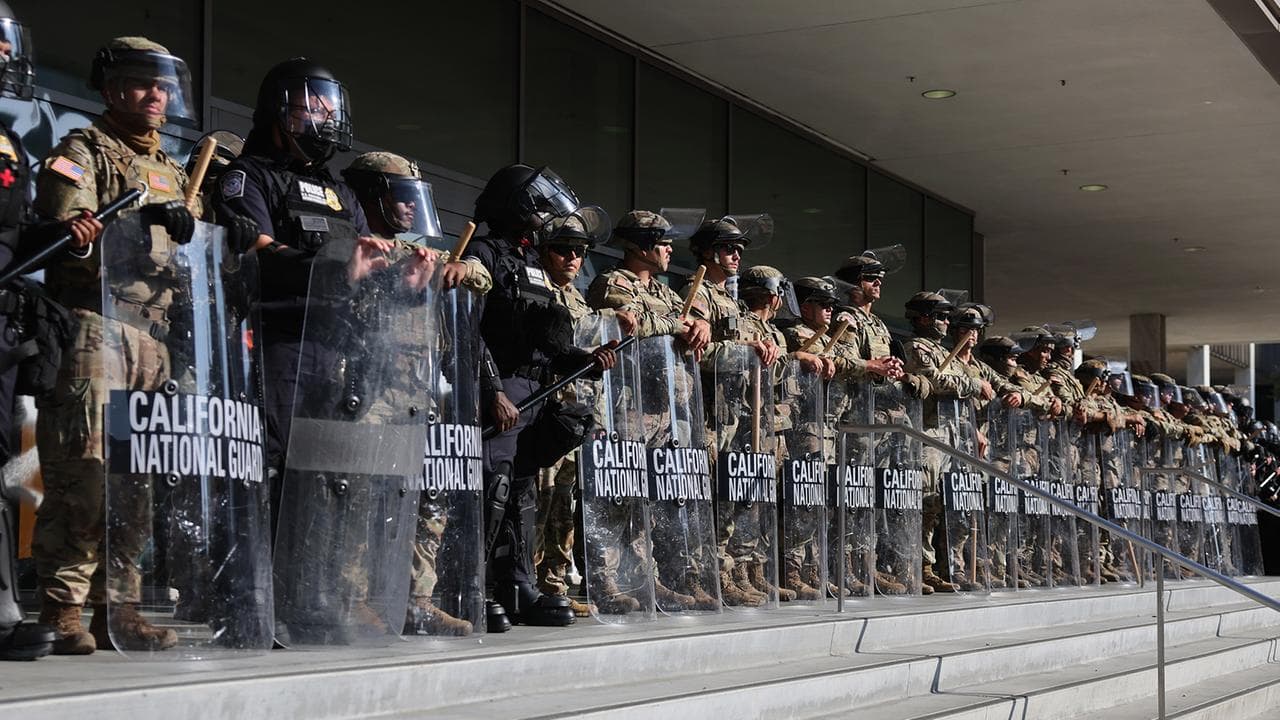
Protests in L.A. – and the US President deploys the National Guard. Historian Berg sees Trump's desire to rule as unrestrictedly as possible behind this. To achieve this, he uses a"classic chess move."
tagesschau.de: US President Donald Trump speaks of insurrectionists in Los Angeles. California Governor Gavin Newsom, in turn, sees an attack on democracy after the deployment of the National Guard and the Marines. Which, in your opinion, is closer to reality?
Manfred Berg: I think that's Gavin Newsom, because this is clearly Trump's attempt to stage a crisis in which he can further expand his authority as commander-in-chief of the armed forces and the emergency powers vested in the president. But these powers aren't clearly defined anywhere. You won't find anything specific about them in the U.S. Constitution—these are the so-called"implied presidential powers." Furthermore, many individual statutes contain specific emergency powers for the president. This is constitutionally very vague.
It would be extremely naive to trust that Trump is concerned about public safety here. The governor of California and the mayor of Los Angeles say they have the situation under control. An insurrection against the United States is certainly not in sight here. And Trump certainly knows a thing or two about an insurrection, if you think back to January 6, 2021...
Differences from past cases
tagesschau.de: ... the storming of the Capitol, which he incited and then watched on TV, in order to pardon convicted participants right at the beginning of his second term. Now, Trump is not the first president to deploy the National Guard. What distinguishes this deployment from previous ones?
Berg: In the past, there have been cases where individual states themselves have requested it. This was the case on several occasions during the so-called"race riots" in the second half of the 1960s, and also in 1992 during the"race riots" in Los Angeles. And then, during the civil rights movement, there were cases where the president explicitly deployed the National Guard against the declared wishes of the states because they refused to protect civil rights activists, enforce the law, and prevent violence.
Here I see a crucial difference: There is no evidence that the State of California or the City of Los Angeles are violating the law.

To person
Manfred Berg is a professor of American history at the University of Heidelberg. His 2024 book"House Divided: A History of the United States from 1950 to the Present" deals with the polarization of US politics and society.
"Danger that the democratic system will be undermined"
tagesschau.de: If Trump tries to expand his powers, what is his long-term goal?
Berg: Trump is striving for an authoritarian presidential regime. During his first term, and even before the 2024 elections, he has never made a secret of his desire to rule like an elected dictator. And that's what he's trying to do.
The deployment of the military, or in this case the National Guard, in a domestic crisis is a classic move in such a scenario. Trump deliberately brought about this crisis through drastic measures. It was to be expected that there would be protests against the raids on migrants. This now provides him with the justification for his actions.
In the American federal system, the states are very strong and have the authority to ensure their own internal security. Only when they are no longer able or unwilling to do so does the federal government have certain powers. There are reasonable grounds for doubt as to whether this situation actually exists in Los Angeles. The governor of California, in any case, vigorously denies this, and in my view, he rightly sees the danger that this is intended to undermine the democratic and federal system of the United States.
tagesschau.de: On the other hand, Texas Governor Gregg Abbott has now announced that he will call in the National Guard.
Berg: This shows how divided the US is and how deeply loyal the Republican Party is to Trump. I would bet that a Republican governor of Texas—except perhaps for natural disasters—would never act like this if the president were still Joe Biden.
Majority of conservative judges
tagesschau.de: We know from the presidential election that there are a large number of citizens in the United States who want a tougher stance on migration policy. Could it be that Trump can rely on their support here as well?
Berg: Certainly among his supporters. He's popular with the hard core, and that's not going to change anytime soon. But regardless of whether a particular policy is popular or expedient, the following still applies: the American president, despite his problematic power, is not a dictator. He is bound by the law and the constitution. Trump has repeatedly questioned that.
The presidential decrees by which he primarily governs must be consistent with the Constitution and federal law. Ultimately, this is decided by the courts, and ultimately by the Supreme Court. However, there is a clear 6-3 majority of conservative justices there, who have not yet decisively opposed him. And he's probably counting on this friendly majority.
"Congress says and does nothing"
tagesschau.de: Do the Democrats have an answer to this conflict that can be supported by a large number of voters?
Berg: The 2024 election showed that the US is divided into two roughly equal camps. The margin wasn't particularly large—2.3 million votes, 1.5 percentage points. In this respect, it would be crucial for the Democrats to win back at least some of the voters. Of course, such a conflict could contribute to voters turning away from Trump, at least those who aren't ideologically and personally loyal to him.
Newsom now has a certain opportunity to distinguish himself as a leading figure in the fight against Trump. But there's also a great danger that any escalation of violence could be blamed on the Democrats. Trump will then surely accuse them of inciting these riots. The US is in a very difficult situation. And it's striking: Congress is saying and doing nothing.
tagesschau.de: How do you explain that?
Berg: This also shows how much power in the US has shifted toward the White House. This trend, which we've observed for decades, is tailor-made for someone like Trump.
Congress is often gridlocked. In this respect, it's entirely understandable that many Americans say: We need a strong national leader who will finally cut through this deadlock and break the rules so that this deadlock can eventually be resolved. That's certainly one reason why many people voted for Trump.
Trump is doing many things that conservatives have warned against
tagesschau.de: Republicans accuse Newsom of launching his campaign for the 2028 Democratic presidential nomination with his recent speech and his actions in this conflict. Is that absurd?
Berg: No. It may be that Newsom was giving a political window-dressing speech to position himself as a possible leader of the Democratic Party. But Newsom didn't ask for Trump to send troops so he could resist him and make a name for himself. I'm sure any Democratic governor in his position would have done the same.
What's happening here is a massive encroachment into the powers of the states. One thing surprises me: American conservatives, in particular, have been warning against a tyrannical federal government for decades and have advocated for states' rights. Where are they now?
Trump may not be a traditional conservative, but he came to the White House under the banner of conservatism and with the votes of American conservatives, and he is now doing many of the things conservatives have warned against for decades.