
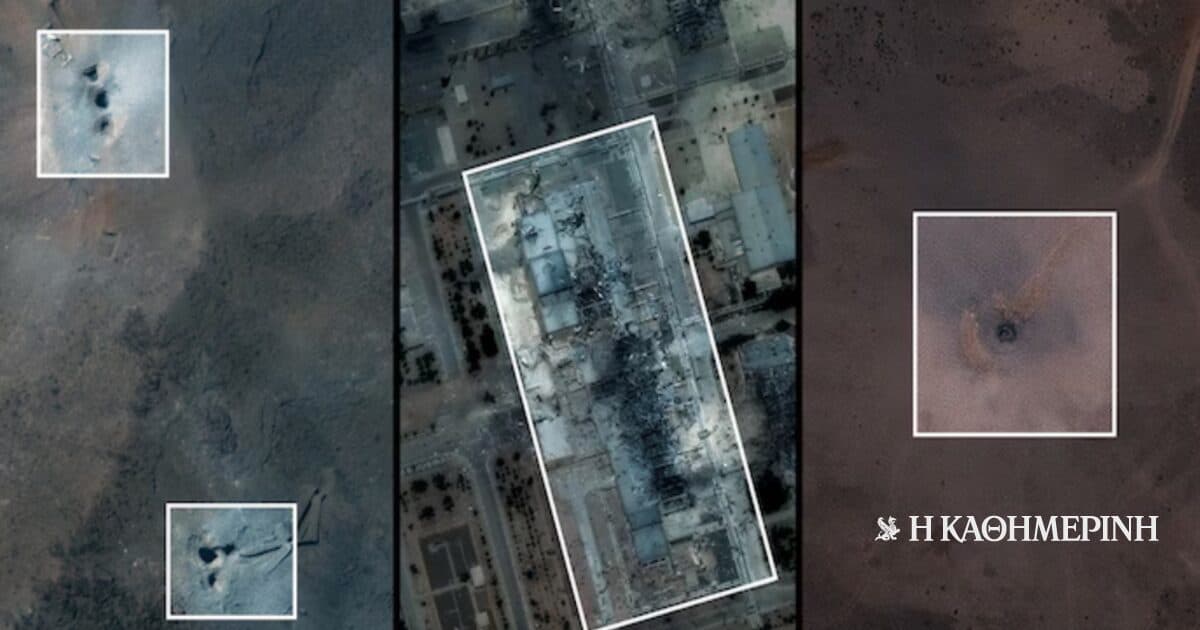
Satellite images provide the first indications of the consequences of the American strikes on three facilities considered key to Iran's nuclear program.
The images reveal extensive damage to surface infrastructure as well as the entry points of bombs that penetrated the ground to hit underground facilities that were previously considered virtually invulnerable.
At about 2:10 a.m. Sunday (local time), a U.S. B-2 stealth bomber dropped the first two MOP (Massive Ordnance Penetrators) bombs on the fortified underground uranium enrichment facility at Fordow, according to Gen. Dan Kane, chairman of the U.S. Joint Chiefs of Staff. The 13.6-ton MOP bombs are designed to destroy underground targets. A total of seven B-2 bombers dropped 14 such bombs on Fordow and Natanz, US officials said.
At the same time, a US submarine launched more than 24 Tomahawk missiles at key infrastructure in Isfahan, according to Kane. These attacks were the final stage of the operation and were completed at approximately 2:35 a.m.
An Israeli official speaking to the Washington Post said initial assessments indicated that the center in Isfahan was destroyed, while the Fordow and Natanz facilities were severely damaged. He spoke on condition of anonymity because of the nature of the information.
Experts warn that it is too early to draw firm conclusions, as the effectiveness of strikes on underground facilities depends on depth, geological composition and potential secondary explosions due to flammable materials. However, satellite images offer important early data on the strikes.
The blows to Fordow and the unusual mobility
Images taken on Sunday morning show six apparent bomb entry points along the mountain range above Fordow. The facility, built on a mountain 100km south of Tehran, was previously considered invulnerable except for MOP use.
Clustering multiple bombs around a single impact point is a common tactic for destroying fortified infrastructure, explains Wes Bryant, a former head of threat assessment at the Pentagon. In such attacks, multiple bombs can penetrate through the same opening.
According to experts, the attacks targeted a 250-meter section that houses uranium enrichment centrifuges. The fate of the equipment remains unknown, as it is located hundreds of meters underground.
A few days before the attack, satellite images showed unusual vehicle movement in Fordow, with 16 trucks along the road leading to the facility. By the next day, most had moved about 800 meters northwest.
Researcher Spencer Faragasso speculates that the tunnels may have been backfilled to contain any potential leakage of hazardous materials. If equipment was removed, it would have been completed before the tunnels were filled, Faragasso said, noting the challenge of handling and transporting the uranium and centrifuges, which use hazardous chemicals and can be easily damaged. It would be a large and complex undertaking, he added.
The tunnel entry points now appear to be covered with dirt — either from the shockwave of the attacks or due to Iranian preparation.
Isfahan
About 350 km south of Tehran, the Isfahan Nuclear Technology Center—Iran’s largest nuclear research facility—was hit by Israeli strikes earlier this month. According to the International Atomic Energy Agency, at least 10 buildings were damaged, including the main chemical laboratory, a fuel fabrication plant and nuclear material storage facilities.
The plant converted uranium into a form that could then be enriched at Natanz or Fordow. Newer satellite images show damage and debris at the complex. The main uranium conversion unit was severely damaged, according to Faragaso, and was put out of service.
The IAEA confirms that entrances to an underground tunnel complex, where enriched uranium is believed to be stored, were also hit. The fate of Iran's nearly 400 kilograms of highly enriched uranium remains unknown.
As in Fordow, heavy vehicles were recorded near tunnel entrances in Isfahan before the attacks, which were then filled in. This preparation suggests that Iran was warned in good time, according to expert Jeffrey Lewis.
The destruction of Isfahan will slow the program, but some of the equipment has likely been moved, analyst Decker Eveleth noted.
Natanz
Natanz, about 225 km south of Tehran, is the main enrichment facility with two factories: one on the surface and one underground. A third, newer section, located at great depth, is where centrifuges are manufactured.
The Israeli raids of June 13 destroyed the electrical infrastructure and buildings on the surface, causing significant damage to underground facilities as well, according to the IAEA.
Satellite images after the US attack show at least one MOP (GBU-57) hole in the underground plant. No significant new damage to the buildings on the surface is visible.
According to Lewis and Faragaso, the underground facility was likely destroyed due to the bomb's power and its relatively shallow depth. Expert George Herbert estimates that the energy of the explosion was enough to destroy the equipment, but not to cause the collapse of the infrastructure. However, the images do not indicate that the third plant, for the manufacture of centrifuges, was hit in Sunday's attack.