
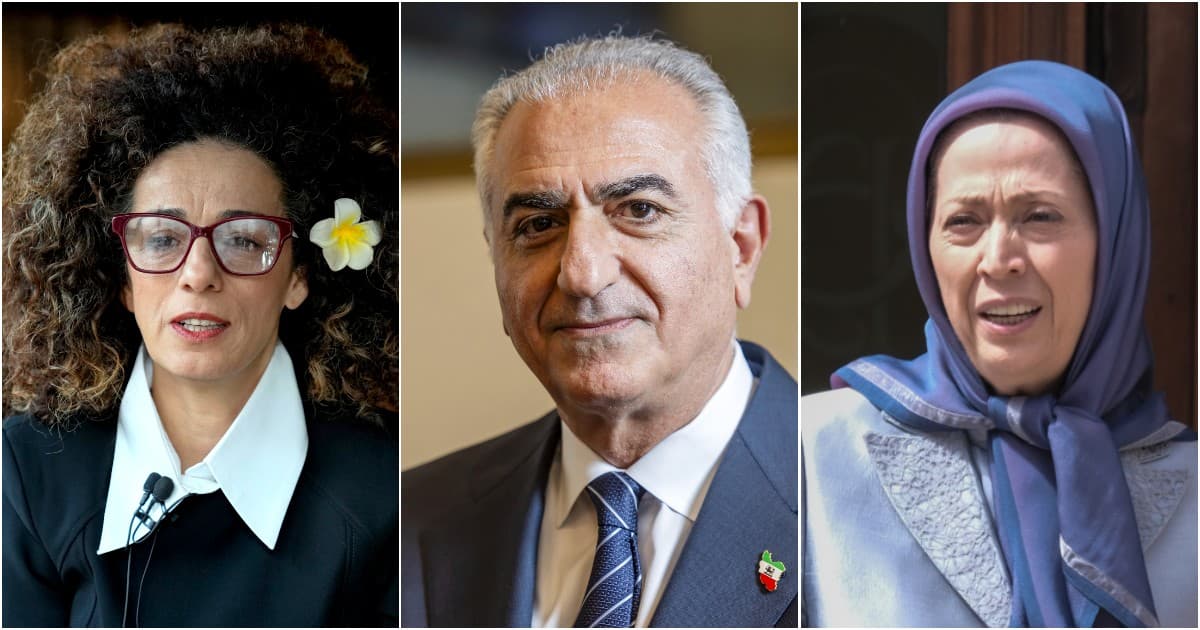
The war between Israel and Iran has been going on for a week now, marked by Israeli strikes on several Iranian cities and by – often symmetrical, specular – Iranian ones in retaliation, especially on Tel Aviv and Haifa. It now seems clear that the aim of the Jewish state is not (anymore?) only to “bring back” or even destroy the Iranian nuclear program, but rather to stimulate, favor, provoke, directly or indirectly, the fall of the Islamic Republic, that is, the institutional architecture of power in Iran for 46 years. Outside the country, the debate on a possible post-revolutionary future has never died down, indeed it has been made even more visible by a series of famous figures from the Iranian diaspora.
Some of these – and this is the case of journalists and activists like Masih Alinejad or Arash Azizi – rather than proposing themselves as a political opposition abroad to the Islamic Republic have tried over time to highlight its distortions, or to give prominence – especially on social media – to the protest movements of Iranian civil society, especially the urban one, progressively more and more intolerant of the illiberality of the system. United by a more or less clear opposition to the Islamic Republic, their reactions to Israel's attack in Iran have been more heterogeneous than perhaps one might have expected.
Masih Alinejad, an Iranian-American activist who was forced to leave Iran in 2009, is best known for having launched one of the most systematic “ anti-veil ” campaigns, also founding a popular Facebook page, My stealthy freedom, in which she invited Iranian women to post photos of themselves not wearing the hijab , which is required by law in Iran. Alinejad, extremely active on X in her campaign for the overthrow of the regime, has expressed since June 13th, immediately and primarily concern for her compatriots during the Israeli attacks, blaming Trump for his invitation to evacuate a megalopolis like Tehran, before later expressing satisfaction for the elimination of a series of military figures of the Islamic Republic, but also for the bombing of state television,"the same one that dragged my family to dishonor me live".
Even more active on X is the Iranian researcher Arash Azizi, perhaps more pragmatic than Alinejad, who clearly condemned the Israeli attack, and then did the same with the Iranian retaliation, once it was established that civilians had also been hit, underlining in particular"the regime's inability to defend the population from such an aggression". Azizi does not seem particularly influenced by the possible political consequences of this attack, much less by the idea that it could provoke a regime change :"_The most likely future for Iran in the medium term is that a fringe of the regime takes power, signs a truce with Israel and the US, putting an end to its anti-Israeli obsession and becoming a more normal authoritarian state".
Nazanin Boniadi, an activist and famous actress, more mildly condemned the attacks, stressing on social media that “innocent Iranians are caught in the middle between foreign fire and tyranny ” and that “if there is something that unites the majority of Iranians, it is the defense of the territorial integrity of the country. Any attempt by foreign powers to divide Iran will cause civil society to unite against that threat.” In the days that followed, like many other celebrities in the diaspora, she more or less explicitly called for the uprising, condemning the demonstrations in solidarity with Iran that waved the flag of the Islamic Republic with which she does not identify. A series of Iranian activists and artists, including Nobel Prize winner Narges Mohammadi, lawyer Shirin Ebadi, directors Mohammad Rasoulof and Jafar Panahi then published a letter of firm opposition to the ongoing war – asking Trump to stop it – for which they also blamed the Iranian authorities (even if the blame is placed on Israel), whose nuclear program should be stopped and asking for its “ immediate resignation ” just as the Israeli authorities claimed that the military enterprise begun last June 13 “could lead to the fall of the regime”.
Researcher Esfandyar Batmanghelidj, founder of the think tank Bourse&Bazaar, an expert on economic and energy issues, as well as the sanctions regimes that have been applied against Iran over the years, has a slightly different opinion and stance. In the Guardian, Batmanghelidj distanced himself from the above-mentioned letter and wrote, not without a certain bitterness, that “countries, like missiles, follow trajectories. In recent days, Iran’s has changed dramatically due to Israeli bombing. Iranians are no longer in control of their future and find themselves looking at the trajectories of ballistic missiles wondering what could have been”.
The independent researcher tried to provide other interpretations of what is happening, underlining how this attack has interrupted and risks jeopardizing what in his opinion was a slow and gradual process of economic recovery and internal socio-political change that had already been set in motion, starting in 2022, when"the authorities actually had to recognize the Women, Life and Freedom movement". Batmanghelidj observed how the establishment actually favored the unexpected victory of the reformist Masoud Pezeshkian in last year's presidential elections, after the death in an accident of his predecessor, the principalist Ebrahim Raisi , perhaps the closest to the Supreme Leader of the last five or six Iranian presidents. Pezeshkian, as president in a parliamentary minority, called the new law on the obligation to wear the veil passed last year by Parliament"unjust". In general, she observes, the veil is no longer a taboo. And in fact there are numerous testimonies in recent years from the large Iranian cities, where an ever-increasing number of women actually go around without wearing it.
Reza Cyrus Pahlavi, 65-year-old son of the last Shah exiled by the revolution, was instead among the few to actually support the Israeli military intervention against the country where he was born, knowing that his eventual – and complicated – success that would stimulate the fall of the regime would see him strongly supported both by Israel – of which he has long declared himself a friend – and by the United States as the new leader of the country. A few minutes after the first Israeli bombings in Iran on June 13, Reza Pahlavi tweeted: “ Ali Khamenei, the foolish leader of the anti-Iranian regime of the Islamic Republic, has once again involved Iran in a war for which they are responsible. My message to the army, to the forces of law and order and security is clear, separate from the regime and unite with the people. To the international community I say: do not give another lifeline to this dying terrorist regime”. In the following days, with the other strikes of Tel Aviv and the responses of Tehran, he called for uprisings"that can give a lethal blow to this dying regime", speaking of"the best time to overthrow the regime", of"not fearing instability or civil wars after its fall because we have a plan for its future and for the first hundred days" and on the other hand defending, guest of a program on Abc, the Israeli prerogatives. His wife Yasmine Etemad-Amini, on X openly supported the Israeli bombings, even after knowing that they had caused at least a hundred civilian deaths. His tweet was taken up and condemned by the aforementioned Arash Azizi.
Despite a troubled history and an extremely opaque present, the Iranian opposition abroad today is formally – and very partially – represented by the National Council of Resistance of Iran (NCRI), a de facto expression of the Mojahedin-e Khalq (People's Fighters of Iran – MEK), a formation led today by Maryam Rajavi and until 2003, the year of her mysterious disappearance in Iraq , by her husband Masoud Rajavi. Their history is very particular: initially animated by a peculiar Marxist-Islamic orientation, the MEK was among the most active groups during the revolutionary uprisings of 1978-79. Ousted from power in typical post-revolutionary infighting, the MEK quickly turned against the nascent Islamic Republic, assassinating its second president, Mohammad Ali Rajaei, in 1981.
With the aggression of Saddam Hussein against Iran, its members took refuge in Iraq where they fought against their own country alongside the Iraqi Rais, earning themselves the nickname of monafiqeen, the hypocrites, in Iran. Over the years, they gradually abandoned their original orientation and gradually reintroduced themselves as a" democratic alternative" to the regime, also involving the Iraqi Kurdistan Democratic Party. The popularity of the MEK, more than from its almost non-existent roots in Iran, perhaps derives more from the visibility they obtained after being welcomed into the Parliaments of a series of European countries - including Italy -, presented precisely as a democratic alternative to the current regime. Perhaps because of its historical opposition to the Shah (and therefore also to his son), or even for tactical considerations, the Mek has recently distanced itself from the attack on Iran, stressing that the regime must fall through popular revolt and not through war.