
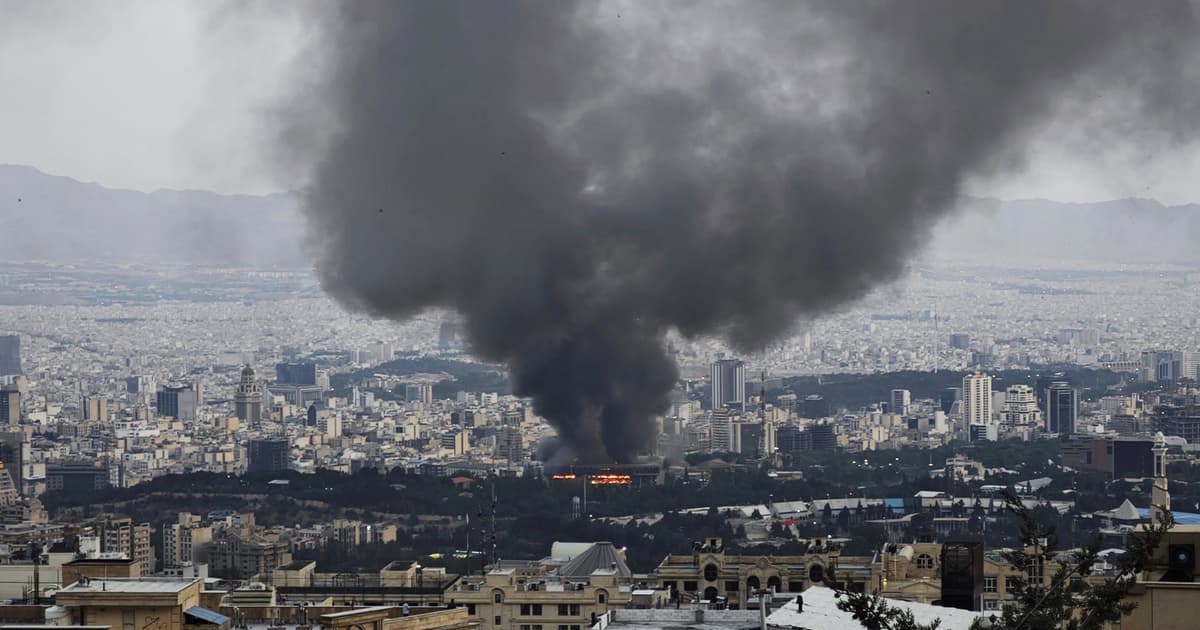
The situation in the Middle East is likely to escalate after the American strikes on Saturday night, says security policy expert József Kis-Benedek. In his opinion, Donald Trump achieved exactly the opposite of what he wanted, as with this strike, far from creating peace between Iran and Israel, he further aggravated the situation, since"Iran does not belong to the category of those who just surrender."
As we reported, the United States of America attacked Iran on Saturday and Sunday. President Donald Trump first announced on social media and then officially: the US Air Force carried out a successful attack on three Iranian nuclear facilities, Fordow, Natanz and Isfahan, overnight. The US president said that the airstrikes on the most important facilities of Iran's nuclear program ended in a"stunning military success."
József Kis-Benedek, former military attaché at the Hungarian embassy in Israel and security policy expert, explained to Index that the consequences of the American attack last night could be much more far-reaching and broader than just being felt in the Middle East region, as fuel prices, for example, will certainly rise, and this in turn will also affect Europe - just as prices per liter rose over the weekend.
But he also mentioned – just as Kaiser Ferenc did in our previous article – that Iran may try to close the Strait of Hormuz – which the Iranian parliament has now decided on – but it is almost certain that it will launch further strikes against Israel.
In my assessment, the reason Trump brought this attack forward – because he said he would spend two weeks thinking about whether to attack nuclear power plants – is because there have been quite a few attacks against Israel, and about 10 percent of the missiles have hit their targets
– he said. And this – considering the size of Israel – caused quite serious destruction. “There was no doubt in my mind that they would attack these facilities,” he added. The reason for this, according to the expert, is that Israel does not have bombs of the same quality as the United States.
It would be a big mistake.
He also said that the extent of the destruction is still being assessed, but there are conflicting statements from both sides. According to the Americans, the action was carried out precisely and perfectly, and the bombs hit their target. The basis for this is that several bombs were used one after the other, “they deepened with one, continued with the other, and there is fire,” said Tibor Kis-Benedek, adding that Iran is communicating the exact opposite.
Iranians say they failed to destroy Fordow facility inside mountain
– said the former Israeli attaché, adding that according to some reports, the uranium they had already enriched to 80-90 percent had already been transported from there, but no one can confirm this yet. However, Tehran has certainly stated that they will continue the nuclear program.
Tibor Kis-Benedek also mentioned that negotiations are almost certainly not expected in the near future, as"Iran does not belong to the category of those who just surrender", rather a certain degree of escalation must be expected. It cannot be ruled out that the Americans will launch further attacks, and not only against nuclear power plants, they have the opportunity and the capability to do so,"from now on it is only a matter of political will".
He also said that it is possible that Iran will attack American bases in the near future, but that it would be a"big mistake," since the United States would then attack with much greater force than it is now, and it is not at all certain that Iran would"be worth getting into such adventures."
Finally, József Kis-Benedek also mentioned that it is very likely that even Donald Trump does not know what to do now, because despite his saying that peace can come from now on, Iranian Foreign Minister Abbas Araghchi said that the United States had thus failed the negotiations, and that he would travel to Moscow on Monday to negotiate with Vladimir Putin. It is very likely that the American president is waiting to see what Iran will do, because he expected Iran to surrender, and he says that
sorry, I'll drop everything and negotiate, but it's done the exact opposite. So to the question of what to expect, I can say that it's very uncertain
– concluded the security policy expert.
Serious consequences
After the attack on Saturday night, countries around the world reacted to the United States' move, effectively dividing the world into two camps. One side says that Iran cannot have nuclear weapons, so the United States had to attack anyway – British Prime Minister Keir Starmer even boasted that he knew in advance of the attack – while the other side condemns the strikes and considers them aggression, with many calling America's move a violation of international law (for example, Russia, China, and even Iran itself).
Meanwhile, US Secretary of Defense Pete Hegseth and Chief of Staff Dan Caine held a press conference at the Pentagon about Saturday night's US strikes on Iran.
Both leaders proudly recounted the details of the “bold and magnificent” attack, which proved that no one else in the world could have done it but the United States.
In their opinion, the strikes were successful, but it would be"too early" to say anything more specific.
According to security policy expert Péter Tarjányi, the attack marked the end of an era in the Middle East. In his analysis published on social media, the expert wrote: America has “stepped out of the shadows” and the region has “entered the era of open war.”
We are at a historic point. And this is just the beginning […] It is not yet a world war, but we have entered the antechamber of it
– the expert concluded his not very reassuring analysis.
The latest development is clearly that on Sunday afternoon, the Iranian parliament voted to close the Strait of Hormuz, which almost all experts considered a possible consequence.