
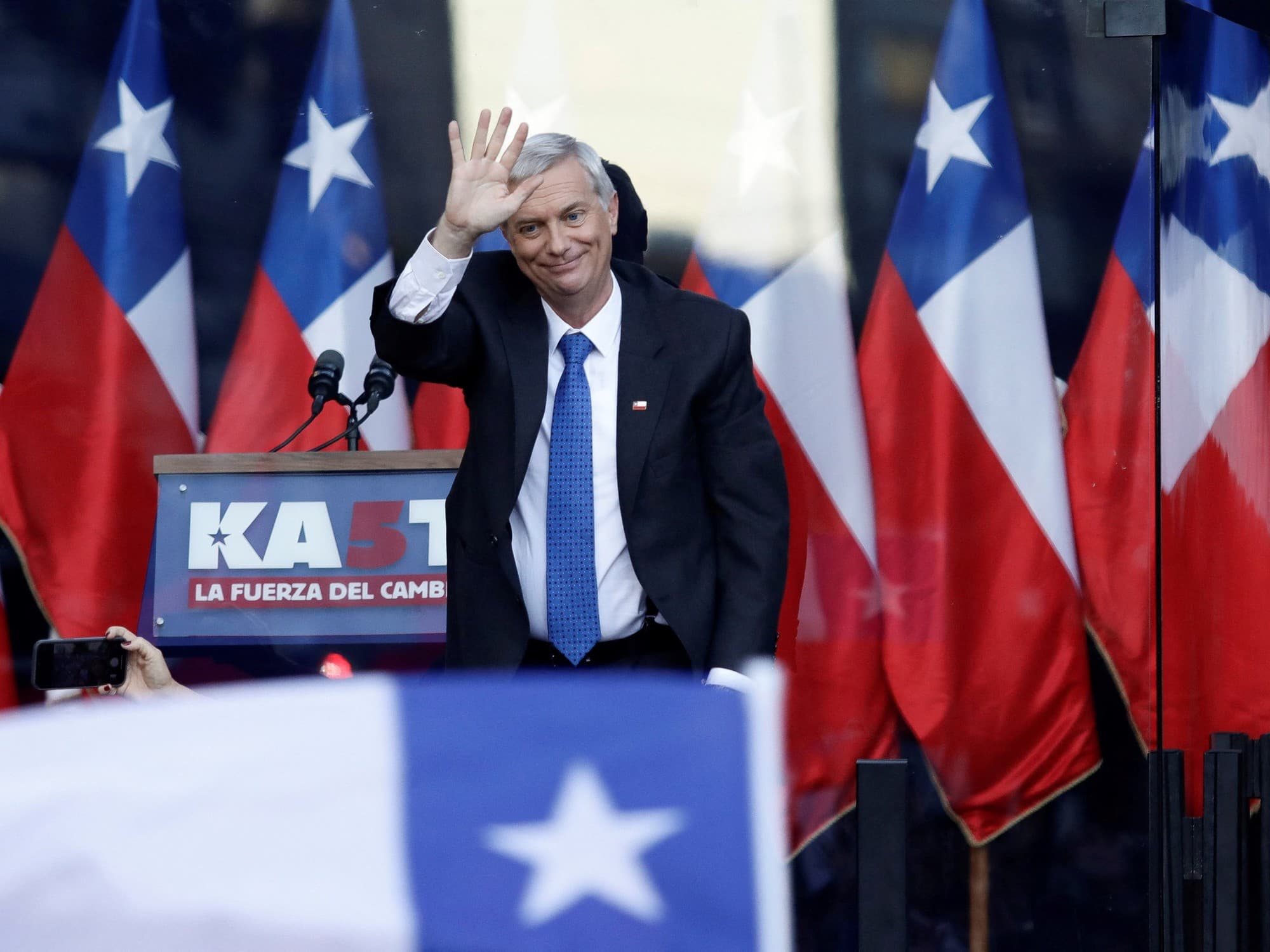
“I am José Antonio Kast, I want to be president of the Republic so that the real change you need in your family, the real change our country needs, can become a reality.”
With these words, the ultraconservative leader concluded his participation in the final televised debate against the government candidate, Jeannette Jara, last Tuesday. Two days later, at a massive rally in Temuco, in the south of the country, where he brought to a close a whirlwind and contentious presidential campaign, he reiterated the idea he had maintained like a mantra in recent months: that if he came to power, he would bring about a radical change in the country, to end crime and revive economic growth, two of the main demands here.
This 59-year-old lawyer and former ultra-Catholic congressman joins the wave of far-right leaders who govern in parts of the world and becomes the first Pinochet supporter since the return to democracy to come to power in Chile.
Married to lawyer Pia Adriasola, 59, with whom he has nine children, he is the founder of the Republican Party, close to the Spanish far-right movement VOX, and shares similar views to those of the presidents of the United States, Donald Trump, of Argentina, Javier Milei, or the former president of Brazil, Jair Bolsonaro.
With his proposals of zero tolerance against illegal migration and crime, he won the support of more than half of Chileans, who express fear in the face of growing crime in the country, at the hands of drug trafficking groups that have infiltrated the country in recent years through the border.
José Antonio Kast, this Sunday, when he went to vote in Paine, on the outskirts of Santiago. Photo: EFE
He also praised Nayib Bukele's hardline approach in El Salvador, where he visited the mega maximum security prison that houses leaders of the fearsome gangs but where serious human rights violations were reported.
"All Chileans, if they had to vote today and had Bukele on the ballot, would choose Bukele," he said last week during a televised debate.
New discourse
In his third attempt to reach the presidency - he was a candidate in 2017 and again in 2021 - Kast was pragmatic, avoided talking about values, and focused his speech on the two or three crucial issues, such as security, immigration, and the economy.
Four years ago, Kast was harshly criticized for his extreme positions, such as his opposition to abortion laws, same-sex marriage, and his acquiescence to the military dictatorship—he voted Yes to Augusto Pinochet's continued rule in the 1988 plebiscite. This time, however, he moderated his rhetoric and avoided addressing these sensitive issues during the campaign. He chose not to give interviews and declined to participate in two of the four debates scheduled between the first and second rounds of the election.
Instead, he focused on combating crime and irregular migration, the two main citizen concerns in a country that was hit by an increase in urban violence and where there are an estimated 330,000 undocumented immigrants, which many link to the increase in crime.
Kast promises an “emergency government”, with measures that include expanding self-defense, the “legal presumption of self-defense” in critical cases, and police and military incursions to reclaim areas “under the control of drug traffickers”.
It also proposes making irregular migration a crime, promoting mass expulsions, and reinforcing borders with the construction of"fences, walls, and trenches."
In 2021, Kast was the most voted candidate in the first round but was defeated by Gabriel Boric in the runoff, in a climate of popular dissatisfaction after the massive protests of 2019 that demanded structural reforms and the drafting of a new Constitution, in the most violent riots since the return of democracy in 1990.

In the campaign that just ended, there was almost no talk this time of his sympathy with the legacy of the Pinochet regime or of the accusations that his father had been a Nazi.
Despite his attempt to deny these claims, arguing that his father was"forced into service," an investigation by The Associated Press showed that his father, Michael Kast, had joined Adolf Hitler's party at the age of 18 in a Germany where, although military service was mandatory, membership in the Nazi party was voluntary.
Born and raised in Paine, on the outskirts of Santiago, he is the son of a German couple who arrived in Chile in the 1950s after Germany's defeat in World War II. Kast explained that his parents were farmers without university degrees who came"with great effort."
After raising capital with a chicken business, Michael Kast opened a major sausage factory in 1964, which helped them become a prosperous and influential family in the area.
Political legacy
José Antonio is the youngest of ten siblings and hopes to continue the legacy of his influential political clan. He is the brother of the late economist Miguel Kast Rist, who served as Minister of Labor (1980-1982) and President of the Central Bank (1982) under Pinochet, among other positions.
He is also the uncle of a senator, a congressman, and a former councilwoman.
His political career began in 1996 when he joined the Independent Democratic Union (UDI), a right-wing party founded by lawyer Jaime Guzmán, who had been an ally of the military government.
That same year he was elected councilman and then served as a deputy for the UDI for three consecutive terms between 2002 and 2014.
In 2016, he resigned from the party, believing the traditional right wing to be"too soft," and a year later launched his first presidential campaign. He garnered less than 8% of the vote as an independent candidate, but since then he has gained ground and, since 2019, has established himself as an influential political figure after founding the Republican Party, which brings together veteran right-wing activists and independents.
He now promises to be the president"of all Chileans." This Monday he will begin working on the transition. Many here are waiting to see what Kast will be like as president.