
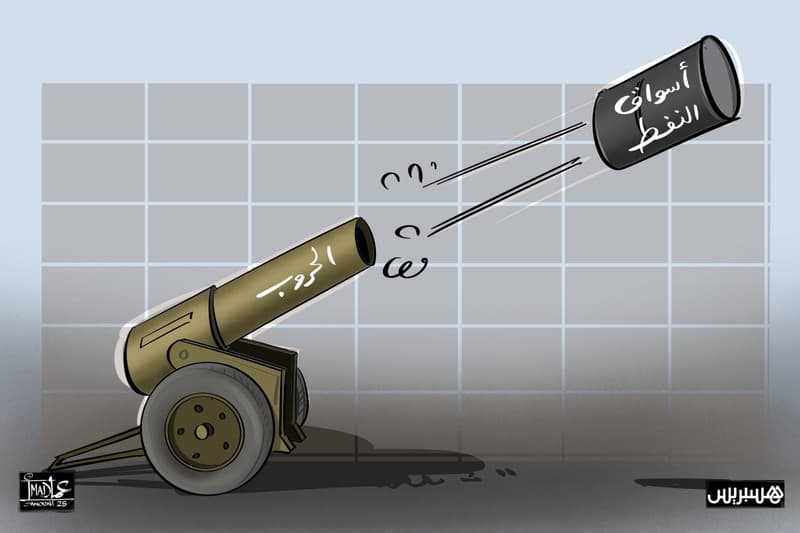
The recent exchange of missile strikes between Iran and Israel, and fears of a prolonged, all-out war, have accelerated unprecedented price increases in oil and derivatives markets, capping one of the highest weeks in prices since 2022, when Russia attacked Ukraine.
Brent crude prices continued their upward trajectory, rising by about 6 percent on average per barrel on a weekly basis, while the exchange of fire on Saturday night and Sunday night renewed fears of direct targeting, which actually (up to the third day of the confrontation) targeted Iranian ports and oil facilities. Meanwhile, the Israeli Oil Refineries Company Limited admitted that “the Haifa refinery and pipelines were damaged” by Iranian missiles, in response to the large-scale Israeli attack that targeted prominent Iranian military personnel, scientists, and nuclear facilities.
In the energy equation and the bone-breaking battle between Tel Aviv and Tehran, the"risk factor" rises sharply with the possibility of "closing the Strait of Hormuz," one of the most prominent oil shipping lanes and vital arteries in the global energy system linking Iran and the Gulf states that produce oil and liquefied gas.
Moroccan energy experts, who monitor international market fluctuations, agree that 2025 could end with a"heavy energy bill" scenario for oil and petroleum-derived importing countries like Morocco, unless the ongoing conflict is halted or a scenario of its spatial expansion is considered.
Over $100"incoming"
"The ongoing tensions in the Middle East will have a definite impact" on the global oil market, according to Abdel Samad Malaoui, a research professor at the University of Beni Mellal and an international expert in energy technology. He added that"the recent attacks between Iran and Israel increase the likelihood of a negative impact on the energy market."
Malawi told Hespress that "the Strait of Hormuz is a major passageway for global oil, accounting for 20% of global supplies, and rising tensions raise the risk of a potential closure or disruption of international trade routes for oil and its derivatives." He pointed out that the International Energy Agency, OPEC, and research institutions are warning of the impact of tensions on oil prices.
The same spokesperson added,"Pessimism dominates current forecasts, as barrel prices will jump rapidly if the war continues, potentially reaching $100 to $120 per barrel." Meanwhile, JPMorgan expects the price to reach $150 per barrel.
While the expert emphasized that"all current indicators reinforce the scenario of a continuing war in the Middle East, which will have a negative impact on the oil market," particularly on importers, he spoke of"Morocco, like other fossil fuel importing countries, being affected by global events."
The energy professor explained that “Morocco imports between 80 and 90% of its energy needs from the international market,” adding that “the fossil fuels that Morocco relies on come largely from the Middle East (...) which negatively impacts the country and its energy bill.” In his estimation, Morocco “may face double pressure due to the rising cost of the energy bill; along with the worsening trade deficit, which could threaten the stability of the Moroccan dirham, and the possibility that it may be forced to tighten monetary policy.”
Malawi recalled to the newspaper the"visible effects" of the 2022 Ukraine-Russia war crisis, which he considered to have"affected oil and gas prices," before "inflation in Morocco reached unprecedented levels compared to previous years." He concluded: "Economic stability in Morocco is threatened by its heavy reliance on energy imports."
"Energy crisis on the verge"?
The spokesman pointed out that "international reports (including one by the International Monetary Fund) have demonstrated the fragility of energy markets to geopolitical shocks, with significant impacts on supply chains and economic sectors."
In response to Hespress's questions, Malawi commented:"The energy crisis may persist due to major countries reducing their strategic energy reserves. The rise in energy prices following the Russian-Ukrainian war is a significant factor." He added: "OPEC has shown limitations in containing the rise in global oil prices; the rapid increase in production and the decline in exploration investments are increasing market fragility."
While the expert warned that "the continuation of the war for weeks or months could lead to the emergence of signs of a new energy crisis," he continued,"energy markets are vulnerable to rapid fluctuations due to geopolitical shocks."
Based on similar oil crises experienced by the world in the 1970s and 1980s, Malawi estimates that “high oil prices are a likely cause of a global economic slowdown, harming investors, particularly in the energy sector and its associated shipping, supply, and value chains…”
The speaker concluded by citing that"the World Bank's latest report in May 2025 confirmed these findings; a $10 increase in the price of a barrel of oil could reduce global output by between 2% and 0.3%, especially for emerging economies that rely on external energy."
Risks raise speculation
Amin Bennouna, an energy expert, believes that “what the oil and gas markets are currently witnessing is an emotional reaction that is driving speculation and increasing risks with the exchange of blows since Friday.” He places this in the context of “a new state of stability that the fossil fuel market has been experiencing since its severe turmoil in mid-2022 following Russia’s war on Ukraine and Western sanctions on Moscow.”
"The Ukrainian war had effectively altered global maritime oil trade routes, as well as reconfiguring the map of producers and importers with a new route system, before the Iranian-Israeli military tensions renewed investor fears and raised levels of market uncertainty," Bennouna told Hespress.
The spokesperson added,"Oil and energy markets in general are highly volatile and sensitive to geopolitical events, especially when it comes to liquid fuels, which are volatile and subject to a system of sale, contracting, and transportation via ships, which inevitably leads to delays in transactions between producers and customers. However, the risks of war and its continuation increase the level of delays, insurance costs for marine shipping, and disruptions to value chains."
Based on estimates based on previous geopolitical crises, the same source believes that “despite the occurrence of a crisis in the fossil fuel supply market, it is highly unlikely that the price of a barrel of oil will exceed $130,” adding that “the nature and pace of increases remain dependent on developments, the outcome of escalation, and the nature of the objectives.”
The Moroccan energy expert summarized his statement to the newspaper by saying, “The fear of the availability of supply for the next day and at what price per barrel is the current question, and it is difficult for all parties involved in the oil trade, especially import buyers.” He added, “We may be experiencing the beginnings of a crisis of a different kind. There is no traditional problem related to the balance between supply and demand in the oil market, but rather geopolitical circumstances that facilitate greater speculation and the exploitation of the atmosphere of heightened anticipation, fear, and the elevated level of risk in the minds of investors based on news of the strikes.”