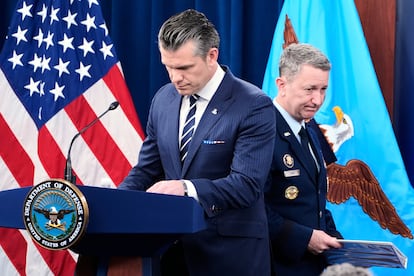

Secrecy was the Pentagon's primary concern in preparations for Operation Midnight Hammer, carried out this Saturday against Iran's nuclear facilities on the orders of US President Donald Trump. According to Secretary of Defense Pete Hegseth and Chief of Staff General Dan Caine, the first US military intervention on Iranian soil since the triumph of the Islamic revolution in 1979 resorted to"several diversionary tactics" to prevent the leakage of any information that could alert Tehran. The scale of the attack was immense: 125 aircraft deployed to transport 75 missiles, including 14 bombs weighing more than 13,000 kilos.
Initial indications, Hegseth says, suggest that the operation"has had the desired effect" and that Iran's nuclear facilities in Fordow, Natanz, and Isfahan have been destroyed. But officials acknowledge that it will take some time to determine the exact extent of the damage. International Atomic Energy Agency measurements have not detected significant radiation outside the facilities, which may suggest that the damage has not been as severe as a US administration prone to hyperbole claims.
The operation, about which Hegseth claims the required notifications to Congress were made—according to CNN, Trump did notify Republican lawmakers, but not Democrats—had begun to be planned, according to senior officials,"months ago" to give Trump the option to attack if the president so desired. During that time, the necessary reinforcements were being moved to the region. The president had been using increasingly bellicose language toward Tehran, despite the fact that until ten days ago his administration was conducting negotiations with that regime regarding Iran's nuclear program.
Preparations were rushed a couple of weeks ago, given the rise in tensions between Iran and Israel and the Israeli attack on Iranian nuclear and military targets on the 13th. The plans were"highly confidential" and only a handful of people knew about them, Caine revealed.
The pursuit of secrecy was such that several diversionary maneuvers were even used: hours before the attack on Saturday, a group of B-2 bombers headed out into the Pacific, visible as a decoy. This immediately put the media and experts on alert: these planes are the only ones capable of carrying the heavy GBU-57 bunker-busting bombs, weighing over 13,000 kilos, needed to penetrate to the depths where the Fordow facility was located, beneath the mountains south of Tehran.
According to the progress being made in commercial real-time flight tracking applications, these planes appeared to be heading for the military base on the island of Diego Garcia in the Indian Ocean, and had a long journey ahead of them, taking hours and hours to get there.
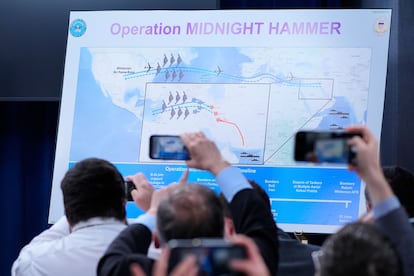
But meanwhile, the B-2s that were actually going to take part in the operation headed toward Iran in stealth mode, heading eastward, much faster. The first GBU-57 bombs fell on Fordow at 6:40 p.m. Washington time (2:10 a.m. Tehran time, 12:40 a.m. Spanish time). It was the first time such bombs had been used in combat. Meanwhile, Trump was ostensibly holding a meeting with his National Security Council in the White House crisis room.
The strike was carried out alone, without Israeli participation, Caine pointed out. The military high command did acknowledge that US aircraft benefited from the bombings carried out by Israeli forces in previous days: they had attacked and greatly weakened Iranian defensive systems, which made it easier for US aircraft to operate unhindered.
The bombing raids ended less than half an hour later, at 7:05 p.m. U.S. time. In total, seven B-2s carried out the attacks against the Iranian targets. Fourteen GBU-57 bombs were dropped on Fordow and Natanz.
The bunker-busting bomb attacks were followed by the launch of some 30 Tomahawk missiles against Isfahan, home to Iran's longest-range ballistic missiles,"to maintain the element of surprise," according to Caine. In total, the US military used 125 aircraft, including bombers, fighter jets, refueling and surveillance aircraft, and launched 75 missiles, including GBU-57 bombs.
Meanwhile, the White House warned reporters that there would be no further official activities for the rest of the day, without making any mention of what was happening on the other side of the world. It is unclear whether the Pentagon's diversionary maneuvers included the US president's Thursday statement that he would give himself two weeks before making a decision on a possible attack, to give diplomatic efforts a chance. The attack by US aircraft came just 48 hours later.
The aircraft involved in the operation did not detect any fire targeting them at any point, Caine stressed."It appears they didn't see us. We managed to maintain the element of surprise," he told the media at the Pentagon press conference on Sunday. The three facilities suffered"extremely severe damage," according to the military's top brass, who specified that, however, it will take time to determine the exact extent of the destruction.
Defense Secretary Pete Hegseth asserted that the United States"is not seeking war," but added: "We will act swiftly and decisively when our people, our partners, or our interests are threatened." Meanwhile, Vice President J.D. Vance stated in an interview on NBC's Meet the Press that Iran's nuclear program has been severely impacted by the bombings.
Vance also urged Iran to accept Trump's calls to end its uranium enrichment activities and achieve peace."We are not at war with Iran. We are at war with Iran's nuclear program," the US government's deputy leader stressed.