
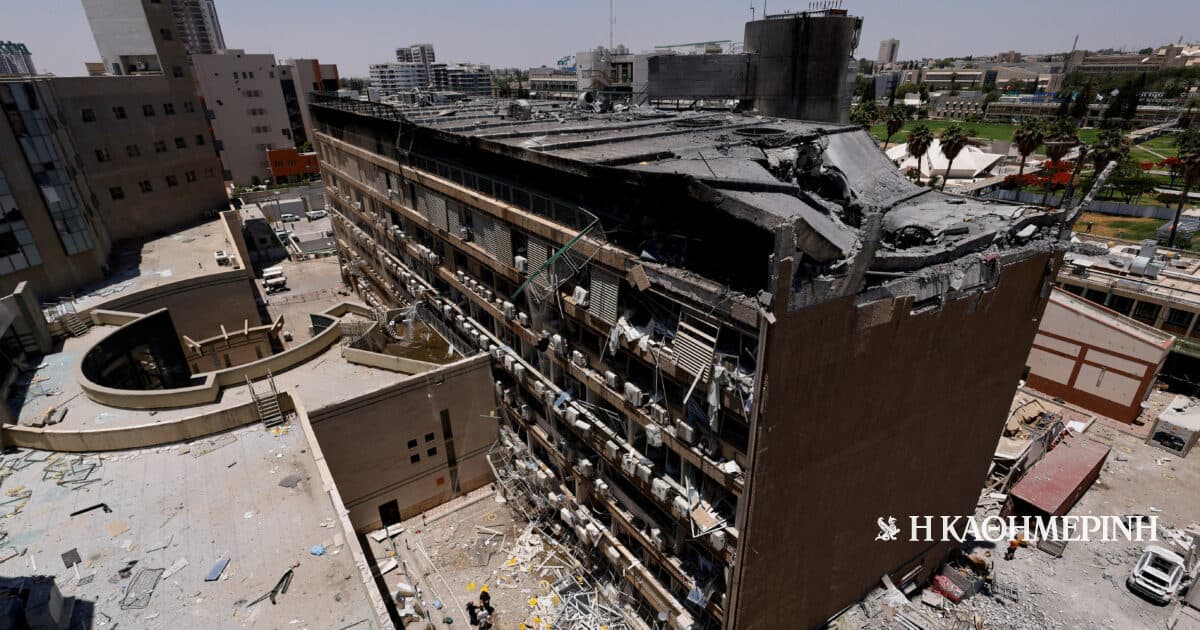
Israel has announced an escalation of military strikes on strategic targets in Iran , following an Iranian missile attack that hit, among others, the Soroka hospital in Beersheba, causing damage and minor injuries. Israel responded with strikes on nuclear facilities in Arak and Natanz, while Iran remains in a near-total internet blackout. The conflict continues with uncertainty over whether the US will become militarily involved, as Trump avoids announcing final decisions. Meanwhile, European and Iranian officials are set to meet in Geneva.
Live image from Tel Aviv
20:13
Summary of events
- Israeli Defense Minister Yisrael Katz said Iran's Supreme Leader Ali Khamenei can no longer be allowed to exist, accusing him of personally ordering strikes on hospitals such as Soroka in Beersheba.
- The Israeli prime minister, from Soroka Hospital, praised the US contribution to Israel's air defense, without confirming direct involvement in the bombings: The decision rests with the president.
- A rocket hit the base of a skyscraper on Jabotinsky Avenue in Ramat Gan, destroying a pizza shop and old apartment buildings.
- At least 240 injured: According to the Israeli Health Ministry, four people were seriously injured in the Iranian attacks with missiles.
- The IDF announced that Iran used a missile with multiple warheads, making it difficult for Iron Dome to intercept.
- US special envoy Steve Witkoff had repeated telephone contacts with Iranian Foreign Minister Abbas Araghchi. Tehran rules out return to talks unless Israeli bombing stops.
- Chancellor Friedrich Merz called on Netanyahu to show restraint, while supporting attacks on Iranian nuclear facilities.
- A senior Iranian lawmaker said Iran could close the Strait of Hormuz if its vital interests were threatened.
- The US special envoy for Syria warned Hezbollah not to get involved in the Iran-Israel conflict.
- Israeli gunfire killed at least 25 people in Gaza, including 15 near a humanitarian aid distribution point.
- The Iranian Foreign Minister Araghchi confirmed that he will meet tomorrow with his British, French and German counterparts as well as the EU High Representative.
- Iran accused the IAEA of acting as an accomplice in Israel's war of aggression.
20:07
We will know in 24-48 hours whether the US will participate in the strikes against Iran
According to the Times of Israel, an Israeli official said that the assessment in Tel Aviv is that President Donald Trump will give the"ok" to attacks on Iran's nuclear program.
As he himself stated: The expectation is that they will join, but no one is pressuring them. They have to make their own decision. Israeli authorities estimate that the picture will become clearer within the next 24 to 48 hours.
19:38
Netanyahu: Regime change in Iran is not a goal, but it could be an outcome
Israeli Prime Minister Benjamin Netanyahu said on Thursday that changing or collapsing the Iranian regime is not Israel's goal, but could be a possible outcome of developments.
"The question of changing or falling this regime is primarily about the Iranian people. There is no substitute for that. I did not present it as a goal – it may be an outcome, but it is not a declared or official goal," Netanyahu said in an interview with Israeli public broadcaster Kan.
19:32
Funerals in Iran for victims of Israeli strikes
A funeral was held in the southwestern Iranian city of Ahvaz on Thursday for those killed in Israeli airstrikes. The mourning ceremonies were attended by crowds of citizens holding flags and photos of the dead.
Alireza Mohammadi/ISNA/WANA via REUTERS
19:29
BBC Analysis: Trump may not have made up his mind yet
In times of crisis, there is always the temptation to believe that leaders have already made critical decisions. They simply do not reveal them. They cite the need for secrecy for the success of a business. All of this is probably true.
However, it is equally possible that key decisions have not yet been made.
The BBC's Gary O'Donoghue in Washington says the move of military assets and personnel shows readiness but does not necessarily mean a decision has been made. Instead, it suggests the president is keeping all options open."Nobody knows what I'm going to do," Trump said of Iran, adding that he would make a decision a split second before it was necessary.
According to the BBC, he may be telling the truth. The tactic of delaying decision-making is not new. And Margaret Thatcher, after all, is said to have said: Don't make a decision until you have to.
The three consecutive days of meetings in the White House Situation Room reveal that Trump is not a passive observer, but is closely monitoring developments and evaluating his options.
BBC
19:14
WHO chief condemns attacks on health facilities
The Director-General of the World Health Organization, Tedros Adhanom Ghebreyesus, condemned the attacks on health facilities that occurred amid the escalation between Israel and Iran.
In a post on the X platform, he described the reports of attacks on health facilities as shocking, making special mention of the morning attack on the Soroka Medical Center in Israel and the deaths of Red Crescent workers in Iran.
"We call on all parties to protect health facilities, staff and patients at all times. The best medicine is peace," he stressed.
18:59
US and Iran in secret talks under the shadow of war with Israel
President Trump's special envoy, Steve Witkoff, and Iranian Foreign Minister Abbas Araghchi have had several phone conversations in the past week in an effort to find a way out of the crisis triggered by Israeli attacks on Iran, three diplomats told Reuters.
According to the same sources, who spoke on condition of anonymity, Tehran has made it clear that it will not return to negotiations as long as Israel's bombing, which began on June 13, continues.
18:58
US moves aircraft and ships amid fears of Iranian retaliation
The US armed forces have taken a series of precautionary measures to protect personnel and equipment in the Middle East, as tension with Iran escalates following Israeli attacks and threats of possible US involvement.
According to Pentagon officials who spoke to CNN, the undocked US aircraft were removed from the large Al Udeid air base in Qatar, while the US Navy warships stationed at the US Naval Support Activity Bahrain departed the port earlier this week. It is not known where the ships and aircraft have been moved.
18:51
Iran rejects accusations of attack on Israeli hospital
Iran's mission to the UN categorically denied targeting the Soroka hospital in Beersheba, calling Israel's claims false.
In a post on X, she states that the Iranian strikes are precise and limited to facilities directly involved in Israeli attacks on Iran.
Iranian Foreign Minister Abbas Araghchi acknowledged that the shock wave from an attack on an Israeli military base caused superficial damage to the hospital.
Israel accuses Iran of deliberately seeking to hit the hospital, calling it a criminal act.
18:50
US moves planes and ships from bases in Middle East
The US military has removed all unprotected aircraft from the Al Udeid base in Qatar and has pulled all of its warships stationed at the Bahrain naval base out of port, according to Pentagon officials who spoke to CNN.
CENTCOM has also moved blood supplies to the region, in anticipation of possible attacks by Iranian forces or their allies, should Donald Trump order a strike on Iranian nuclear facilities.
CNN
18:27
Trump remains unpredictable, even in the face of war
Trump remains unpredictable as the crisis with Iran escalates. He avoids clarifying whether he will take military action or pursue a diplomatic solution, stating: I may do it, I may not. Nobody knows.
Although he is demanding unconditional surrender from Tehran, he does not rule out negotiations, saying that the Iranians have offered to meet him at the White House. The war is complicated. Nothing is over yet, he said characteristically.
18:16
Unrest in Trump camp over possible involvement with Iran
MAGA members are expressing anger at Donald Trump over the possibility of a US strike on Iran. Steve Bannon calls for restraint, warning that we cannot go through the same thing again.
Trump responds that my supporters love me more than ever and states: My only priority is that Iran never obtains a nuclear weapon.
Reuters
18:04
Iran: New strategy if a third country gets involved in the war on Israel's behalf
Iran's Supreme National Security Council warned that Tehran would adopt a different strategy if a third country became militarily involved on Israel's side.
17:57
22,000 tourists ask to leave Israel
According to the Israeli Ministry of Tourism, 22,000 tourists have declared their intention to leave the country, while the airspace remains closed since the start of the clashes, except for special repatriation flights for Israelis, which began yesterday.
Of the approximately 40,000 tourists who were in Israel at the start of the war, about 32,000 remain, with some having already left via the land borders with Jordan and Egypt.
17:55
Canada plans to evacuate citizens from Israel, West Bank and Iran
Canada's foreign affairs minister announced that plans are underway to provide commercial travel options to Canadian citizens wishing to leave Israel, the West Bank and Iran through neighboring countries.
At the same time, additional consular services have been developed in the region, while support is available to those crossing the border.
17:45
Iran: No casualties from Israeli strike on Khondab facility
The Atomic Energy Organization of Iran announced that the Israeli strike on the Khondab heavy water facility caused no casualties, nor is there a threat or harm to residents of the area.
17:39
Khamenei to Iranians: Continue with strength – Don't show fear
Iran's Supreme Leader Ayatollah Ali Khamenei called on the Iranian people to remain steadfast in the face of external threats. If the enemy understands that you fear him, he will not leave you alone, he said in a post on X. Continue the stance you have taken until now - continue it with strength, he stressed.
17:39
Iran to US: This is not America's war
Iran's deputy foreign minister, Khatibzadeh, told the BBC that Tehran wanted diplomacy, but under conditions of ongoing attacks, no one could negotiate. He stressed that once this aggression stops, diplomacy is the first option.
At the same time, he warned that if Donald Trump gets the US involved, he will go down in history as a president who entered a war that does not belong to him.
Asked about the inequality of power, he replied that what counts is national unity and resistance against any foreign invader.
17:20
Merz asked Netanyahu for restraint in a telephone conversation
German Chancellor Friedrich Merz spoke by phone with Israeli Prime Minister Benjamin Netanyahu, expressing Berlin's understanding of the Israeli strikes on Iranian nuclear facilities, but stressed the need for restraint and a diplomatic resolution to the crisis, according to a German government source cited by Reuters.
17:04
Israeli Army: End of alert – Citizens can leave shelters
The Israeli military announced that civilians can leave protected areas in all areas, signaling that the threat from the Iranian attack has passed.
16:57
Rocket attack on northern Israel underway
At present, there are no reports of casualties or injuries after the latest barrage of attacks.
16:56
Turkey strengthens border with Iran amid conflict with Israel
Turkey has increased security measures on its border with Iran due to the escalation of the conflict with Israel, a Turkish Defense Ministry source told Reuters on Thursday.
Although there is no increased pressure from crossings, Ankara remains on alert, condemning the Israeli attacks as a violation of international law and offering to mediate in the restart of US-Iran talks.
16:54
New wave of Iranian attacks underway - Sirens sound in Haifa and northern Israel
Citizens in areas where sirens are sounding are being instructed to enter bomb shelters and remain there until further notice.
16:51
Iranian diplomat: Bushehr not hit – Israel's claims are psychological warfare
An Iranian diplomat told Reuters that the Bushehr nuclear plant was not hit by an Israeli attack, dismissing the claims as psychological warfare on Israel's part.
16:41
Israel: Iran used a missile with multiple warheads
The Israeli military announced Thursday that Iran used a missile with multiple warheads in the latest attack, according to the Associated Press.
Such missiles are difficult to intercept, as air defense systems – such as Iron Dome – must detect and neutralize multiple targets simultaneously.
There is no independent confirmation of the incident yet.
16:37
New attack from Iran – Israeli air defenses activated
The Israeli military announced that missiles were fired from Iran towards Israeli territory a short time ago. Air defense systems have been activated to intercept the threat.
Citizens are urged to immediately enter protected areas as soon as the warning siren is heard and to remain there until further notice. Exit is only permitted upon official instruction, the relevant announcement notes.
16:30
Israel strikes at the heart of the Iranian regime
Israel's air campaign aims not only to destroy Iran's nuclear and missile programs, but also to dramatically weaken the theocratic regime of Supreme Leader Ali Khamenei, according to Israeli and Western officials cited by Reuters.
Netanyahu leaves open the possibility of regime change, while analysts warn of the risk of regional chaos if the Islamic republic collapses.
Israel has expanded its targets and is striking government buildings in Tehran, while planning two weeks of intensive raids.
Dennis Ross believes that Tehran is being pressured into negotiations, but the White House is seeking guarantees of a permanent cessation of uranium enrichment before supporting a ceasefire.
Trump leaves all possibilities open, noting that no one knows what I will do.
Iran, isolated and without substantial support from Russia and China, has seen its network of allies collapse after the defeat of Hezbollah, the overthrow of Assad, and the losses of the Houthis.
Although Israeli public opinion and opposition parties support the operation, experts warn that the collapse of the regime will not bring democracy, but likely a harsher, militaristic administration by the Revolutionary Guards.
Western governments, including France, are concerned that a violent collapse of Iran could trigger chain reactions across the region, from Azerbaijan to Pakistan, creating a dangerous power vacuum.
Reuters
16:26
Trump: The Wall Street Journal has no idea what I think about Iran!
In a post, Donald Trump denied a report about his intentions towards Iran, writing: The Wall Street Journal has no idea what I think about Iran!
It is recalled that the Wall Street Journal reported that the American president told his associates that he approved plans for the US armed forces to attack Iran, but has not yet given the final order to proceed, because he is waiting to see if Tehran will capitulate and abandon its nuclear energy program - something that Tehran explicitly rules out.
16:23
Iran warns US of harsh response in case of conflict
Iran's Supreme Council warned that any American intervention in favor of Israel would provoke a harsh response from Tehran.
The criminal American government and its foolish president must know for sure that if they make the mistake of moving against Islamic Iran, they will face a harsh response from our Republic, according to a statement broadcast by Iranian state television.
AFP
16:19
Russia: Chernobyl-style disaster if Bushehr nuclear plant is hit
Moscow issued a stern warning, stressing that a possible Israeli strike on the Bushehr nuclear power plant in Iran could cause a disaster comparable to that of Chernobyl.
Rosatom CEO Alexei Likhachev said such a blow would be beyond any harm and confirmed the removal of dozens of Russian specialists from the facility.
Iran's only operating nuclear reactor, Bushehr, was built with Russian technical assistance and is located on the Persian Gulf coast. An Israeli spokesman initially said the plant had been hit, but another military official later called the statement a mistake and declined to confirm or deny the strike.
Nuclear experts and Gulf Arab states are expressing strong concerns about possible radioactive contamination in the wider region. Scott Rocker, vice president of the Nuclear Threat Initiative, told CNN that an attack on Bushehr would result in the dispersion of a large amount of radioactivity.
Russian Foreign Ministry spokeswoman Maria Zakharova said that Moscow is monitoring with particular concern the security of the facility, where Russian citizens work.
CNN
16:10
Iran to Israelis: Stay away from military targets
Iranian Foreign Minister Arakchi called on Israeli citizens via Twitter to follow Iranian evacuation instructions before the strikes and to avoid areas near military and secret facilities.
He also stated that the Iranian armed forces will continue to pound the criminals until they stop and pay for the criminal aggression against the Iranian people.
16:08
New Israeli strikes on western Iran
The Israeli military announced that it had struck several missile launch sites in western Iran after detecting attempts to restore them.
16:07
Israel: Iran fired a missile carrying a cluster bomb warhead
The missile's warhead breaks up during descent, at a height of seven kilometers from the earth's surface, dispersing about 20 smaller munitions in a radius of about eight kilometers.
16:06
China evacuates its citizens from Israel
China's embassy in Israel has helped more than 270 Chinese citizens leave the country, according to the Global Times.
16:05
Iran in darkness: 24 hours without internet
It's been 24 hours since the start of the nationwide internet blackout in Iran — the worst since the protests of 2019, according to Clash Report.
16:03
Iran with its back against the wall: Weakened but dangerous
The Iranian regime is now in the most difficult position it has ever been in, 46 years after the revolution that brought it to power. But will this lead to its end?
16:02
Netanyahu: Trump is a true friend of Israel – I trust his judgment
Visiting the Soroka Hospital in Beersheba, which was hit by an Iranian missile, the Israeli prime minister praised Trump's stance and stressed the importance of cooperation with the United States.
President Trump will do what is best for America, he said. I trust his judgment. He is a terrific leader, a true friend of Israel and the Jewish people.
Netanyahu noted that he speaks almost daily with Trump and reiterated Israel's commitment to eliminating the threat of nuclear annihilation.
President Trump's resolve and clarity are clear: Iran cannot have a nuclear weapon, and to ensure that, it cannot enrich uranium. It's that simple, he said.
- The Israeli prime minister stated that the US is already helping significantly, strengthening Israel's air defenses, while he avoided directly commenting on the possibility of direct American military involvement, saying that this is a decision that belongs exclusively to Trump.
15:58
Threats from Tehran to close the Strait of Hormuz under conditions
Tehran is considering closing the Strait of Hormuz in response to Israeli military operations and Western pressure, according to statements by Iranian lawmakers on Thursday.
Behnam Saeedi, a member of the presidency of Parliament's National Security Committee, told the semi-official Mehr news agency that Iran has multiple options and that closing the Strait of Hormuz is one of the possible ones.
However, MP Ali Yazdihah clarified that free navigation in the Persian Gulf and the Straits will continue unless Iran's vital national interests are endangered.
If the United States officially and operationally enters the war on behalf of the Zionists, then it is Iran's legitimate right to exert pressure by disrupting the transit of oil, he said.
Reuters reported on Wednesday that commercial shipping vessels are already avoiding Iranian waters around the Straits due to increased tension.
15:56
Netanyahu from Soroka Hospital: The entire people of Israel are paying the price
Netanyahu visited the Soroka Hospital in Beersheba, which was hit by an Iranian missile, and made statements, emphasizing the collective and personal cost of the war. The entire people of Israel are paying a price. We are going through a lightning war and we are going through it in a terrible way, he said.
He referred to the human toll and the cost to families, making special mention of his own: Each of us bears a personal cost, and my family is no exception — this is the second time my son Avner has had to cancel his wedding due to a missile threat. It is a personal cost to his fiancée as well. And I must say that my beloved wife is a heroine, and she bears a personal burden.
15:38
Summary of events
- Israeli Defense Minister Israel Katz warned that the Israeli military would intensify strikes on strategic targets in Iran, following an Iranian missile strike that hit, among other things, the large Soroka hospital in Beersheba.
- It is the first Israeli hospital to be directly hit since the start of the war last Friday. Tehran claims it targeted military installations near the hospital, without providing evidence.
- The Israeli response included airstrikes on Iranian nuclear facilities, including the defunct Arak reactor and facilities in the Natanz region.
- Iran has been in a near-total internet blackout since Wednesday night. The International Atomic Energy Agency confirmed a strike on a reactor under construction without nuclear material.
- The conflict is intensifying amid uncertainty over whether President Trump will involve the United States militarily. He said: I like to make final decisions a second before the end, because things change.
- On Friday, European and Iranian diplomats will meet in Geneva for the first official contact since the start of hostilities, without the participation of Israel or the United States.
15:02
Iran's leader urges Iranians to continue with strength
Iran's Supreme Leader, Ali Khamenei, said, addressing the Iranian people, that if the enemy feels that you fear him, he will not leave you alone.
In a post on X, he stressed: Continue the same behavior you have had until today. Continue this behavior with force.
14:57
Russia warns of Chernobyl-like disaster
The head of Russia's nuclear energy company has warned that an Israeli attack on Iran's Bushehr nuclear plant could lead to a Chernobyl-style disaster.
An Israeli military spokesman said Israel had attacked the plant, but an Israeli military official later called the statement an error and said he could neither confirm nor deny that the Bushehr plant on the Gulf coast had been attacked.
Bushehr is the only nuclear power plant operating in Iran and was built by Russia.
President Vladimir Putin told reporters in the early hours of the morning that Israel had promised Russia that Moscow workers - who are building more nuclear facilities at Bushehr - would be safe, even if Israel tried to degrade Iran's nuclear capabilities by force.
The head of Russia's state nuclear company Rosatom warned on Thursday that the situation poses risks.
If there is an attack on the first operating power plant, it will cause a disaster comparable to Chernobyl, the state news agency RIA reported, citing Alexey Likhachev.
Likhachev was referring to the world's worst nuclear disaster in 1986, when a reactor exploded in Chernobyl, Soviet Ukraine.
An attack on Bushehr would be beyond... evil, Likhachev added.
Russia has removed some of its specialists from Bushehr, he said, but the core workforce - which, according to Putin, numbers hundreds of people - remained at the site.
"We are prepared for any scenario, including the rapid evacuation of all our employees," RIA reported, citing Likhachev.
14:54
Tom Barak: Hezbollah involvement would be a very bad decision
The US special envoy for Syria, Tom Barak, has warned Lebanon's Hezbollah not to get involved in the war between its main backer, Iran, and Israel.
Barak, who is also the US ambassador to Turkey, is making his first visit to Beirut, where he met with senior Lebanese officials, including parliament speaker Nabih Berri, a Hezbollah ally.
"I can say on behalf of President Trump... that it would be a very, very, very bad decision," Barak said after his meeting with Berry, responding to a question about the US position in the event of Hezbollah's involvement in the war.
The organization condemned Israel's attacks on Iran when the conflict erupted on Friday, but announced no intention to intervene in support of Tehran.
14:47
Xi's signal to Trump
Chinese leader Xi Jinping called on major powers to help de-escalate the conflict with Iran during a phone call with his Russian counterpart Vladimir Putin, in an indirect message to the United States, according to a CNN analysis.
The two leaders condemned Israel's actions against Iran during the phone call, with Putin again offering to mediate, according to the Kremlin.
Without naming the United States, Xi said the international community, especially major powers with significant influence on the parties to the conflict, should make efforts to de-escalate the situation, not the other way around, according to a statement from the Chinese Foreign Ministry.
Xi said there should be an immediate ceasefire, urging both sides — but especially Israel — to end hostilities.
The parties to the conflict, especially Israel, must cease hostilities as soon as possible to prevent the situation from escalating and resolutely avoid the expansion of the war, Xi told Putin, according to the Chinese statement.
Both sides agreed to maintain close contact between their diplomatic and security services in the coming days.
14:39
Israeli Health Minister: The red line has been crossed
Israel's Health Minister said Iran crossed the line by attacking a major hospital in the southern Israeli city of Beer Sheva.
The red line has been crossed. The dictatorial regime in Tehran has crossed the line and is acting like a barbaric terrorist organization, Uriel Boussot reported in X.
Iran's Islamic Revolutionary Guard Corps (IRGC) announced for its part that it targeted an Israeli intelligence and command center near a hospital.
14:32
At least 240 injured in Iranian attacks
At least 240 people were injured in Iranian missile attacks on Israel this morning, the Associated Press (AP) reports.
The news agency reported that four people were seriously injured, according to the Israeli Health Ministry.
The vast majority of the injured, including 70 at Soroka Hospital in the southern Israeli city of Beersheba, suffered minor injuries.
14:26
What has happened in the last few hours:
In Israel
- The Soroka Hospital in Beersheba, southern Israel, was damaged by a rocket attack.
- The attack led Israel's defense minister to say that Iran's leader should no longer exist.
- Iran claims the target of the attack was a military installation near the hospital.
- Several areas in Israel were also hit overnight, with dozens of people injured.
In Iran
- Israeli forces said they had attacked Iranian nuclear facilities, including the heavy water reactor at Arak, the uranium enrichment plant at Natanz, and the facility in Isfahan.
- Iran filed a complaint with the International Atomic Energy Agency, saying it had become a partner in an aggressive and unjust war by Israel.
- We will overcome these difficult days, Iranian President Masoud Pesekian said.
Meanwhile, US President Donald Trump has approved plans for an attack on Iran, but has not made a final decision, according to reports in US media.
14:19
Israeli military official: Bushehr was not hit
An Israeli military official stressed that it was a mistake to say earlier that Israel had struck Bushehr in Iran. He clarified that Israel had struck the nuclear facilities in Natanz, Isfahan and Arak.
14:10
Pakistanis return to their country after Israeli attacks on Iran
REUTERS/Naseer Ahmed
13:54
Russia has called on Israel to immediately stop airstrikes on the Bushehr nuclear plant, where Russian experts work.
13:48
Israel Katz on Khamenei: He is the modern Hitler - He should not exist
Israel's defense minister said Iran's supreme leader, Ali Khamenei, is a modern-day Hitler and can no longer be allowed to exist. This followed an Iranian missile attack that hit the Sokora hospital, according to local media and the AFP news agency.
Speaking to reporters in Holon, a suburb of Tel Aviv, Israel Katz reportedly said: Khamenei openly declares that he wants the destruction of Israel, he personally gives the order to shoot at hospitals. He considers the destruction of the state of Israel as a goal... Such a person can no longer be allowed to exist.
Earlier, Iranian state media reported that the main target of the morning missile attack was a military facility next to Sokora Hospital, and not the hospital itself.
Katz also mentioned that if during the horrific Holocaust, the state of Israel existed and there were strong Israel Defense Forces, and we knew that we could send the army to a fortress to capture the enemy of the Jewish people, Hitler, in order to thwart his plan to exterminate the Jews, we would have done so.
We would have sent the Israeli army and wiped it out, he noted, adding: That's exactly how I see the current situation — Khamenei is the modern-day Hitler.
13:46
Washington divided, as in the Iraq war
US diplomat David Satterfield said that the disagreements in Washington about the possibility of a US attack on Iran do not concern the consequences of a strike on the nuclear facility in Fordow.
The debate is about whether such an action would definitively end the Iranian nuclear program, he told the BBC.
It is one thing for the US to strongly support Israel and another for the country, its aircraft and weapons to attack Iranian territory, he added.
Iran has repeatedly denied that it is building nuclear weapons. The US Director of National Intelligence, Tulsi Gabbard, has also said that Iran is not building a nuclear bomb, but Trump has rejected her comments.
The BBC's US correspondent, Anthony Zurcher, highlights that this division is reminiscent of the 2003 rift over the Iraq war.
13:38
Can there still be a diplomatic solution?
In the next 24 hours, either President Trump will give the green light for the implementation of a US military plan or there will be a diplomatic solution, Liz Douche reports in her analysis for the BBC.
Trump boasts that he likes to make decisions at the last minute.
This may be part of a psychological war or perhaps the American president believes this is the best way to close a deal.
Iran's Foreign Minister, Abbas Araghchi, is expected to attend talks in Geneva tomorrow with his counterparts from Britain, Germany and France, while the UN Security Council will meet in New York.
Countries with close ties to Trump, such as Saudi Arabia, Qatar and the United Arab Emirates, made it clear to the American president during his recent tour of their region that they do not want war in their neighborhood.
Trump continues to imply that a negotiated agreement is possible.
Among the central issues is whether the US will withdraw its demand that Iran reduce uranium enrichment to zero - a red line for Tehran.
Iran and the US are taking a tough stance, attacks are intensifying and, behind the scenes, the phone lines are burning, according to the BBC's analysis.
13:26
Israeli attack on Iran's state television building in Tehran
Photo Majid Asgaripour/WANA via REUTERS
13:21
Israel targets Bushehr, Isfahan and Natanz nuclear facilities
An Israeli military spokesman said Israel had attacked Iranian nuclear facilities in Bushehr, Isfahan and Natanz and continued to target additional facilities.
Bushehr is Iran's only operational nuclear power plant and is located on the Gulf coast.
13:15
Putin-Xi telephone conversation
Russian President Vladimir Putin and Chinese President Xi Jinping discussed the recent G7 meeting in a telephone conversation, highlighting the imperfections in relations between the G7 leaders, according to the Kremlin.
The two men plan to meet in China in late August, at the next meeting of the Shanghai Cooperation Organization, Kremlin adviser Yuri Ushakov told reporters.
The two leaders also condemned Israel for its attacks on Iran, according to the Kremlin.
13:07
Turkey: Strengthened border security
Turkey has stepped up security on its border with Iran amid Tehran's conflict with Israel, a Turkish Defense Ministry source told Reuters, adding that Ankara has not seen an increase in migration flows.
The source, who was not named, said Turkey continues to develop a multi-layered and integrated air and missile defense system, using domestically produced radars and weapons systems. He added that the goal is to maintain potential combat readiness at a high level.
The source also said that Turkey's Quick Reaction Aircraft (QRA) took off after Israel began its attacks on its southeastern neighbor, Iran, adding that the aircraft continued to patrol the border due to fears of possible violations of Israeli airspace.
13:04
China's call for an end to hostilities
China has urged Middle Eastern countries, especially Israel, to stop hostilities, the message came after fresh exchanges of fire with Iran and as US President Donald Trump warned he was considering US military action in the conflict, according to the French news agency AFP.
Chinese Foreign Ministry spokesman Guo Jiakun stated:
China strongly calls on all parties involved in the conflict, especially Israel, to put the interests of the people of the region above all else, immediately cease hostilities and end the fighting.
He added that Beijing opposes any act that... violates the sovereignty, security and territorial integrity of other countries, and opposes the use or threat of use of force in international relations.
12:56
Bulgaria closes its embassy in Tehran
Bulgaria has closed its embassy in Tehran and evacuated diplomatic staff and their families who have moved to neighboring Azerbaijan, as the conflict between Iran and Israel intensifies, Bulgarian Prime Minister Rosen Zhelezkov told local media.
Zhelyazhkov said 12 people from the embassy and their families were evacuated after Israel warned residents to evacuate Tehran's third district.
The Bulgarian embassy is in the immediate vicinity of this area and we decided to remove our diplomats from the country, he said, adding that the embassy will continue to operate from Baku.
The personnel arrived by road, after a six-hour convoy to the border, where they waited another six hours due to border controls, according to the announcement.
12:52
Iran confirms meeting with European officials on Friday
Iran's Foreign Minister, Abbas Araghchi, confirmed that he will meet with his counterparts from Britain, France and Germany, as well as the European Union's top diplomat tomorrow, Friday, in Geneva, according to Iranian state media.
He stressed that the meeting will take place at the request of the three European states.
12:47
How are Iranians dealing with the situation?
Iranian citizens are expressing their fears as the conflict with Israel escalates, and some families are leaving Tehran, while others seem determined to stay.
Several Iranians described to CNN daily life in and around the capital in recent days. All asked not to be named for security reasons.
We are all in shock, said Sima, 45, adding: Some of us have nowhere to go. Some of us are still in our apartments, waiting to see if we will survive.
Sima added that her friend, from Shiraz in south-central Iran, was forced to hitchhike for three days to reach his grandparents due to a lack of fuel.
Those living outside Iran have been cut off from their loved ones, while others have decided to leave the country.
12:38
Iranian President's message to the nation
Iran's president addressed the nation via a social media post, saying he has ordered all government departments to serve Iran.
All ministries and government agencies have taken on the mission to serve Iran with all their strength and resources, with your patience and support, said Masoud Pezheskian.
With the grace of God and with the help of empathy and solidarity, we will overcome these difficult days, adds Pezheskian.
12:30
Trump: Who does he turn to for advice?
As the world awaits Trump's decision, his former national security adviser KT McFarland provided some insight into how he might decide.
Speaking to the BBC, he stressed that the US president may turn to his personal network for advice on whether to attack Iran.
McFarland also said that, unlike most presidents who rely on their staff and cabinet for briefings, Trump prefers to talk to people he knows, such as Mohammed bin Salman, the crown prince of Saudi Arabia.
However, ultimately, according to McFarland, Trump will make the decision himself.
And once he makes the decision, he no longer has doubts, he doesn't question himself. He just lets things flow, he says.
Immediately after ordering the bombing of Syrian airfields in 2017, Trump went to dinner with Chinese President Xi Jinping, according to McFarland, who recalled how the US president learned that the US mission was complete while eating chocolate cake for dessert.
12:19
Trump will decide at the last minute
I might do it, I might not. Nobody knows what I'm going to do. That's what US President Donald Trump said yesterday on the White House lawn, when asked if the US was getting closer to an attack on nuclear facilities in Iran.
Since then, according to reports, Trump has approved plans for a US attack, but is currently postponing the decision, waiting for Iran to agree to abandon its nuclear program.
Iran's mission to the UN has expressed doubts about this possibility, stating that it does not negotiate under pressure.
Trump's former national security adviser, K.T. McFarland, told the BBC that the US president would wait until the last minute to decide, adding, however, that without a deadline, it is unclear what that might mean.
12:13
International Atomic Energy Agency: The facility was not operational and contained no nuclear material, therefore there are no radiological impacts
12:11
The International Atomic Energy Agency has confirmed that the Khodab (formerly Arak) heavy water research reactor under construction in Iran was hit.
12:09
Minor damage to Dutch embassy in Tel Aviv - No injuries reported
12:06
Holon, a suburb of Tel Aviv in Israel after the Iranian missile attack
REUTERS/Violeta Santos Moura
11:59
Ayatollah Ali Sistani: Warning against targeting Ali Khamenei
Iraq's top Shiite cleric, Ayatollah Ali Sistani, warned against targeting Iranian leaders and said war between Iran and Israel could plunge the entire region into chaos, according to the French Agency (AFP).
Sistani said that targeting Iran's top religious and political leadership would have disastrous consequences for the region.
He also warned that it could cause widespread chaos that would exacerbate the suffering of the people and seriously harm the interests of all.
Sistani called on the international community to make every effort to end this unjust war and find a peaceful solution to Iran's nuclear program.
Sistani, an Iranian, is the highest religious authority for millions of Shiite Muslims in Iraq and around the world, with the power to mobilize a huge portion of that base in Iraq.
As warnings of an escalation of regional war intensify following Israel's surprise attack on Iran last week, fears are growing of intervention by Iranian-backed Iranian factions, particularly against American interests in the region.
11:52
Hezbollah: Killing Ali Khamenei would have catastrophic consequences
Hezbollah has issued a statement expressing its support for Iran's Supreme Leader, Ali Khamenei, following threats from Israeli and US leaders that he could be killed.
The statement says that the assassination threats [of Khamenei] are foolish and reckless and will have disastrous consequences... Expressing them is an insult to hundreds of millions of believers and those associated with Islamism, and is absolutely condemnable. Today, we are more determined and united around it.
Hezbollah has not participated in attacks against Israel since Friday, when Israel began attacking Iran. In a statement after the first Israeli strikes, the Lebanese group condemned the attack.
11:45
Communication between the Foreign Ministers of Egypt, France and Britain
Egyptian Foreign Minister Badr Abdelati discussed with his French counterpart Jean-Noel Barrot and British National Security Advisor Jonathan Powell the escalation of tensions between Iran and Israel.
In a statement after the phone call, Abdelati said that the E3, an informal cooperation agreement on foreign policy and security issues between Britain, Germany and France, is responsible for opening dialogue and negotiation and for utilizing all available channels with the Iranian side, in order to reach compromises that will contribute to de-escalating tensions.
Source: AP
11:37
Iranian Foreign Minister: Present at a meeting in Turkey on Saturday
Iranian Foreign Minister Abbas Araghchi is expected to attend the Organization of Islamic Cooperation (OIC) meeting in Istanbul on Saturday, according to a Turkish Foreign Ministry source, amid the conflict between Israel and Iran.
The source said that the special session of the organization's 51st Council of Foreign Ministers is expected to focus on Israel's recent attacks on Iran.
Turkey has strongly criticized Israel, calling its actions illegal and saying Iran is legitimately defending itself.
At the start of the two-day summit, Turkish Foreign Minister Hakan Fidan is expected to call on Muslim countries to unite against destabilizing actions in the region, a ministry source said. President Recep Tayyip Erdogan will also address the summit.
The Organization of Islamic Cooperation, which includes 57 member states, has long served as a political and diplomatic forum for Muslim countries.
Source: Reuters
11:30
Israel in the morning, after the barrage of missile attacks from Iran
Photo. REUTERS/Violeta Santos Moura
11:24
What do we know about today's attacks:
In Israel
- An Israeli hospital in Beersheba, in the southern part of the country, was damaged by a rocket attack.
- Iran claims that the target of the attack was a military installation near the hospital.
- Several areas in Israel were attacked overnight, resulting in dozens of people being injured.
- Israeli Prime Minister Benjamin Netanyahu said that Tehran would pay the price.
In Iran
- Israeli forces reported that they had attacked Iranian nuclear facilities, including the heavy water reactor at Arak and the uranium enrichment plant at Natanz.
- Iran filed a complaint with the International Atomic Energy Agency (IAEA).
Meanwhile, US President Donald Trump has approved plans for an attack on Iran, but has not made a final decision on whether to proceed, according to reports in US media.
11:20
What are the risks of an attack on nuclear facilities?
Israeli attacks have targeted Iran's nuclear program, but have focused on uranium enrichment facilities.
The damage to these facilities does not pose the risk of a nuclear accident and disasters like those at Chernobyl or Fukushima, according to experts who spoke to the BBC.
This is due to the fact that no nuclear reaction takes place in enrichment facilities.
In a nuclear power plant's reactor, uranium atoms are split in a controlled fission reaction that produces heat for energy and more radioactive waste.
Enrichment facilities, on the other hand, simply produce the fuel.
Nuclear materials scientist Simon Middleberg from Bangor University explained that if an enrichment facility were bombed, the enriched uranium would likely be dispersed into the environment.
However, a nuclear reaction is not likely to occur and, therefore, the risks would remain local and would not constitute a radiological hazard beyond the small exclusion zone around the facility, he explained.
11:03
Iran against Grossi: He betrayed his role
Iranian Foreign Ministry spokesman Esmail Baghaei said in a post on X that the head of the International Atomic Energy Agency, Raphael Grossi, betrayed the non-proliferation regime, making the organization an ally of Israel in an unjust, aggressive war.
Misleading reports have serious consequences, Mr. Grossi, and require accountability, the Iranian official added.
"You have turned the organization into a tool for non-members, in order to deprive members of their basic rights," Baghaei further emphasized.
10:57
What has happened in the last few hours:
- A hospital in Beersheba, in southern Israel, was hit in a barrage of rocket attacks launched by Iran overnight.
- The Soroka hospital suffered extensive damage, a spokesman said, while Israel's emergency services said at least 65 people were injured across the country.
- Iranian state media reported that the missile attack targeted a military facility next to the hospital, not the hospital itself.
- In Iran, the Israeli military said it targeted nuclear facilities, including the defunct Arak heavy water reactor and the Natanz facility.
- The attacks this morning come at a critical time as Donald Trump considers the possibility of direct US involvement in Israel's campaign.
- Trump has reportedly approved plans for an attack on Iran, but has not made a final decision, while Iran's supreme leader warned of irreparable damage in the event of US intervention.
10:53
Kremlin: Possible US intervention in the Iran-Israel conflict would mean another terrible spiral of escalation
10:51
Katz warned Iran's supreme leader that he would be held accountable
Israeli Defense Minister Yisrael Katz said Iran's Supreme Leader, Ayatollah Ali Khamenei, will be held accountable following the Iranian attack on the Shorok hospital in Israel, according to the French Agency (AFP).
The minister added that he ordered the army to intensify attacks against the Islamic Republic, speaking of war crimes.
He added that he and Israeli Prime Minister Benjamin Netanyahu ordered the military to intensify attacks against strategic targets in Iran and against electricity infrastructure in Tehran, in order to eliminate threats to the state of Israel and to shake the Ayatollahs' regime.
10:43
How Israel can use today's attacks
Israel justified its attacks by saying that Iran had reached the point of no return in its nuclear program, as well as that it was close to developing a nuclear weapon, although it has provided no evidence of this.
Iran claims that its nuclear program has political, peaceful purposes, and the recent assessment by US authorities was that Iran had not decided to turn its nuclear program into a weapon – although it is not clear whether it had any plans to do so.
The attacks this morning come at a critical time, as US President Trump considers direct US involvement in Israel's campaign.
The attacks are likely to be used by Israeli officials and those in favour of military action to pressure Trump to take action, Hugo Macega reports for the BBC from Jerusalem.
Iran's supreme leader, Ali Khamenei, rejected Trump's calls for surrender, and Iran threatened to strike American military interests in the Middle East in retaliation.
Its proxies in Iraq and Yemen could also attack, sparking even more violence.
Efforts to de-escalate the conflict have so far failed, with Israel stating that the campaign will continue.
10:38
What does today's attack on Israel show?
Iran managed to cause significant damage to Israel, as its missiles penetrated the country's air defenses, hitting several locations, reports Hugo Batsega, in his response to the BBC from Jerusalem.
The intensity of recent bombings has decreased, indicating the damage that Israel's airstrikes have caused to the Iranian military.
The Israeli government announced an easing of some of the restrictions imposed because of the war.
However, today's attacks show that Iran still has the ability to launch missiles and cause damage. Among the sites hit were Soroka Hospital in the southern city of Beersheba, Holon, where a missile landed between buildings, and Ramat Gan, both in the Tel Aviv area.
Iran said the target in Beer Sheva was, it said, a military target near a hospital, but Sharon Haskel, Israel's deputy foreign minister, accused Iran of deliberately targeting Soroka. It is unclear what the possible targets in the other cities hit were.
Iran responded after nearly a week of Israeli airstrikes on military and nuclear facilities, energy facilities, airports, government buildings, and residential areas.
Iran spoke of an aggressive war, emphasizing that it has the right to defend itself.
10:28
US guidelines for American citizens in Israel
The U.S. Embassy in Israel has urged all U.S. government employees and their family members to remain in shelters until further notice. In addition, the U.S. State Department announced that emergency measures are being planned for the departure of individuals from Israel.
10:20
The number of injured in Israel has reached 65
A total of 65 people are hospitalized with injuries from the recent Iranian attacks, according to Israel's emergency service, Magen David Adom.
The injured include an 80-year-old man and two 70-year-old women who are in serious condition, two 80-year-old women in moderate condition, 42 people in mild condition and 18 people who were injured while heading to shelters.
10:18
Iran launches 30 ballistic missiles
Iran launched approximately 3 0 ballistic missiles against Israel this morning, according to estimates by the Israeli military, as reported by the Israeli media outlet Times of Israel.
Among the targets were the Soroka Hospital in southern Israel, as well as the cities of Holon and Ramat Gan in central Israel, according to the same estimates.
Doctors reported three seriously injured as a result of the attacks, with two in moderate condition and dozens more with minor injuries.
10:13
Iran: Military facility near hospital was the target
The main target of Iran's missile attack this morning was a military facility next to the Soroka hospital in Beersheba, and not the hospital itself, Iranian state media reported.
According to the IRNA news agency, the attack targeted the Israeli Defense Forces (IDF) Command and Intelligence (IDF C4i) headquarters and an army intelligence camp in the Gav-Yam Technology Park.
The hospital was only exposed to the shock wave and did not suffer serious damage, but the military infrastructure was a precise and direct target, it added.
10:05
Images from Israel after Iran's missile attack
Photo: REUTERS/Ammar Awad
09:54
Iranian official to US: Don't get involved in the conflict
Iran's deputy foreign minister warned the United States against getting directly involved in the conflict between Israel and Iran, while insisting that Iran has all necessary options on the table , according to comments carried by Iranian state media.
If the US wants to actively intervene to support Israel, Iran will have no choice but to use the means at its disposal to teach a lesson to the aggressors and defend itself... our military decision-makers have all the necessary options on the table, Kazem Gharibabadi said, according to state media.
"Our recommendation to the US is to at least remain non-participant if they do not wish to stop Israel's aggression," he added.
09:47
Israeli Defense Minister Katz: The military has received instructions to intensify attacks on strategic targets in Tehran, with the aim of eliminating the threat to Israel and destabilizing the Ayatollah's regime.
09:44
Israeli President: Iran's attacks targeted civilians
Israeli President Yitzhak Herzog said that Iranian missile attacks that damaged the Soroka hospital in southern Israel targeted civilians.
A baby in intensive care. A mother at his side. A doctor running from bed to bed. An elderly nursing home resident. These were some of the targets of Iran's missile attacks on Israeli civilians this morning, he wrote in a statement to X.
The Soroka Medical Center in the southern Israeli city of Beersheba suffered extensive damage from Iranian attacks, according to its spokeswoman.
"I send strength and support to the medical teams, the patients and the residents of Beer Sheva and all the cities that were attacked throughout Israel this morning," Herzog said.
In moments like these, we are reminded of what is really at stake and what are the values we defend, he added.
09:39
Tel Aviv hospital receives 10 injured
A hospital in Tel Aviv has admitted 10 people injured during Iran's latest barrage of attacks against Israel, its representatives told the American news network, CNN.
Ichilov Hospital reported that most of the injured are being treated in the trauma ward in mild condition.
09:32
Iranian Deputy Foreign Minister Gharibabadi: If the US wants to actively intervene to support Israel, Tehran will be forced to use the means at its disposal to defend itself and teach the aggressors a lesson
09:27
Iran's Atomic Energy Organization: We informed the International Atomic Energy Agency about Israel's threats and attacks, but the UN watchdog has not taken any action
09:24
Iran's Atomic Energy Organization confirmed that Israel attacked the Khodab research reactor and heavy water complex, again violating international law, the IRNA news agency reported.
09:19
Netanyahu: We will impose a full price on the tyrants of Tehran
09:17
Netanyahu: This morning the tyrannical terrorists of Iran launched missiles at Soroka Hospital and civilian population in central Israel
09:15
Smoke rises above Soroka Hospital in Beersheba, Israel, after Iran's missile attack (Photo: REUTERS/Amir Cohen)
09:09
The Israeli military announced that it had targeted the nuclear reactor in the Arak region of Iran and a nuclear weapons development facility in the Natanz region overnight.
09:08
Israeli minister: Iran's attack on hospital is criminal
Israel's Deputy Foreign Minister described Iran's attack on the Soroka hospital as deliberate and criminal.
Sharon Haskel, in a post on X, stated that the site that was hit is not a military base but a hospital, adding that it is the main medical center for the entire Negev region of Israel.
He also shares video that appears to show the damage inside the hospital.
People need to raise their voices, Haskell added.
09:03
32 injured in Israel
About 32 people were injured in Iran's latest barrage of retaliatory strikes, according to the Israeli emergency service Magen David Adom.
In a statement, an MDA spokesman said doctors were providing medical care and transferring two people to hospitals in serious condition... as well as 30 others with minor injuries.
He added that additional MDA teams are treating several injured people at various locations.
09:00
The Israeli military announced that it attacked a site in the Natanz region of Iran overnight.
08:59
Trump, the bunker buster bomb and negotiation
Donald Trump reportedly told US defense officials that it would only make sense to launch strikes against Iran if the so-called bunker buster bomb was certain to destroy the critical uranium enrichment facility at Fordow, according to people familiar with the discussions.
Trump has been told that dropping the GBU-57, a 13.6-ton bomb, will effectively neutralize Fordow, but he does not appear to be fully convinced, according to the sources, as he also expects that the threat of US involvement could lead Iran to negotiations.
Disabling Fordow – whether diplomatically or militarily – is considered vital to preventing Iran from acquiring nuclear weapons, after the International Atomic Energy Agency (IAEA) announced that the facility had enriched uranium to 83.7% – close to the 90% required to build nuclear weapons.
Any attempt to destroy Fordow would require US involvement, as Israel does not have the munitions to strike a facility so deep in Iran nor the aircraft to transport them.
08:51
The Israeli military announced that it had struck the Arak nuclear reactor in Iran overnight.
08:50
We will continue attacks on any target belonging to the aggressor Zionist, said the head of the Iranian armed forces, Abdolrahim Mousavi.
08:46
Damage from Iranian attack in Ramat Gan, Israel
Photo: REUTERS/Nir Elias
08:37
Mobility at the largest US base in the Middle East
The US military has moved aircraft and ships from bases in the Middle East that could be vulnerable to a potential attack from Iran, two US officials told Reuters on Wednesday.
The moves come as President Donald Trump weighs whether the United States will join Israel in bombing Iran's nuclear and missile facilities, as residents fled the country's capital on the sixth day of airstrikes.
Meanwhile, the U.S. embassy in Qatar issued a warning on Thursday temporarily restricting access for its personnel to Al Udeid Air Base, the largest U.S. military installation in the Middle East, which is located in the desert outside Doha.
The embassy asked staff and American citizens in Qatar to exercise extreme caution and in light of the ongoing hostilities in the region.
The two US officials, who spoke on condition of anonymity, said the movement of aircraft and ships was part of plans to protect US forces, but declined to say how many had been moved and where.
An aircraft carrier in the Indo-Pacific is also headed to the Middle East.
08:32
Iran's main targets for the attack on Thursday morning were the Israeli army's headquarters and intelligence center, as well as the Israel Defense Forces' intelligence camp next to Soroka Hospital, according to the Iranian news agency IRNA.
08:27
Trump considers US options
Iran and Israel continue to trade attacks, while US President Donald Trump 's decision on whether the US will become involved in the conflict is imminent.
Trump has considered plans for an attack on Iran, but is waiting to see if Tehran will back down on its nuclear program, according to a source cited by CNN.
Israeli Prime Minister Benjamin Netanyahu thanked Trump for his support.
The United States evacuated some embassy staff and their families from Israel on Wednesday by military aircraft, three sources told CNN. U.S. Ambassador Mike Huckabee told X that the embassy was working to evacuate them by flights and cruise ships.
08:19
Times of Israel journalist Emmanuel Fabian published photos from the scene of the attack at the Beer Sheva hospital.
08:15
Reports of a strike on a hospital in southern Israel
The Soroka Hospital in the southern Israeli city of Beersheba was hit by a ballistic missile, according to Israeli officials, as part of Iran's latest barrage of airstrikes in retaliation for Israeli attacks.
Unconfirmed videos on social media showed people running through corridors filled with dust and debris and doctors standing outside among the building's ruins.
A hospital spokesman reported damage to the hospital and also extensive damage in various areas, while adding: We are assessing the damage, including injuries. We ask the public not to come to the hospital at this time.
Earlier, sirens sounded across the country and Israeli media reported loud explosions in central Israel, Tel Aviv and Jerusalem.
08:04
Images from Soroka Hospital hit by Iranian attack
07:57
US directive to its personnel in Qatar
The US embassy in Qatar is temporarily restricting access for its staff to Al Udeid Air Base, urging American citizens to be more vigilant.
07:55
Powerful explosions in Tel Aviv and Jerusalem
Deafening, repeated explosions were heard this morning in Jerusalem and Tel Aviv, AFP journalists reported, shortly after the Israeli army issued a warning against a new ballistic missile launch from Iran, triggering alarms in various areas of the country.
According to AFP correspondents, the explosions were heard at around 07:10 (local time and Greek time) and are the most powerful they have heard since the Israel-Iran war broke out on June 13.
Israeli media reported Iranian missile strikes on at least four locations, including a hospital in southern Israel.
However, an Israeli army spokesman announced a short while ago that citizens can now leave the shelters, as the alert level has been lowered.
07:54
Attack on a heavy water reactor
Israel attacked Iran's Arak heavy water reactor on Thursday morning, according to Iranian state television.
As the same source reported, there was absolutely no risk of radiation, while the facility had already been evacuated before the attack.
07:52
Israelis in shelters
07:49
Another night of tension
According to the IDF, multiple Iranian missiles hit civilian population centers, including a hospital in southern Israel.
07:45
The latest developments
- Donald Trump is considering his options regarding US involvement in the Israel-Iran conflict. According to the Wall Street Journal, he has reportedly approved attack plans, but has not yet given the green light, expecting a possible capitulation from Tehran.
- According to the Bloomberg agency, although everything remains fluid for now, top American officials are preparing for the possibility of an attack on Iran in the coming days, possibly even as early as next weekend.
- On the military front, the two countries continued to exchange missile attacks during the night. Israel claims to have struck military targets in Tehran, while Iran has fired ballistic missiles at Israel.
- On Wednesday night, in a speech to the Iranian nation, Supreme Leader Ayatollah Khamenei said that Iran is not surrendering, warning that any potential US military involvement would cause irreparable damage.
- Tehran is willing to accept US President Donald Trump's offer to hold bilateral talks soon, the New York Times reported on Wednesday, citing a senior US official.