
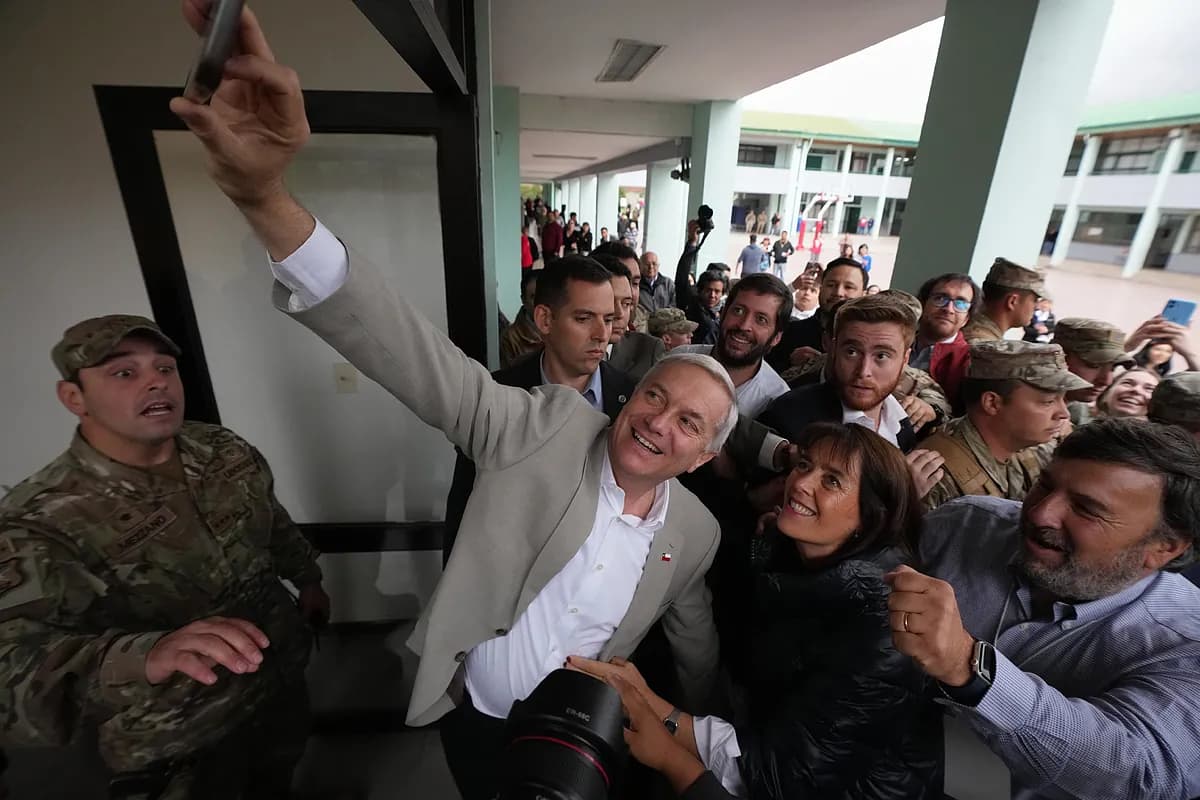
When, on October 18, 2019, a group of young people decided not to pay the metro fare because they considered the price increase excessive, Chile embarked on a journey that swept it down a turbulent river, nearly culminating in revolution. Six years and two months later, José Antonio Kast leads the vote count with 98.5% tallied. With 58.2%, he would defeat Jeannette Jara, who would obtain 41.8%. These results represent a very different Chile, a Chile that demands a"tough on crime" approach. The electoral service has already confirmed the victory of the hard-right leader.
What remains of"Plaza Dignidad," the epicenter of the protests whose images circled the globe? Little to nothing, only an urban renewal project that, paradoxically, will enable the passage of a third metro line there, a symbolic triumph of that metro of burning stations and carriages.
And where is Chilean politics headed? Barring a surprise of galactic proportions, it's headed towards José Antonio Kast, who, in his third attempt, will reach La Moneda Palace, according to all the polls, and by a resounding margin over his rival from the left-wing coalition, former Labor Minister Jeannette Jara.
If in 2021 the victory of Gabriel Boric installed in the La Moneda Palace the most left-leaning government since that of Salvador Allende in the 1970s, a Kast presidency would mean the most right-wing government since the return of democracy in 1990. This is a consequence of six years in which Chile was a kind of open-air political science laboratory, with two constitutional plebiscites in which two proposals were overwhelmingly rejected, one for being too far to the left and the other for leaning too far to the right.
"The Chilean case is very exceptional. Studies show that historically, constitutional plebiscites have been approved by an overwhelming majority. Chile broke that trend by rejecting proposals for a new constitution on two occasions. There is no other country in the world where that has happened," Sebastián Soto, professor of Constitutional Law and member of the second convention, explained to EL MUNDO.
Is there an explanation for the abrupt political shifts occurring in Latin America's fifth-largest economy? Soto offers one:"This could have many causes, but one likely one is that Chileans are getting used to rejecting everything rather than adhering to anything, which would explain the pendulum swings we've witnessed in Chilean politics in recent years."
The pendulum swing, everything indicates, leads in 2025 to Kast, who is running for the Presidency for the third time, and who, from being labeled as the candidate of the"ultra" or "extreme" right, has been moderating his image, especially thanks to two factors: the appearance on his right of the National Libertarian Party led by Johannes Kaiser, and the expansion of his support base, since after the first round, the traditional and moderate center-right announced its support.
Thus, Chilean politics is accelerating its reconfiguration, after three decades in which the alternation of power occurred between a traditional center-right and a moderate social democracy. Today, the positions are much stronger.
A paradigmatic case is that of former president Eduardo Frei Ruiz-Tagle (1994-2000), a leading figure of the Christian Democratic Party (DC), a party now threatened with extinction and founded by his father, also a former president, Eduardo Frei Montalva. Two weeks ago, when Frei Ruiz-Tagle received Kast at his home, Chilean politics experienced an earthquake.
"Although, as everyone knows, we come from different political positions and have had different stances on many issues, we find ourselves at a crucial moment in which the country requires unity," said the 84-year-old former president, who is now under investigation by a disciplinary tribunal and threatened with expulsion from the Christian Democratic Party, which officially supported Jara.
Frei Ruiz-Tagle had already warned weeks earlier that he would not follow that path:"With deep dismay I see what has happened in my party, which has made a decision that betrays the principles that formed it and renounces the spirit of Christian humanism for purely electoral purposes (...). This is a path that I do not share at all and that I will not follow." And, aware of what was coming, he left another message:"Let it be clear, I am not going to resign from my party, to which I have belonged all my life."
That grand agreement known as the "Concertación," which united socialists and Christian Democrats, among others, allowed the moderate center-left to govern Chile for 24 of the first 32 years of democracy, before Boric's arrival changed the landscape. Socialist Michelle Bachelet, who governed Chile for two terms (2006-2010 and 2014-2018), made it clear, without explicitly stating it, that she will vote for Jara, although her situation is particularly complex: Bachelet, who was the United Nations High Commissioner for Human Rights, aspires to be elected next year as UN Secretary-General, the first woman to hold that position. She needs the support of the new president."I have my principles, and I'm not going to change them," she affirmed when voting this Sunday, although she said she was willing to meet with Kast if the right-wing candidate reaches La Moneda (the presidential palace).