

Venezuela's skies have become another front in a war—one not yet formally declared by the United States. For the past week, what seemed like just another element of Washington's hybrid offensive against Caracas has transformed into a vast, silent battlefield isolating the country. Venezuelan airspace is now the scene of threats, warnings, canceled flights, and military maneuvers, fueling a standoff with an uncertain outcome between the two nations.
Around 1:00 p.m. local time on Sunday, air traffic trackers showed an unusual sight: only seven aircraft were crossing Venezuelan airspace: a handful of civilian planes, a few commercial flights still maintaining their routes, and one aircraft from the Bolivarian Air Force. On those maps saturated with tiny, colorful planes, Venezuela stands out like a huge black hole. For the first time in a long time, a sky once teeming with international connections appears these days as a forbidden territory. Donald Trump's message—who on Saturday arrogated to himself the right to declare a"total closure" of Venezuelan airspace—is clear: Caracas is left alone in the skies as well.
Washington's strategy is precisely aimed at this void: to transform air isolation into yet another instrument of political pressure. Fewer goods, less mobility, more uncertainty. Imposing an exclusion zone doesn't seem like a measure Trump could implement from the Oval Office, but it serves as a warning. For everyone. It encourages airlines to avoid the route, fuels the perception of risk, and reduces the symbolic pressure it has exerted on Nicolás Maduro's government.
This Sunday, Nicolás Maduro responded once again to the actions of the White House occupant. The Chavista leader sent a letter to the Organization of the Petroleum Exporting Countries (OPEC) and its member countries (OPEC+)—comprising more than 20 states—in which he accuses Washington of attempting to seize the country's"vast oil reserves" "through the use of lethal military force."
The United States has used airspace as a tool of coercion in other international crises—from flight restrictions over Iraq in the 1990s to air pressure over Libya and Syria during periods of heightened tension—but rarely in such a unilateral manner and so directly linked to a hemispheric dispute. “The Western Hemisphere is America’s neighborhood, and we will protect it,” said Pete Hegseth, Donald Trump’s Secretary of Defense, a few weeks ago when announcing the start of Operation Southern Spear, which targets drug trafficking but, above all, Venezuela.
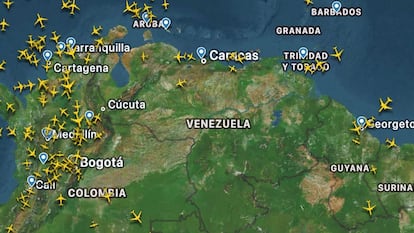
The US offensive, with an unprecedented military deployment in the Caribbean and months of bombings of alleged drug boats that have left more than 80 dead, keeps the Chavista regime on high alert. With constant shows of force. With messages of unity. And with warnings that they will defend themselves to the bitter end.
On Thursday, Nicolás Maduro's Defense Minister, Vladimir Padrino, posted a video on Instagram showing military aircraft maneuvers. The post, intended to commemorate Bolivarian Military Aviation Day, contained a forceful message from Padrino: “We are prepared to defend our homeland's skies. We are ready to respond to any aggression against the people of Venezuela, against its sovereignty, and against its territorial integrity. Bolivarian military aviation knows it must strike hard wherever it needs to strike. Strike and conquer!”
Trump's announcement on Saturday was described by the Chavista regime as a"hostile act" and an "explicit threat of the use of force." Meanwhile, the United States has continued its overflights near the Venezuelan coast. F-18 fighter jets were seen on Saturday near Falcón State in western Venezuela. The Bolivarian Armed Forces responded by deploying a new air defense system in the city of Lecherías, in eastern Venezuela.
The region is watching the turn the crisis has taken with concern. Latin American leaders fear an escalation, an armed conflict, and consequently, a new humanitarian crisis that would push hundreds of thousands of Venezuelans—once again—to their borders. From Mexico to Buenos Aires, governments are closely monitoring the conflict's trajectory, fearing and uncertain that at any moment—and under any circumstances—an already volatile situation could become even more tense.
“One shot is enough to start a war, but nobody knows how it will end,” warned Brazilian President Luiz Inácio Lula da Silva. At the same time, the possibility that nothing will happen, that things will be resolved—it's unclear how—through diplomatic channels, is not ruled out.
In Bogotá, President Gustavo Petro has become the leading critic of Trump's strategy to gain hegemony in the continent. The Colombian president publicly questioned the Republican's announcement on Sunday regarding the de facto closure of Venezuelan airspace. Petro called for the urgent intervention of the International Civil Aviation Organization and the European Union."If a foreign president can close the airspace of another country without any legal basis, then national sovereignty ceases to exist," he warned.
“The closure of Venezuelan airspace is completely illegal,” declared the Colombian president on his X account, his preferred platform for commenting on any issue. Colombia has reason to be concerned: it shares more than a thousand kilometers of border with Venezuela, and four million Venezuelans have emigrated to the country seeking refuge. Furthermore, Petro's relationship with Trump has reached unprecedented levels of hostility.

In just one week, the airspace has changed dramatically. The crisis in Venezuelan airspace dates back to November 21, when the U.S. Federal Aviation Administration (FAA) issued a warning about increased military operations in Venezuelan airspace. Since then, tensions between the two countries have escalated once again.
Colombian aviation authorities were the first to recommend that their airlines not fly to or from Caracas, although Bogotá remains the preferred route for evacuating stranded tourists. The Spanish State Aviation Safety Agency (AESA) joined the US warning, recommending the suspension of routes until at least Monday, December 1st. These alerts triggered a wave of cancellations by Air Europa, Plus Ultra, Iberia, Turkish Airlines, Avianca, LAN, Gol, and TAP.
Venezuela interpreted the airlines' precautions as support for"acts of state terrorism promoted by the United States government." In response, it revoked the licenses of all companies that suspended their flights. Thus, the air connectivity crisis that the country has faced for several years has entered a new and serious phase. Currently, Venezuela only has air connections with Bogotá, Panama City, and some of the Antilles.
Air travel restrictions are also disrupting daily life in the lead-up to the Christmas holidays. The suspension of international flights has left hundreds of passengers stranded both within and outside the country. At Madrid's Barajas Airport, dozens of Venezuelans have slept in the corridors, hoping to find a way to return home. Panama's Copa Airlines is the main carrier maintaining connections with Venezuela, but in response to Trump's message on Saturday, it has tightened its security protocols and is only operating daytime flights.
Russian tour operators, which run regular charter flights from Moscow to Margarita Island, have also suspended their schedules. “The resumption of the flight program to Venezuela is planned after the situation normalizes,” states a press release on the website of the Association of Tour Operators of Russia. Travelers who had purchased packages for December 1st have now been offered Varadero, Cuba, as an alternative destination. The organization notes that Russian tourists currently on the Venezuelan island will return to Moscow on their originally scheduled dates.
The air travel crisis has required more than rhetoric and symbolism from the Chavista regime. Vice President Delcy Rodríguez announced on Saturday that a “special plan” would be activated for the return of stranded Venezuelans and the departure of those who need to travel, but she did not provide details on how it would be implemented. The two weekly flights repatriating migrants from the United States have also been suspended. Rodríguez blamed opposition leader and Nobel Peace Prize laureate María Corina Machado for requesting the airspace blockade and accused Washington of “complying with her.”