
JERUSALEM/WASHINGTON - US President Donald Trump said he had “obliterated” Iran’s main nuclear sites in strikes overnight, joining an Israeli assault in a major new escalation of conflict in the Middle East as Tehran vowed to defend itself.
Mr Trump, in a televised address to the US people, called the strikes a “spectacular military success” and warned Tehran against retaliation, saying it would face more devastating attacks if it does not agree to peace.
Iran, which has responded to Israel’s sudden blitz on its nuclear and military apparatus since June 13 with missile fire on Israeli cities, called the US attack a grave violation of international law that would have “everlasting consequences”.
"Iran reserves all options to defend its sovereignty, interest, and people," wrote Foreign Minister Abbas Araqchi in a social media post, noting that the Israeli and US attacks on Iran came despite ongoing talks between Washington and Tehran.
The US strikes, with bunker-buster bombs and Tomahawk missiles, pushes the Middle East to the brink of a major new conflagration in a region already aflame for more than 20 months with wars in Gaza and Lebanon and a toppled dictator in Syria.
The Islamic Republic has been a sworn enemy of both Israel and the United States since its 1979 revolution, and the eruption of open warfare after decades of proxy shadow-fighting could have vast unforeseen consequences.
Israel has long said its aim was to destroy Iran’s nuclear programme.
But only the United States possesses the massive 30,000-pound bombs - and the huge batwing B2 bombers that drop them - designed to destroy targets like Iran’s most sensitive uranium enrichment plan at Fordow built beneath a mountain.
During the past nine days of war, Israel killed much of Iran’s military leadership and spoke of pressing on until it topples the Islamic Republic’s clerical rulers.
Mr Trump had veered between offering to end the war with diplomacy or to join it, at one point musing publicly about killing Iran’s supreme leader.
His decision to join the fight is ultimately the biggest foreign policy gamble of his career.
Still, he held out the prospect of averting a wider conflict if Iran accedes to demands.
Iran’s future held “either peace or tragedy” and “if peace does not come quickly we will go after those other targets,” he said.
CBS News reported that Washington had contacted Tehran to say it did not aim for regime change.
Speaking in Istanbul, Iran’s Mr Araqchi said Tehran was weighing its options for retaliation and would consider diplomacy only after carrying out its response.
“The US showed they have no respect for international law. They only understand the language of threat and force,” he said.
Israeli Prime Minister Benjamin Netanyahu congratulated Mr Trump on a “bold decision”.
Israeli opposition leader Yair Lapid also praised Mr Trump, saying the world was now a safer place.
Iranians contacted by Reuters described their fear at the prospect of an enlarged war involving the United States.
“Our future is dark. We have nowhere to go – it’s like living in a horror movie,” said Ms Bita, 36, a teacher from the central city of Kashan before the phone line was cut.
Iran’s elite Revolutionary Guards said they had fired 40 missiles at Israel overnight and, warning of more to come, added that they had not yet made the main part of their capabilities operational.
Air raid sirens sounded across most of the country, sending millions of people to safe rooms and bomb shelters as explosions rang out and missile interceptions were seen above Jerusalem and in other parts of the country.
Mr Aviad Chernovsky, 40, emerged from a bomb shelter to find his house had been destroyed in a direct hit.
“It’s not easy to live now in Israel (right now), but we are very strong. We know that we will win,” he said.
Satellite imagery
Satellite images of the mountainous area covering the subterranean Fordow uranium enrichment plant obtained by Reuters appear to show some damage after the US strikes, and possible damage to nearby entryways.
It was largely impossible to assess the extent of the damage inside Iran on the morning of June 22.
Communication both within Iran and with the outside world has been sharply curtailed in recent days, with internet access shut.
Iran says hundreds of people have been killed in Israeli bombing, most of them civilians.
Iranian state media, which broadcast vivid footage of damage to civilian targets in the first days of Israeli bombardment, have stopped showing regular images of damage.
Much of Tehran, a city of 10 million people, has emptied out, with residents fleeing into the countryside as Israel pounded the capital.
Gulf Arab states, which have in recent years tried to cool long-time rivalries with Iran and fear their crucial energy exports could be targeted in any expanded conflict, expressed concern at the escalation.
Mr Trump’s decision is the biggest foreign policy gamble of his two presidencies, and he was flanked during the announcement by Vice-President J.D. Vance, Defence Secretary Pete Hegseth and Secretary of State Marco Rubio.
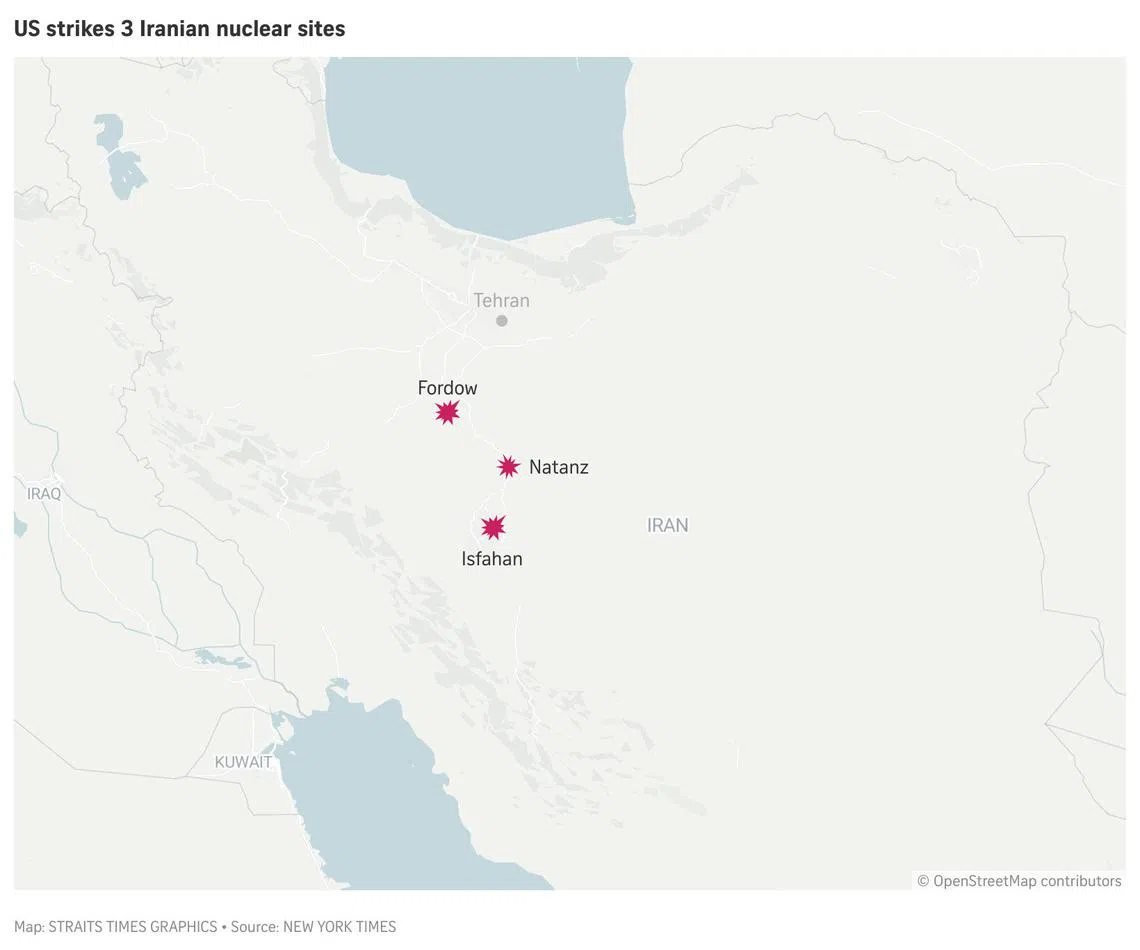
He said US bombing had taken out Iran’s three principal nuclear sites: Natanz, Isfahan and Fordow, which are involved in production or storage of enriched uranium, a material used as fuel for power plants but also to make atomic warheads.
The UN nuclear watchdog, the IAEA, said no increases in off-site radiation levels had been reported after the US strikes, and the agency’s head Rafael Grossi said he was calling an emergency meeting of its 35-nation board of governors for June 23.
A senior Iranian source told Reuters that most of the highly enriched uranium at Fordow had been moved elsewhere before the attack and the number of nuclear personnel there had been reduced to a minimum.
Mr Mohammad Manan Raisi, a lawmaker for Qom, near Fordow, told the semi-official Fars news agency the facility had not been seriously damaged, without elaborating.
Iran’s Atomic Energy Organisation said it would not allow development of its “national industry” to be stopped.
Iran says its nuclear programme is peaceful, and that it has a sovereign right to pursue it under the global nuclear Non-Proliferation Treaty (NPT).
Western countries have long accused Iran of pursuing a nuclear weapon, and the IAEA concluded in June that Iran had violated its treaty obligations.