
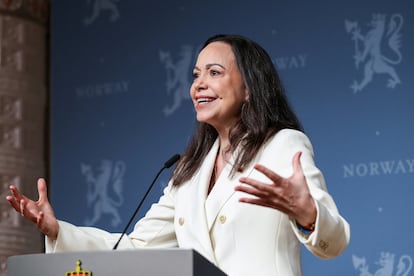
María Corina Machado has finally achieved it. After a journey of thousands of kilometers, an odyssey against all odds after living more than 16 months in hiding, the opposition leader crossed the threshold of the Rococo Ballroom at the Grand Hotel in Oslo, smiled before a sea of cameras and microphones, and stood before the world as the winner and star of this year's Nobel Peace Prize."This has been a recognition for each and every one of us, for 30 million Venezuelans," she declared at the very beginning of a press conference with a taste of revenge, convened this Thursday by the prize organizers, almost 24 hours after the award ceremony she was unable to attend."I've arrived a little late, but I'm here now," she said.
With the mystery surrounding her presence in the Scandinavian country now solved—her first trip outside Venezuela in 14 years—an endless list of questions still hangs over her present and future. Extremely cautious and visibly emotional, Machado carefully measured the extent of her responses. She was fully aware of what she could and could not say, what she wanted to communicate and what she preferred to omit.
Regarding the offensive launched by the United States against the Chavista regime, Machado expressed her support for President Donald Trump, but without going into detail about whether she would support a US invasion of the country. “President Trump’s actions have been decisive in reaching the point where we are now, in which the regime is weaker than ever,” she asserted, after confirming that she received assistance from Washington to leave Venezuelan territory. She also thanked “the men and women who risked their lives” to make it happen.
Machado has, however, left the rest of the details that have leaked in recent hours about her unusual escape up in the air, such as her departure by speedboat to the island of Curaçao, her arrival in Miami on a private jet, or the flight that helped her cross the Atlantic to reach Oslo. She has confirmed her intention to return to her country and continue the confrontation she has waged for more than two decades against the government of Nicolás Maduro. “My return to Venezuela will be when the conditions are right for my safety, and it doesn't depend on the regime's continuity,” she asserted. “I don't think they knew where I was. That's why they couldn't arrest me,” she added, aware that her mere presence in the Norwegian capital poses a challenge to Chavismo.
The next steps for Machado and the Venezuelan opposition are uncertain, at least for now and publicly. Machado has not decided how long she will remain in Norway. She has not revealed with whom she will meet to continue garnering international support for her cause, nor what her first actions would be if she were to lead the Venezuelan government. She has not disclosed any details about the contacts she has established with the White House or whether she will seek a meeting with Trump. She has also not spoken openly about the possibility of a US intervention against the Maduro government, after nearly four months of an unprecedented military deployment in the Caribbean.
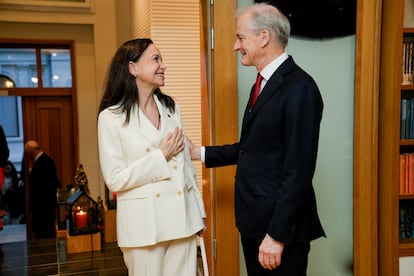
“We’re taking it one day at a time, and as I’ve said, I’m not going to speculate on the strategies of foreign governments to guarantee their national security,” Machado concluded, after being questioned on the matter a couple of times by journalists present in the room. “Venezuela is already invaded by Russian agents, Hezbollah, and criminal gangs,” she declared in a previous appearance alongside Norwegian Prime Minister Jonas Gahr Štor, who reaffirmed his support for her efforts to promote democracy in Venezuela.
“In Venezuela, we have an authoritarian regime that is waging war against its citizens,” stated Norwegian Prime Minister Jonas Gahr Štor. “This year’s Nobel Prize has enormous significance,” Štor added, emphasizing the role of democracies as a determining factor in achieving peace, not only in the Caribbean nation, but also in a global context where democratic regimes have become increasingly threatened.
Echoing the arguments the United States has used to justify its military pressure off the Venezuelan coast, the opposition leader asserted that “Venezuela has become the criminal center” of the Americas and that the Maduro government’s ties to drug trafficking “are what sustains the regime and its powerful system of repression.” “We’re going to go all the way,” she commented when asked about the timeline for political change in her country. “One day at a time, first things first,” she insisted, switching between Spanish and English, when asked if she was interested in running for president of Venezuela.
Machado has also avoided commenting on those who have criticized her selection as this year's Nobel Peace Prize laureate."I respect all points of view; the Venezuelan context is very complex," she remarked, while also defending her decision to stand up to Chavismo."Many times it would have been easier and more politically correct to remain silent, but we have raised our voices," she stated.
Like the Nobel organizers, the Venezuelan opposition leader has sought to transcend ideological divisions, asserting that her coalition of international support includes “parties and governments across the entire ideological spectrum.” “Ultimately, it is understood that our struggle transcends these differences, which are ultimately necessary in a democracy.”
The leader appeared flanked at the Nobel press conference by the president of the Norwegian Nobel Committee, Jorgen Watne Frydnes, whose speech during the award ceremony caused a widespread international stir due to the tone and starkness with which he described the Venezuelan political context and demanded that Maduro step down and relinquish power. “We are here to defend democracy,” Frydnes emphasized, adding that he was grateful that “threats and fear” had not prevented Machado from arriving in Norway. “Venezuela has entered one of its most repressive periods in years,” he commented.
After several days of uncertainty and amid enormous anticipation, the arrival of the Venezuelan opposition leader has shaken the Norwegian capital. It has paralyzed the city center streets, profoundly impacted the political and media agenda, and generated unprecedented excitement.
Amid countless interpretations of what her first public appearance in over a year implies, the leader has dismissed the idea that her departure from the country will weaken the opposition forces:"Quite the contrary, Venezuelans inside and outside Venezuela are very happy that I can be here."
“I couldn’t sleep last night,” the opposition leader admitted, describing the emotional rollercoaster she experienced in the last few hours. “I kept going back to the screen to see my children. I hugged all three of them at once; it was one of the most extraordinary, spiritual moments of my life,” she added.
Exultant during a marathon of official events that began early in the morning, and hailed by her supporters as a symbol of dissent against Chavismo, the real Machado could not hide the enormous personal toll that the political struggle to which she has dedicated the last few years of her life has taken. The leader cleared her schedule in the afternoon and prioritized spending time with her family and taking some time to recharge.
“Someday I’ll have the chance to tell the story,” she said of the saga that brought her to Oslo. “It’s been quite an experience,” Machado added, aware that the most important recognition of her political career has spurred on those who see her as the force for change in their country to continue the fight. “I have hope that Venezuela will be free again.”