

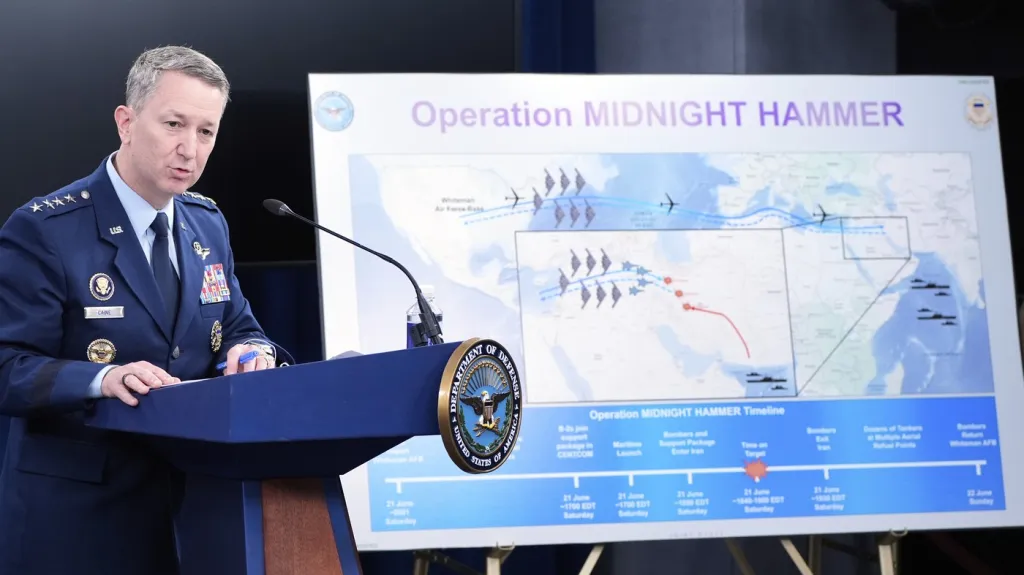
The US Chairman of the Joint Chiefs of Staff, Dan Caine, described the course of the US strikes on Iranian nuclear facilities as part of Operation Midnight Hammer. It involved more than 125 aircraft and the use of several B-2 bombers deployed over the Pacific as “decoys.” Other B-2s dropped more than a dozen massive bombs on Iran’s Fordo and Natanz facilities, while Tomahawk missiles were fired at a facility in Isfahan. The operation took months to prepare and, according to Caine, was known only to a small circle of people.
“The operation began Friday night into Saturday morning,” Caine said at a Pentagon press conference. As the B-2 bombers took off from the U.S., some headed west as decoys, while the rest “continued quietly east with minimal communication throughout the 18-hour flight.”
As soon as the bombers arrived in Iranian airspace, according to Caine, at around 11:00 p.m. CEST on Saturday, a U.S. submarine fired more than twenty Tomahawk cruise missiles at the nuclear facility in Isfahan.
Later, the lead B-2 bomber dropped massive “bunker-busting” bombs on the Fordo nuclear base, and the remaining bombers then hit their targets. “It was the first operational deployment of the bomb called the GBU-57 MOP,” Caine added. The bomb itself is over six meters long and weighs more than 13.5 tons. It is nicknamed the bunker buster. Directional flaps correct the direction of impact. And a laser sensor is also key, this component ensures precise guidance.
B-2 aircraft dropped bombs at an altitude of twelve kilometers. During the flight, they receive a signal from satellites that guides them to a specific target. When they hit, they fly at the speed of sound, over 1,235 kilometers per hour. Thanks to this speed and energy, the bomb literally drills into rock or reinforced concrete. It can penetrate up to sixty meters deep, and into hard rock it can be slightly less, around forty meters.
Source: CT24
Damage assessment
The final assessment of the damage in Iran will take some time, according to the general."The initial damage assessment indicates that all three sites have suffered extremely severe damage," Caine also said.
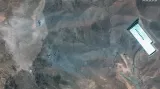
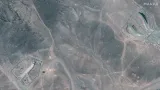
All three Iranian nuclear facilities – in Natanz, Isfahan and Fordow – were hit between 00:40 and 01:05 (CEST), according to the chief. Iran's air defense system apparently did not detect the American forces, according to Caine, and the bombers were not targeted as they departed Iranian airspace.
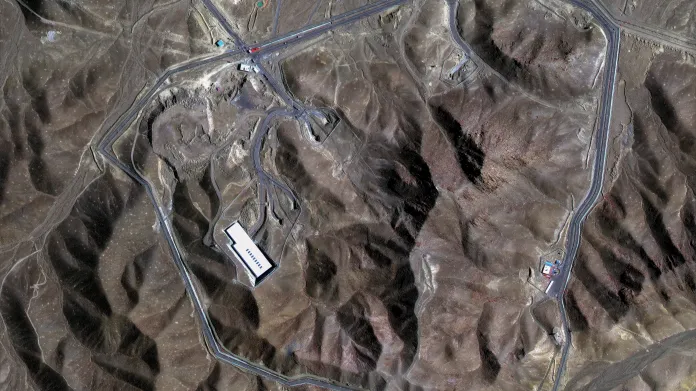
+ 2 more
"This was the longest B-2 mission since 9/11," Caine said, adding that it was an extremely complex and secretive operation. The deception maneuver over the Pacific was known only to a narrow circle of planners in Washington and at the command in Tampa, Florida.
The B-2 bomber is the most expensive military aircraft of all time
The American B-2 Spirit bomber is probably the most expensive military aircraft ever to enter service, with each of the twenty-one examples costing more than two billion dollars. The “invisible” aircraft, whose prototype first flew on July 17, 1989, somewhat paid for the end of the Cold War. According to the original plans, 130 aircraft were to be built, but in the end the Pentagon ordered less than a sixth, including enormous development costs.
The whole machine resembles a large, strong wing, from which the cabin and a pair of gondolas with jet engines protrude at the top. The flying wing did not find much use in history - towards the end of World War II, several prototypes of the Horten Ho 229 fighter-bomber, one of Hitler's"miracle weapons", were completed, at the same time Northrop was also working on a long-range bomber project in the form of a flying wing. However, nothing came of the propeller-driven YB-35 or the later YB-49.
The aircraft can carry, among other things, two GBU-57A/B MOP guided bombs. The most powerful conventional bomb in the US arsenal weighs a total of 13,600 kilograms and, thanks to its design, is capable of penetrating several tens of meters of material before exploding. The US Air Force said that up to sixty meters, and in the case of reinforced concrete, according to the BBC, it is up to eighteen meters. The bomb then contains almost 2.5 tons of explosives.