“He can go the easy way, the hard way or somewhere in between, or end up dead. But the clear goal is that Maduro leaves,” says an opposition source close to the administration in Washington. “The only way to change his mentality or calculations is to make him think he’ll be killed, and that being a prisoner is an honor.”
In essence, this is what both Team Trump and Team Machado (i.e. Comando Con Venezuela) wants the public to believe about Maduro’s options. Every tweet by Pete Hegseth and his Department of War, every Trump quote about stopping the existential threat of drugs, every statement by Caroline Leavitt hinting at the use of all military tools available are meant to make us believe that Trump may order a strike on Venezuelan soil, or even order Maduro’s decapitation. Tiranicidio that is, which sounds like the stuff of dreams.
Trump’s foreign-policy team also appears fully unified and loyal to his narrative about Venezuela and the boundaries established. There are no dissenters leaking contradiction to the press that are fairly normal in government. From traditional GOP figures like Marco Rubio and Susie Wiles to MAGA politicians like JD Vance, the messaging on Venezuela has been remarkably disciplined since the military deployment began.
No one can deny how far the Americans have gone in the last 22 weeks, hitting almost every button designed to frighten Maduro and his associates. Indirect violence that has killed dozens of alleged traffickers near Venezuelan territory, perhaps even breaching international rules of engagement. Warships docked in Trinidad and Tobago, with others roaming the Caribbean Sea. US fighters stationed in Puerto Rico. Expanded military access to Dominican airports. An operation led by a general personally trusted by Trump, the same officer who oversaw strikes on Iranian nuclear facilities earlier this year.
In public, Trump’s Venezuela policy doesn’t seem like a struggle for Venezuelan rights, not for Machado’s aspirations, not for Edmundo González’s mandate as president-elect
There is also the airline crisis triggered by US pressure, which forced eight major carriers to suspend routes to Venezuela. Today there are zero flights to Europe, unless your family wants to spend Christmas in Moscow. Otherwise, Venezuelans can only fly to Bogotá, Lima, Panamá, Curaçao or Bolivia. Add to that the Cartel de los Soles FTO designation and a CIA “covert ops” authorization with unknown implications.
It’s a textbook case of psychological warfare. To a great extent, Trump has created a wartime environment.
From Guaidomania to awkward acknowledgment
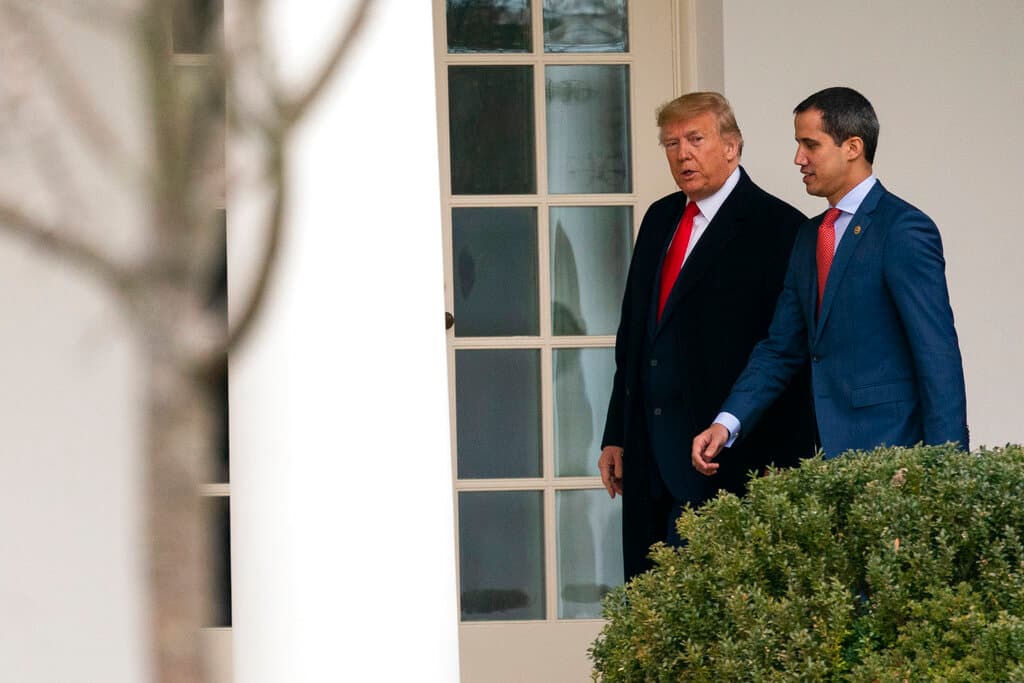
This is a major contrast with 2019, when an inexperienced Trump decided to embrace the figure of Parliament Speaker Juan Guaidó, a relatively unknown politician even in Venezuela, and grew excited at the global chain reaction they generated together. Guaidó swore in as interim president on January 23rd of that year, after Maduro started an illegitimate term on January 10th, precisely because Guaidó had Trump’s explicit backing. Washington became the first government to recognize him, triggering an extraordinary wave of Western support. PDVSA sanctions were designed to strangle Maduro financially. USAID coordinated the border humanitarian-aid stunt. Washington dismantled the chavista embassy, handed over diplomatic posts to the opposition, and enabled the creation of a government-in-exile.
The POTUS-opposition relationship is quite different now. Guaidó was able to appear in public. Leopoldo López and his allies could plan events like the Cúcuta operation or street demonstrations. Even the failed military rebellion of April 30th, which freed López from house arrest before he was forced to request asylum at the Spanish embassy, was the product of months-long negotiations between opposition leaders and chavista actors.
In the end, it turned out that Maduro could withstand international sanctions and unprecedented diplomatic isolation. He could live as a pariah. He survived, with Trump reportedly admitting he even admired his resilience.
Trump surely remembers quite well how he empowered Guaidó and treated him like a sovereign head of state, only to see him become a superfluous proxy, the embodiment of the Free World’s inability to get rid of Súper Bigote.
Now, the Machado-led opposition has little agency in practical terms. If it were up to Team Machado, missiles would have hit Venezuela two or three months ago. But their responsibilities are limited to lobbying in Washington (where the guacamayas keep a much lower profile than their interinato predecessors), gathering intelligence, protecting ranks at home and struggling to raise the spirits of millions through social media.
Trump, who had Guaidó the White House and in Congress during the State of the Union speech, has now insulated himself from the moral burden of promoting democracy in Venezuela. Maybe this is not surprising from a man accused of undermining his country’s democracy. Everything he is doing about Venezuela today has been framed asan anti-narcotics policy in pursuit of US national interests. This doesn’t appear to be a fight for Venezuelan rights, not for Machado’s aspirations, not for Edmundo González’s mandate as president-elect—a figure with a way more solid claim to power than Guaidó then, and someone Trump has not even met.
Unlike in 2019, Trump has kept noticeable public distance from opposition representatives. In public, Trump has acknowledged María Corina as that “very nice” Nobel Prize winner who told him he deserved the award. Before that, Trump only named Machado when she was briefly kidnapped by Maduro agents on January 9, compelling the regime to release her. I’m sure he remembers quite well how he empowered Guaidó and treated him like a sovereign head of state, only to see him become a superfluous proxy, the embodiment of the Free World’s inability to get rid of Súper Bigote. Of course, Machado’s political capital is much more robust than Guaidó’s ever was, but Trump’s distance intends to disown any potential failures from the current opposition leadership.
El Catire and a big call to make
For the time being, a climate of conflict quite different to the one in 2019 will persist. Maria Corina supporters no longer encounter tankie activists explaining the economic inequality of the Cuarta República or the CIA’s efforts to oust Maduro. Liberal scholars and think tank experts are now the main critics of the dominant opposition strategy. Western newspapers will keep telling you about Iraq, Afghanistan and the disastrous consequences of US regime change. A group of opposition pundits and social media activists will jump at every opportunity to attack any anti-war trope and seek to undermine María Corina critics. The opinion of ordinary Venezuelans, living under unbearable economic pressures and unable to discuss politics in public, will not reach international headlines.
In any event, Democrats will keep scrutinizing the methods of the anti-drug deployment, and Trump allies will try to punish them if the Venezuela ploy works out ok. The era of international consensus and Venezuela bipartisanship is over. Neither Machado wants to hold Chuck Schumer’s hand like Guaidó once did with Pelosi. Nor is Trump interested in reaching a middle ground with Lula and Petro. We can’t pinpoint the winners and losers yet, only who the friends and enemies are.
In Wednesday’s cabinet press conference, Trump threatened to bomb Colombia, which was the foremost South American ally of the US this century (who knows, that may even boost the Colombian Left’s prospects of re-election vis-à-vis a divided Right). Juan Orlando Hernandez, a convicted drug trafficker and former president of Honduras, is now a free man after the president pardoned him. It’s quite clear Trump couldn’t care less about democracy and the rule of law in Latin America, and his actions are meant to polarize and radicalize the region.
If POTUS doesn’t force him out and Maduro calls the bluff, the Venezuelan dictator will present himself as the man who twice outfoxed Donald Trump.
All this said, María Corina’s bet on Trump may be the right one, given the desperate circumstances engulfing the nation and the impossibility of productive negotiations with Maduro and Diosdado. They prefer to die con las botas puestas than facing the risky exile of seasoned killers like Ante Pavelic and Anastasio Somoza, or to age haunted by prosecutors like Pinochet and Fujimori once were.
But, what is the president actually looking at right now?
All signs indicate that Trump has been favoring a “soft” removal of Nicolás Maduro, which explains why he recently entertained the dictator’s demands for stepping aside. Trump reportedly found those conditions unacceptable—a Delcy-led transition, full amnesty and sanctions relief for over a hundred associates, and the dismissal of the ICC investigation into crimes against humanity since 2014, among others. The result: Maduro is effectively challenging Trump to go hasta el final. To “finish the job.”
If POTUS doesn’t force him out and Maduro calls the bluff, the Venezuelan dictator will present himself as the man who outfoxed Donald Trump—twice, actually. Trump can always claim he prioritized other foreign-policy matters, like the Ukraine–Russia peace framework being pingponged right now. Maduro could finish his term, maybe even plan an orderly succession, while Maria Corina’s role and personal safety become increasingly precarious. In the US, Trump’s rivals will accuse him of using state violence and military theatrics for political gain, feeding the TACO theory of constant and short-lived impulsive adventurism. TACO meaning, here, “Trump Always Chickens Out.”
Four months have passed since the naval deployment began. Trump has been mentioning that land strikes will come for several weeks. This stage of all-bark-no-bite suggests that Trump would clearly prefer the benefits of a soft removal—including Machado’s promise of preferential access to investment opportunities—but is reluctant to own the consequences of a hard removal, with consequences that the US can’t exactly predict or control.