
The Belarusian regime released 123 political prisoners on Saturday after the United States lifted sanctions on Belarusian potash exports, in an attempt by Minsk to improve its relations with Washington.
Among those released are protest leader Maria Kolesnikova and Nobel Peace Prize winner Ales Bialiatski.
Since the 2020 elections, which human rights organizations denounced as fraudulent and which sparked mass protests across the country, dictator Alexander Lukashenko has imprisoned thousands of critics, opposition members, and protesters. “The head of state decided to pardon 123 citizens from various countries,” the state news agency Belta reported.
“Ales Bialiatski is free!” the human rights group Viasna announced, adding that after 1,613 days in prison, Bialiatski will be deported to Lithuania. “I spoke with him, he is traveling to Lithuania and is doing well,” his wife, Natalia Pinchuk, told AFP.
Bialiatsky, a long-time opponent of Lukashenko and human rights advocate, received the Nobel Peace Prize in 2022. His release, along with that of Kolesnikova, represents a significant political gesture amid international pressure on the Belarusian regime, a key ally of Vladimir Putin's Russia, which has faced isolation and Western sanctions in recent years.

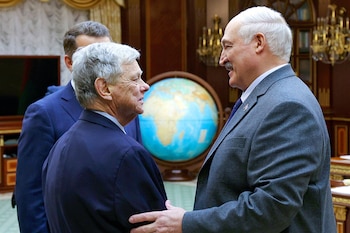
This Saturday morning, the United States announced the lifting of sanctions on Belarusian potash, in the latest sign of a thaw between Washington and the isolated European autocracy. John Coale, Trump's special envoy for Belarus, made the announcement after meeting with Lukashenko in Minsk on Friday and Saturday.
Speaking to the press, Coale described the two days of talks as “very productive.” He also stated that normalizing relations between Washington and Minsk was “our goal.” “We are lifting sanctions and releasing prisoners. We are maintaining a constant dialogue,” he declared, according to the Belta news agency. He also maintained that the relationship between the two countries was progressing from “small steps to more decisive steps” as they intensified their dialogue.
The last time US officials met with Lukashenko in September 2025, Washington announced the easing of some sanctions against the Belarusian regime, while Minsk released more than 50 political prisoners. In total, Belarus has released more than 430 political prisoners since July 2024, in what was widely seen as an effort to reach out to the West.
From exile, Belarusian opposition leader Svetlana Tikhanovskaya told The Associated Press on Saturday that the sanctions relief was part of an agreement between Minsk and Washington, which was expected to include the release of another large group of political prisoners in Belarus.

“The release of political prisoners means that Lukashenko understands the suffering caused by Western sanctions and is seeking to ease them,” Tikhanovskaya declared. She added, “But let’s not be naive: Lukashenko has not changed his policies, his repression continues, and he continues to support Russia’s war against Ukraine. That is why we must be extremely cautious with any talk of easing sanctions, so as not to strengthen the Russian war machine or encourage continued repression.”
The opposition leader also described the European Union's (EU) sanctions on Belarusian potash fertilizers as far more painful for Minsk than those imposed by the United States. She added that while easing US sanctions could lead to the release of political prisoners, European sanctions should drive long-term systemic changes in Belarus and an end to Russia's war in Ukraine.
According to Belta, the latest round of talks also addressed the crisis in Venezuela, as well as the ongoing Russian invasion of Ukraine.
Coale told reporters that Lukashenko had given “good advice” on how to address the conflict, stating that the Belarusian dictator and Putin were “lifelong friends” and had the “necessary relationship to address these issues.” “As relations between the two countries normalize, more sanctions will be lifted,” the US official added, expressing his confidence that the time would come when there would be no restrictions on the Belarusian dictatorship.
Belarus, along with Russia and Canada, is one of the largest exporters of potassium fertilizers, one of the main targets of the sanctions introduced by the United States and the European Union in recent years.
“We have talked about the war between Ukraine and Russia, and about Venezuela (...) We have talked about the future, about how to move forward with the rapprochement between the US and Belarus, to normalize relations. That is our goal,” the US envoy acknowledged.
He added that to achieve this, it is necessary to move from “childish steps” to “safer steps”: “We lift sanctions and release prisoners.”

Last September, the US lifted sanctions against the Belarusian state airline, Belavia, which had been sanctioned by Washington a year after the European Union did so in 2021 for the forced landing of a Ryanair plane covering the Athens-Vilnius route and carrying Belarusian opposition journalist Roman Protasevich, who was immediately detained.
Normalization between the two countries began in August when Lukashenko spoke by phone with the US president, who later wrote on his social network Truth Social that he asked his Belarusian counterpart to release 1,300 more prisoners after the release of a group of dissidents last June, including opposition leader Sergei Tikhanovsky.
“They say that (US President Donald) Trump likes flattery. I don’t mean to flatter, but I want to say that I really like his behavior lately,” Lukashenko told Cole at their meeting on Friday.
In November, the Belarusian dictator pardoned 31 prisoners as part of agreements reached with the United States.
Belarus, a country presided over by Lukashenko since 1994, has been subject to sanctions since the violent repression of the massive opposition protests against the electoral fraud of 2020, measures that multiplied with Minsk's open support for the Russian military campaign in Ukraine two years later.