
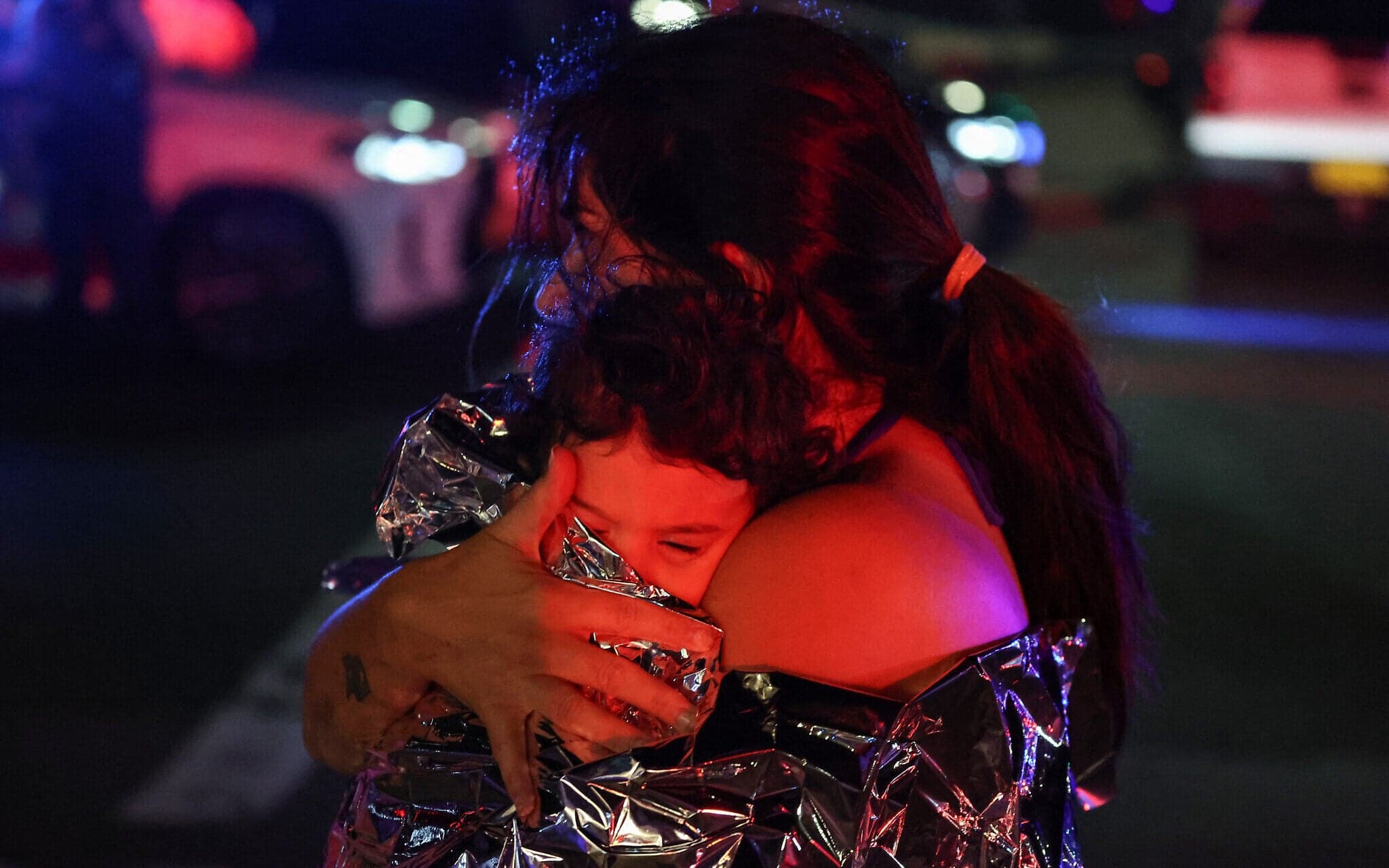
For many Australians, Sunday’s terror attack at a Hanukkah party at Bondi Beach near Sydney felt all but inevitable following years of escalating antisemitic violence and rhetoric.
According to authorities, at least 11 people were killed, as well as one of the two gunmen who opened fire at a family Hanukkah event attended by some 2,000 Jews from the Sydney area. At least 13 were critically injured, including two police officers.
“I’m horrified and devastated that this happened, but not shocked,” Lynda Ben-Menashe, president of the National Council of Jewish Women Australia, told The Times of Israel. “Over the past two years, antisemitism has been rising by the month, and the government has not listened to our pleas. When there is no visible consequence to incitement, violence always ensues.”
Since Hamas attacked Israel on October 7, 2023, sparking the Gaza war and setting off a tidal wave of antisemitism across the globe, Australia’s 120,000-strong Jewish community has been among the hardest hit.
Over the past year, Jews in Australia have seen synagogues, schools and homes firebombed, two nurses threatening to kill Jewish patients in their hospital, and the discovery of a trailer filled with explosives said to have been intended to cause a mass-casualty event at a Sydney synagogue.
“I’m trying to process what impact this is going to have on the Jewish community of Australia,” said Jeremy Leibler, president of the Zionist Federation of Australia. “This may be the worst attack on Jews anywhere in the world since October 7, and it’s the second-worst mass shooting in Australian history. I don’t know what happens now.”
Victims of the attack included several leaders of the country’s Jewish community. Rabbi Eli Schlanger, a Chabad emissary in Sydney, was killed, according to a statement from the Chabad movement.

Among those wounded in the shooting were Arsen Ostrovsky, a human rights lawyer and head of the Australia/Israel & Jewish Affairs Council (AIJAC) branch in Sydney, and Evan Zlatkis, director of media at the Executive Council of Australian Jewry.
“This is what the current government has allowed to come into our country and go unchecked,” Tali Shine, an Australian newscaster, told The Times of Israel following the attack. “When nothing was done about the radicalized protests outside the Opera House [shortly after October 7], it set the tone [for continued attacks on the Jewish community].”
Escalating antisemitism
Two weeks ago, the Executive Council of Australian Jewry (ECAJ) said the country had seen 1,654 antisemitic incidents during the 12-month period from October 1, 2024, to September 30, 2025 — about five times the annual average recorded in the decade prior to the October 7, 2023, Hamas attack.
The previous year, the first after the October 7 attack, saw an even higher 2,062 incidents, ECAJ noted. Australians now feel that antisemitism has become mainstreamed throughout all aspects of national life, the group said.
“We are now at a stage where anti-Jewish racism has left the fringes of society and become… normalized and allowed to fester and spread, gaining ground at universities, in arts and culture spaces, in the health sector, in the workplace and elsewhere,” the report said.

A survey published several months ago by the National Council of Jewish Women Australia found that more than half of Australian Jewish women feel unsafe, and that two-fifths actively hide their Jewish identities.
About 10 percent of women said they were considering leaving Australia, a number that “is probably jumping even higher today,” Ben-Menashe, of the National Council of Jewish Women Australia, said.
After the community saw a record number of attacks in 2023-2024, an arson attack in December on Melbourne’s Adass Israel Synagogue was seen by many as a turning point, and Jews have been frustrated by what they say has been the government’s failure to rein in attacks and violent rhetoric.
In August, Australian Prime Minister Anthony Albanese revealed that Iran was suspected of being behind a pair of 2024 antisemitic arson attacks, calling the actions “dangerous acts of aggression” designed to undermine his country’s social cohesion.
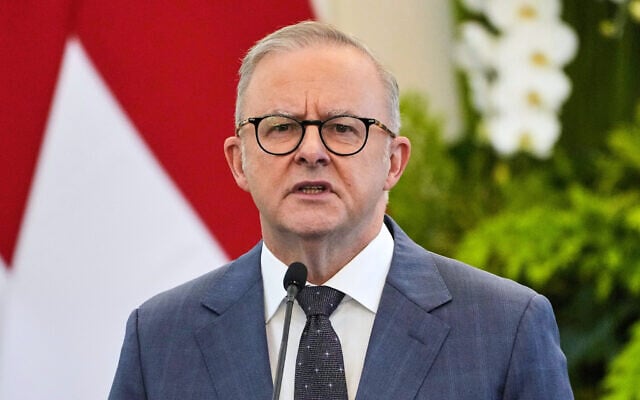
The country’s decision in August to recognize a Palestinian state at the United Nations General Assembly further aggravated the growing sense of alienation among the country’s Jewish community and sparked a sharp war of words between Albanese’s government and Israeli officials.
Following Sunday’s attack, the Australia/Israel & Jewish Affairs Council said it was “horrified” by the shooting, noting that the organization had warned of the potential for violence.
“This is not just a terrible day for the Jewish community, for Bondi, and for Sydney but for all of Australia, and for the values we hold dear, that are the bedrock of what for so long has been our inclusive, harmonious society,” AIJAC executive director Colin Rubenstein said in a statement. “We are horrified by what has unfolded. Our immediate thoughts are with those killed and injured and their families, and with all those who witnessed this horrendous crime.”

AIJAC has warned for years that “the unceasing antisemitic vitriol on our streets would evolve into antisemitic violence if left unchecked,” he said. “We have warned that verbal abuse becomes graffiti, becomes arson, becomes physical violence, becomes murder.
“This is the outcome of the calls we have heard far too often at marches through our cities to globalize the intifada and that all Zionists are terrorists,” Rubenstein added. “Our governments and authorities must act to end this hateful incitement.”
Others said the attack showed that no one in Australia is safe from antisemitic violence.
“We’ve seen a constant barrage of hate coming from the right, the left, and the Islamists, and it was just a matter of time before something like this happened,” Ben-Menashe said. “The fact that this happened at Australia’s most iconic location shows that no Australian is safe.”