
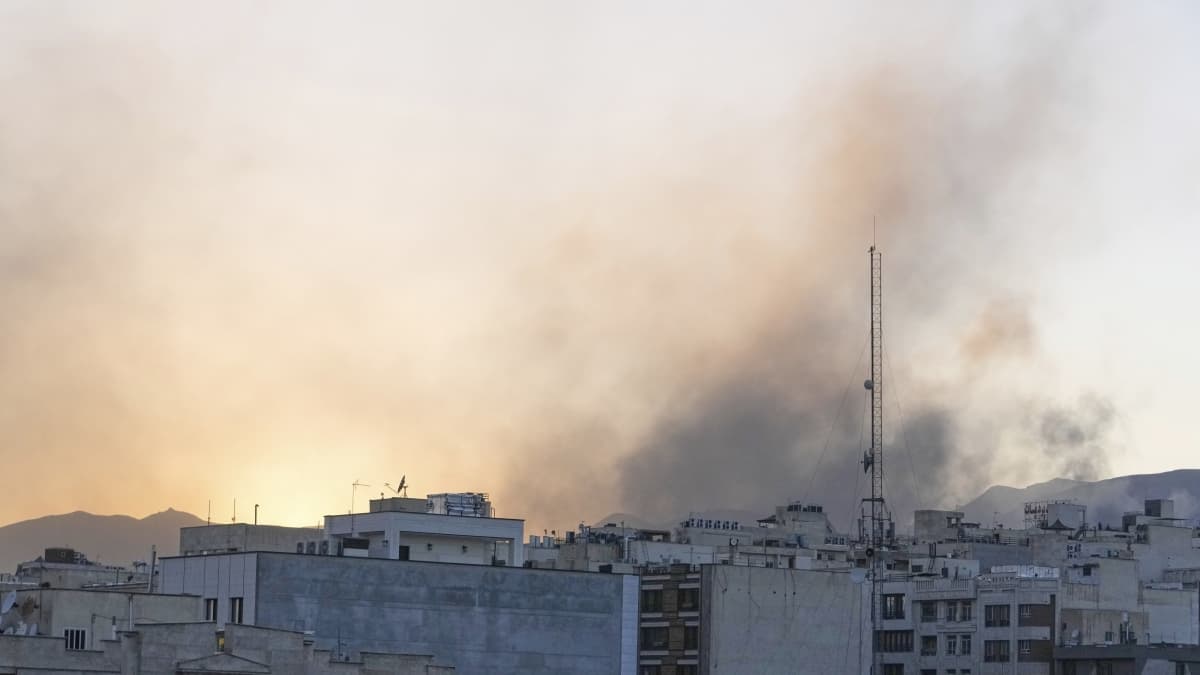
The current situation, so far
(Gianluca Mercuri) I may do it, I may not do it.
Donald Trump flips through the daisy of war : I could attack Iran, but I also might not. Iran is begging me to return to negotiations, but now it has only one option: unconditional surrender.
The biographers of the 45th and 47th presidents of the United States will have a titanic task, but they will certainly dedicate years of studies and rivers of words to these days of June, in which the most anomalous leader in American history seems on the verge of being dragged by Israel into a conflict that is the opposite of what he has been saying for years : no more wars for others, no more regime changes that only bring chaos, America First and let the others sort it out, including allies.
Instead Benjamin Netanyahu seems on the verge of completing his apparent strategic masterpiece, because without Trump's bombers, the Israeli prime minister cannot wage war win, if victory is, at the very least, the elimination of Iran's nuclear program.
So Trump will give the order to attack? In these dramatically uncertain hours, the opinion of the best geopolitical scientist in the world has weight. And Ian Bremmer needs only a few words to explain what will happen:
Donald Trump may be about to cross a line he drew less than a week ago. Barring an Iranian capitulation on nuclear enrichment that no one foresees, it is likely that the president will order US bombers to strike at any moment Iran's most resistant underground facility at Fordow, thus joining Israel's war against the Islamic Republic. The move will not overthrow the Iranian regime. However, it will involve Washington in a conflict that Trump hoped – and promised – to watch from afar.
The American ultimatum, the Iranian response, the Israeli satisfaction: point by point.
- The President's Dilemma I could bomb Iran, I could not bomb it, no one knows what move I will decide. Then, turning to the Ayatollahs: Why didn't you negotiate with me before all this death and destruction?. And again: The regime in Tehran can fall. I haven't decided on the attack yet. To Netanyahu: Good, keep going like this. But what is behind Trump's constant forays?
- A sudden change of direction Immediately after the start of the Israeli attack, on June 13, Trump said that the US would intervene only if Iran had hit their interests, by attacking American bases or blocking the Strait of Hormuz, a strategic chokepoint through which a quarter of the world's oil passes. He then reiterated his role as peacemaker, urging the Iranians to return to negotiations as in the previous two months, when the US request to the Tehran regime had been the total renunciation of uranium enrichment. But Trump's position suddenly changed. The turning point came on Sunday: It is possible that we could get involved. On Monday, the Trump-style warning to the inhabitants of Tehran, 10 million people : Evacuate immediately . On Tuesday, after the rumor spread that he had prevented the assassination of the Iranian Supreme Leader Ali Khamenei , he threatened him personally: We know where he is hiding, but at least for the moment we do not want to eliminate (kill) him!. Finally, the demand for unconditional surrender .
- But what made Trump change his mind? Most likely, the unthinkable collapse of Iranian defenses, which melted away in a matter of days. The Israelis have destroyed most of the missile launch bases, drone factories and surface nuclear facilities, in addition to decimating the Iranian military leadership. On Monday they announced that they control Iranian skies, meaning they can bomb Tehran at will without risking having their planes shot down. Iran responded with a heavy missile launch, of which only 5% got past the Israeli shield, causing 24 victims, against hundreds suffered. The launches are becoming less intense as supplies are depleted. With each passing day, the situation becomes more favorable to the Israelis.
- And then there is history This is Trump's great temptation: to be remembered as the man who definitively crushed the Iranian nuclear threat . Because this is the only thing that Netanyahu cannot do alone, not having planes and bombs capable of destroying the Fordow plant , built inside a mountain. The idea of succeeding where neither Bush, nor Obama, nor Biden have succeeded tickles Trump's ego. To the point of perhaps inducing him to violate his own isolationist commandments.
- The division in the Maga world Or Make America Great Again, the Trumpian movement that has been united so far but with different visions in foreign policy: in the Republican Party the neocon doctrine resurfaces, the one that led to the disaster of the war in Iraq, ultra-pro-Israeli and in favor of regime change despite the failures of recent years ( Iraq, Afghanistan, Libya ). On the other hand, the pure and hard Maga like Steve Bannon and the anchorman Tucker Carlson, against any war and lukewarm if not distrustful towards Israel. In the middle is Vice President JD Vance, a convinced isolationist but now, writes Viviana Mazza, ready to act as a bridge builder: He does it also because his presidential ambitions after Trump depend on it: he has to hold together a disparate coalition - billionaires, technology oligarchs, workers, nationalist populists, former Democrats - united for now by Trump's charisma, but which risks splitting. (On the divisions among Trump supporters, you can also find an extensive report by Luca Angelini in our Rassegna).
- Ayatollah Khamenei launches proclamations of resistance to the bitter end : We will never surrender, the Zionist regime must be punished, American aid is a sign of weakness. If the Americans intervene, the consequences will be irreparable. But all scenarios now see the Supreme Leader's exit as certain. To the point that, writes Greta Privitera, the news has been circulating for days that he has transferred most of the powers to the IRGC, that is, the infamous Pasdaran or Guardians of the Revolution. About to take control according to two hypotheses: The first keeps them in power : the Ayatollah is forced to step back, or is eliminated, and an IRGC general takes over the leadership of the country, perhaps making an agreement with the United States in which he ensures the end of the nuclear and missile program. An outcome that could please Netanyahu and his friend Donald who would pass it off as a"mission accomplished". The second hypothesis is the real regime change: the elimination of the Islamic Republic.
- Very, explains Iranian political scientist Saeid Golkar. Because regime change means eliminating everything that is a regime . And therefore removing Khamenei and the high ranks of the Pasdaran: so far they have eliminated 25 . In total, the Guardians are 180 thousand : two thousand of those who count, 200 of those who command. The two thousand must be eradicated, the others can be convinced to join the regular army. An operation that cannot be done with missiles from the sky, but which would require commando on the field. For now we have no signs that lead us to think of something of the sort, but given the speed with which the situation is changing, anything is possible.
- Meanwhile Israel is celebrating the apparent triumph of its leader, who has once again revealed himself to be a wizard of survival. Until a week ago Netanyahu was in the corner and Israel was a pariah state, increasingly isolated and opposed. The French and Saudis were about to organize an international conference in support of the Palestinian state. Now the spectacular offensive on Iran has overshadowed the daily carnage in Gaza, where at a rate of dozens a day the number of deaths is approaching 60 thousand.
- Cyrus the Great was the Persian king who in 538 BC freed the Jews from Babylonian captivity. Netanyahu today presents himself as the liberator of the Persians. But the Israeli bombs impose on the Iranians the priority of survival over that of the end of a ruthless and hateful regime. Daniele Santoro, an analyst for Limes, is pessimistic: If before June 13 there was a slim possibility that a progressive regime would be established in Iran, tendentially pro-Western and sympathetic, or at least not hostile, to Israel, this eventuality has been buried under the rubble of the buildings in Tehran destroyed by the Israeli Air Force. It is in fact biologically impossible for the young Persians to accept the humiliation suffered by their three-thousand-year-old imperial tradition to the point of legitimizing it. After June 13, a regime change is more likely than in the past. But the new regime would not be made up of young people eager to make peace with Israel to buy the latest iPhone model, but rather a military oligarchy legitimized only by the war with the Jewish state. Which would become permanent. This is exactly what Netanyahu wants.
- Meanwhile, the Europeans are skating along for the time being, each in their own way. Cautious as ever, Melonian Italy: We all want peace and stability, but the main source of instability in the region is Iran. And it cannot become a nuclear power, says the prime minister. It is not surprising that Meloni shows more closeness to German Chancellor Friedrich Merz and his Israel does the dirty work for all of us than to French President Emmanuel Macron, who is not at all discouraged by Trump's harsh rebukes (He is always wrong). Macron, who has also assured that France will defend Israel if necessary, now says he is worried about the ongoing escalation, denounces the growing number of civilian victims and announces an initiative in the coming days , with the closest European partners, to propose a demanding negotiated solution capable of putting an end to the conflict. As always, in short, if Europe strikes a blow, it comes from Paris.
- CNN analyst Fareed Zakaria, interviewed by Paolo Valentino, has some doubts: It seems to me that Trump's attitude in this situation is to
keep every option open. He waited to see how the Israeli action would go. He did not hinder it and when he saw that it was successful even beyond expectations, he wants to put his hat on it and take some if not all of the credit. But it is still not entirely clear whether or not he will authorize American participation with the use of B2 bombers. Much more convinced, and also convincing, Ian Bremmer:
The evidence suggests that Trump is about to pull the trigger . When he does, the headlines will hail an American-Israeli triumph. The real picture will be more mixed: Iran’s nuclear program shattered but not destroyed, its regime weakened but not dead ; the United States deeper into a conflict it had sworn to avoid; and Israel confronting a mortal enemy whose desire to acquire nuclear weapons will only intensify. The Middle East will have 16 fewer centrifuge cascades, but it will not be any closer to peace.