
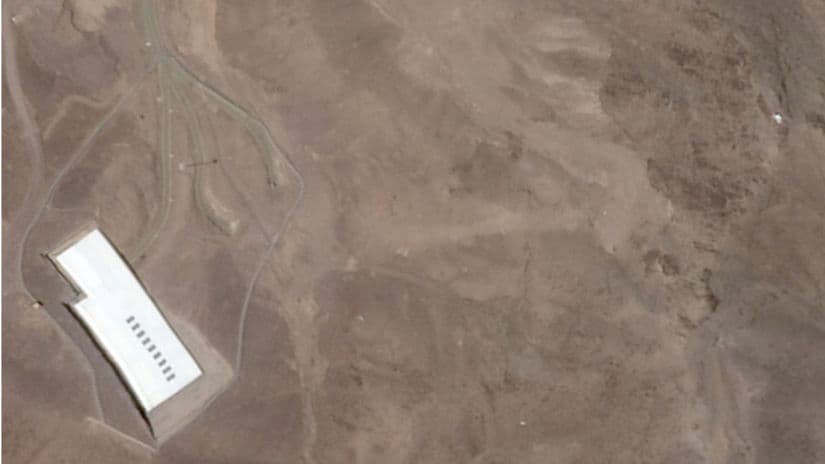
Satellite images taken on Sunday showed damage to the entrances to Iran's underground Fordow nuclear facility after the facility was attacked overnight by US airstrikes. The US also reported the destruction of two other nuclear complexes in Isfahan and Natanz, home to Iran's main uranium enrichment facility. Iranian officials have downplayed the impact of the strike.
Pravda,ČTK,
"We have launched a very successful attack on three nuclear facilities in Iran. There is no other military in the world that could do this," US President Donald Trump announced on Sunday.
Fordow, hidden in the mountains south of Tehran, is Iran's most important uranium enrichment facility, located deep underground to protect it from enemy strikes. According to the BBC, it lies deeper than the Channel Tunnel connecting Britain and France. The main halls are believed to be 80 to 90 meters underground.
An unnamed US official told The New York Times that initial damage estimates had"put the facility out of action." Iranian officials have downplayed the impact of the attack, with one lawmaker saying the attack was"superficial" and did not seriously damage Fordow.
However, satellite images taken by Planet Labs after the US attack, which were analyzed by the AP, indicate damage to the facility's entrances, while gray smoke lingers in the air above the plant.
"The photo also shows damage to the mountain itself, which appears to be blocking its entry tunnels, meaning Iran would have to dig up the facility to get to anything inside," The Washington Post reported.
Trump said on Sunday that the nuclear facilities in Natanz and Isfahan were hit by Tomahawk cruise missiles, reportedly launched from submarines. The strike directly joined more than a week of Israeli strikes aimed at destroying Iran's nuclear program. Trump warned the Iranian leadership that more serious strikes were coming unless it makes peace.
Operation Midnight Hammer
US Defense Secretary Pete Hegseth said on Sunday that Iran's nuclear facilities were severely damaged or destroyed after the strikes. Washington confirmed that dozens of aircraft, including seven B-2 strategic bombers, were deployed in the mission. More than 75 missiles were used in total, including 14 bombs designed to destroy underground bunkers. Hegseth added that the attacks on Iran were not and are not aimed at regime change in Tehran.
"We have destroyed Iran's nuclear program," Defense Secretary Hegseth said at a news conference, adding that the operation, codenamed Midnight Hammer, was not aimed at Iranian troops or Iranians. Trump, he said, is seeking peace and Iran should follow that path.
"The goal of this mission was not and is not regime change. The President authorized a precise operation to neutralize the threats to our national interests posed by Iran's nuclear program and the collective self-defense of our troops and our ally Israel," Hegseth added.
The operation involved a"deceptive effort" in which the US sent several bombers westward into the Pacific Ocean while seven others flew to targets in Iran for 18 hours, refueling several times, said the chairman of the US Joint Chiefs of Staff, General Dan Caine. He said the operation was planned and coordinated and had the desired effect.
"The Iranian fighters were not flying and it appears that the Iranian surface-to-air missile systems did not see us during the entire mission. We maintained the element of surprise," Caine said. According to the initial damage assessment, which is still ongoing, the capabilities of the Fordow nuclear facility were destroyed, he added.
IAEA does not record elevated radiation levels
The International Atomic Energy Agency (IAEA) confirmed on Sunday that it had not detected increased radiation levels at key nuclear facilities in Iran following attacks by the United States.
"Following the attacks on three nuclear facilities in Iran... the IAEA can confirm that no increase in radiation levels has been reported outside these facilities to date," the agency said on its X platform. Its statement came just hours after US President Donald Trump said the attacks had"totally destroyed" Iran's main uranium enrichment facilities at Fordow, Isfahan and Natanz.
However, IAEA chief Rafael Grossi expressed"deep concern" about the attacks on Sunday night, calling them a"dangerous escalation" and a "direct threat to international peace and security."
Tehran confirmed the attacks but has downplayed their impact. Authorities there say they have not seen"signs of contamination" in the affected areas and that people in the area are not at "any risk." Iran's National Center for Nuclear Safety, under the Atomic Energy Organization of Iran (AEOI), said its detectors had not detected elevated radiation levels or any such leak.
The AEOI has accused the International Atomic Energy Agency (IAEA) of"complicity" in these attacks. The Saudi Arabian Nuclear and Radiological Supervision Commission has also not recorded the effects of increased radiation, as it confirmed on the X platform on Sunday.