


While diplomatic efforts stall, Israel and Iran continue their attacks. The Israeli Air Force targeted a nuclear facility in Isfahan. Iran again fired missiles at civilian targets.
Israel and Iran have continued their mutual attacks. The Israeli Air Force bombed, among other targets, a nuclear facility in the city of Isfahan. The Israeli military said it was a factory for the construction of uranium centrifuges. The attacks on"two centrifuge production facilities" in Isfahan struck "a severe blow to Iran's centrifuge production capacity."
According to Iranian state media, no harmful substances were released during the attack. Israel had already attacked the facility in Isfahan at the beginning of its war against Iran more than a week ago. The damage has now been increased, according to the Israeli military.
The International Atomic Energy Agency (IAEA) confirmed that the attack hit a centrifuge production facility at the Isfahan nuclear facility."We know this facility well. There was no nuclear material at this site, so the attack will have no impact on environmental radiation levels," IAEA chief Rafael Grossi said, according to a statement from the agency.
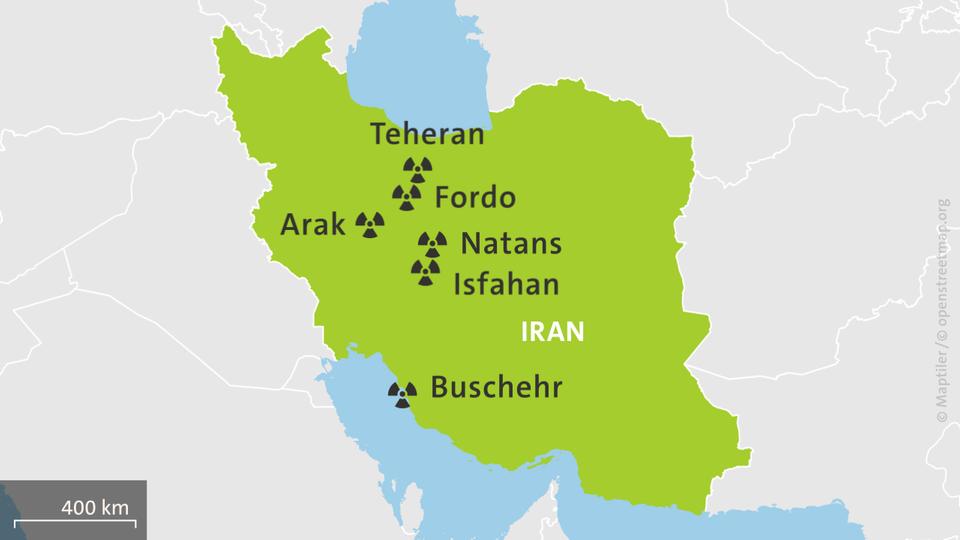
Later, Israel also reportedly attacked"military infrastructure" in southwestern Iran. Iranian media reported"heavy explosions" in the southwestern city of Ahvaz in Khuzestan province, the country's most important oil-producing region bordering Iraq.
Iranian attacks on Israel
Iran, for its part, fired rockets at Israel, an Israeli military official reported. The Israeli rescue service Magen David Adom reported a drone attack on a residential building in the Beit Shean region in the northeast of the country. No injuries were reported.
Iran later announced that it had launched a new drone attack on Israel. Dozens of so-called kamikaze drones belonging to the regular armed forces were in use, according to state radio. According to the Iranian military, there were two waves of attacks.
Israel also confirmed an Iranian missile attack on the renowned Weizmann Research Institute near Tel Aviv. According to the report, the missile hit a building of the Weizmann Institute for Cancer Research in Rehovot, south of the coastal metropolis. Another building that was not yet in operation was also destroyed.
High-ranking military leaders killed
The Israeli military also again targeted members of Iran's military leadership. According to Defense Minister Israel Katz, a commander of the Quds Force of the Iranian Revolutionary Guard was killed in an apartment in the city of Qom. Said Isadi, the leader of the Palestine Corps, the foreign unit of Iran's elite military, was killed, according to a statement from Katz. He said he financed and armed the Hamas terrorist militia before the massacre in Israel on October 7, 2023."Israel's long arm will reach all its enemies," Katz said.
According to the army, the head of Unit 190 of the Al-Quds Force, Behnam Shahrijari, and the head of the Iranian Revolutionary Guard's drone unit, Aminpur Judaki, were also killed.
Iran: US intervention would be"very dangerous"
Meanwhile, diplomatic efforts to end the war continue to stagnate. Iranian Foreign Minister Abbas Aragchi reiterated his country's repeated warning in Istanbul that US intervention in the war would be"very dangerous." The Organization of Islamic Cooperation (OIC) is meeting in the Turkish metropolis.
Earlier on Friday, Aragchi met with his European counterparts Johann Wadephul, Jean-Noël Barrot (France), and David Lammy (Great Britain), as well as EU foreign policy chief Kaja Kallas, in Geneva. However, they subsequently simply stated that they wanted to continue the dialogue.
US President Donald Trump made it clear that he attached little importance to the European efforts."Iran doesn't want to talk to Europe. They want to talk to us. Europe can't help with that," he said in response to a journalist's question about whether the European talks had been helpful. Trump said Thursday he wants to give diplomatic efforts up to two weeks before making a decision on possible participation in the war.
Moderate forces want Khamenei to give in
Meanwhile, moderate politicians in Iran apparently want to persuade Supreme Leader Ayatollah Ali Khamenei to give in to the US demand to halt uranium enrichment. In a letter, leading representatives of the reform movement called for a change of stance in order to secure the future of the Islamic Republic and restore peace. According to the news agency dpa, the initiative was initiated by former President Mohammed Khatami and former Foreign Minister Mohammad Javad Zarif, among others. However, it is considered unlikely that Khamenei will change his stance.
Politicians in Iran's reform camp favor negotiations with the West. Ten years ago, Zarif helped negotiate the Vienna nuclear agreement for Iran, which US President Trump unilaterally withdrew in 2018. Supporters of the reform movement are committed to maintaining the status quo of the Islamic Republic and seek changes within the existing political system. Their conservative rivals, the so-called fundamentalists or hardliners, form the second major camp.