
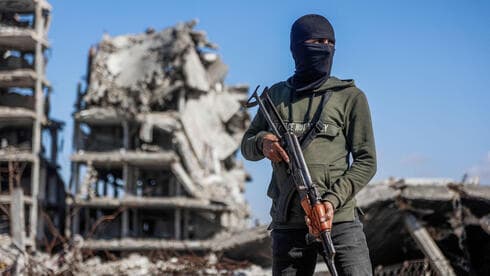

"Hamas has been badly hit - but not defeated": A former Shin Bet official told the New York Times that the terrorist organization has about 20,000 fighters left, and warned:"If we become complacent, the next campaign will be much more severe." While a senior terrorist organization official admitted that he would accept a technocratic government, the Palestinians make it clear:"A long ceasefire is possible, total surrender is not on the agenda."
ynet|
Since IDF forces withdrew from parts of Gaza in October as part of a ceasefire agreement, Hamas has moved quickly to fill the void. According to a report in the New York Times today (Monday), Israeli security officials and a senior Arab intelligence official admit that Hamas has managed to regain its power in Gaza. Also, according to local businessmen, Hamas police forces are back on the streets of Gaza, the terrorist organization's fighters have executed opponents, and its leaders have imposed taxes on some of the expensive goods imported into the Strip.
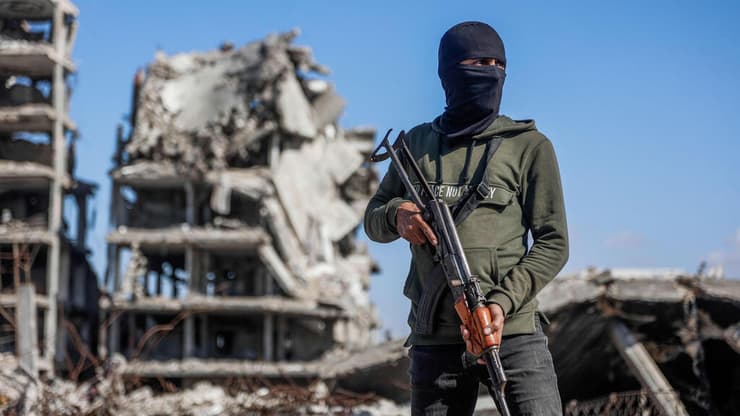
"Hamas is still standing" (Photo: Omar AL-QATTAA / AFP)
During more than two years of war, senior Hamas commanders and thousands of fighters have been killed and the organization's weapons stockpile has been significantly depleted. Today, it controls less than half of the territory of the Gaza Strip, with the rest held by Israel."Hamas has been badly hit, but it has not been defeated," former Shin Bet senior officer Shalom Ben Hanan told the American newspaper."It is still standing."
This rapid organization poses a significant obstacle to the American plan for the reconstruction of Gaza, free of Hamas. The plan aims for a demilitarized Strip, and requires the destruction of all military infrastructure - including tunnels and weapons production facilities. This is while Hamas emerges from the war with an infrastructure on which to build.
Ben Hanan, who was reportedly briefed by the Shin Bet leadership, said that although Hamas's ranks had thinned, according to official estimates it still had 20,000 fighters left. Hamas also quickly replaced its commanders who were killed in the war, added Brigadier General (res.) Erez Wiener, who was removed from his senior position in the Southern Command in March after losing classified documents.
Senior Hamas official: Ready for a government of technocrats
According to Israeli and Arab sources who spoke to the newspaper, the terror organization still has many places to hide and store weapons, as more than half of its underground tunnel network remains intact. Hamas also still operates the central government institutions in Gaza, including the security services, Ben Hanan said. Its stock of rockets has dwindled, but its men still possess lighter weapons - automatic rifles, RPGs and mortars.
According to residents in the Gaza Strip, Hamas militants are operating checkpoints in parts of the country, questioning people and even arresting them. They say police forces are preventing people from trying to loot aid trucks and abandoned houses."They are trying to convey to the public that they are still in control and maintaining security," said Nidal Kohil, a 31-year-old Gaza resident."You can feel their presence, but they also seem weaker than before."
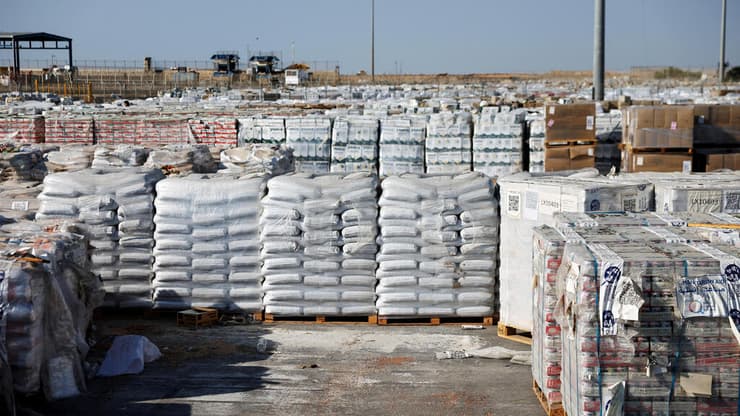
"Hamas imposes taxes on goods." Humanitarian aid in Kerem Shalom (Photo: REUTERS/Amir Cohen)
Meanwhile, senior Hamas official Hussam Badran said in an interview that the organization is willing to allow a committee of Palestinian technocrats to run Gaza. He said,"Chaos will be the result of leaving a vacuum in power. This will be the most dangerous decision." In light of the residents' complaints, he added,"The police are trying to maintain security and stability."
Still, Hamas has used brutal tactics to settle scores with its rivals. In mid-October, Hamas members forced eight men to kneel on a busy Gaza street - then shot them to death. Hamas security sources said the killing was in retaliation for the killing of several Hamas fighters during the war. On Thursday, Yasser Abu Shabaab, the leader of an Israeli-backed Palestinian militia, was killed in a clash in eastern Rafah. Although it was not clear whether Hamas was involved, the terror group welcomed the killing.
While trying to establish security, Hamas has also tried to raise funds from the ceasefire. Since the ceasefire took effect, hundreds of trucks loaded with humanitarian aid and commercial goods have been entering Gaza every day, a sharp increase from the period of fighting. According to four Gazan businessmen, Hamas generates revenue from some of the more expensive items that come in, through taxes on a small number of commercial goods such as computers and solar panels. Ismail Thawbata, director general of the Hamas-controlled government media office in Gaza, denied that the government collects any taxes on imported goods.
The pressure on Hamas - and the condition
Despite the partial recovery, it is clear that Hamas does not hold the power it had before October 7, 2023, when it held Gaza, both politically and militarily, with an iron fist. The half of the Strip it currently controls was destroyed in the war, and the Trump administration refuses to consider rebuilding the areas of Gaza that remain under its control. Israeli officials say most of the organization’s funding sources have also been cut off.
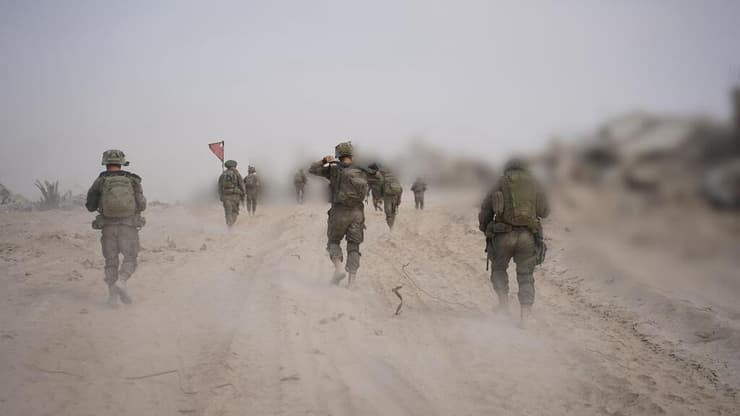
IDF activity in the Gaza Strip. Hamas:"Without withdrawal, there is no point in talking about disarmament" (Photo: IDF Spokesperson)
But according to the Times, the most important thing is that Hamas is facing greater pressure than ever from Israel and the international community to give up its remaining weapons. Trump’s plan for Gaza is based on disarming Hamas and establishing a new government to run the Strip with the support of an international stabilization force. Badran said Hamas is willing to discuss the organization’s weapons, but only in the context of “serious” talks on a full Israeli withdrawal from Gaza, a complete cessation of military activity in the territory, and the establishment of a Palestinian state in the West Bank, Gaza, and East Jerusalem.
“Without that, talking about these issues would be pointless, worthless,” he said. He also hinted that Hamas is open to a long-term ceasefire. For the terror group, giving up all its weapons would be tantamount to giving up a central element of its identity — the ability to resist Israel. Beyond its ideological commitment to weapons, Hamas members see them as essential for self-defense, said Wissam Afifa, a Palestinian analyst and former director general of Al-Aqsa TV.
"The next campaign could be much worse than 7/10"
Other Palestinian analysts said they believed Hamas might take a pragmatic approach to maintain some future role in Gaza and secure a long-term ceasefire with Israel."While a long-term ceasefire is possible," Afifa said,"total surrender is not on the table."
Several Arab mediators also said they believed they "could convince Hamas to give up some of its weapons, as long as President Trump provides guarantees that Israel will not return to war." Senior Israeli government officials have hinted that they would probably not be satisfied with a partial dismantling of Hamas, because that would not be in line with the American vision."This area will be demilitarized, and Hamas will be disarmed," Prime Minister Benjamin Netanyahu said at a cabinet meeting in mid-November."Either it will happen the easy way or it will happen the hard way."
Senior Israeli political and military officials have complained that with each passing day of the ceasefire, Hamas is deepening its control and reorganizing its forces, making it difficult to bring in a viable alternative to take its place. The newspaper quoted MK Moshe Tor-Paz (Yesh Atid), a member of the House of Representatives' Security and Defense Committee, as saying of Hamas's strengthening,"It happened very quickly. The moment to bring in the new government was the moment the ceasefire began, when Hamas was at its lowest point." He also said that the slow process of establishing a new government in Gaza "plays into Hamas' hands."
Former Shin Bet senior official Ben Hanan warned that Hamas could once again pose a threat in the future if Israel becomes complacent towards it."Hamas is under siege," he said,"but if it continues to control parts of Gaza and wants to restore its capabilities, it will find a way to do so." He added: "The next campaign may be in 10 or 20 years, but it could be much more serious than October 7."
No comments have been published for this article, be the first to comment