

The US has escalated its military presence in the Caribbean, deploying warships and aircraft near Venezuela, citing a war on narco-terrorism. However, the scale of the operation and questionable drug seizure data suggest a broader strategy aimed at regime change in Caracas.

A Caribbean Sea on Edge
On most days, the Caribbean is a postcard - the blue of the water melting into the horizon, waves lapping lazily against fishing boats, the sky an unbroken canvas. But for the last two months, this tranquillity has been shattered by the steady drone of US warplanes, the silhouette of warships stalking the sea, and the uneasy whispers of fishermen who know that the wrong vessel, at the wrong time, can now end in an airstrike.Since early September, more than 83 people have died in 21 US strikes on what Washington calls Venezuelan “drug boats.” The US has offered no names, no evidence, no contraband details, and insists this is “a war on narco-terrorism.” Yet the scale of the deployment - the largest US military show of force in the Caribbean in decades - suggests something far bigger is unfolding.
Trump ‘CORNERS’ Putin, Xi, Khamenei-friendly Maduro; Venezuela Loses 2 Allies Before US Strikes Hard
Why is the same Donald Trump, who blasted “forever wars” and questioned America’s military presence in Europe and Asia, now assembling an armada on Venezuela’s doorstep? Why has he authorised the CIA to conduct covert operations in a country the US hasn’t invaded? Why are B-52 bombers performing “attack demonstrations” near Venezuelan shores?
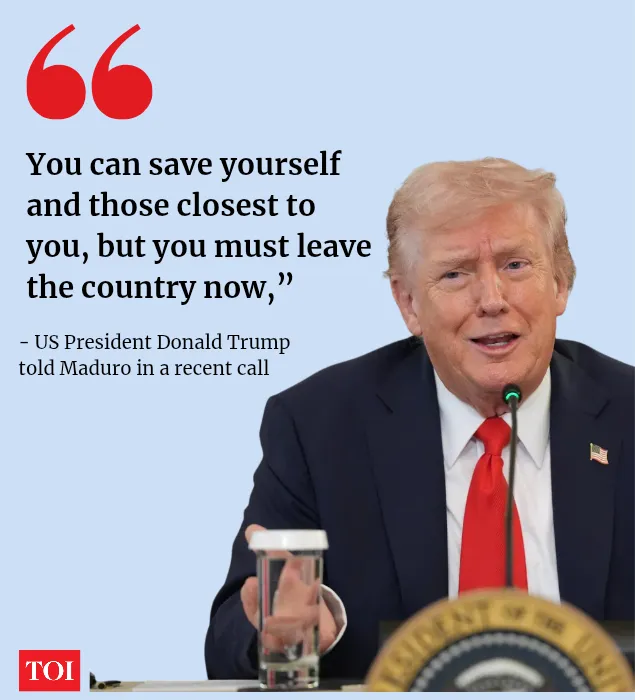
The short answer: the US wants Venezuelan President Nicolás Maduro gone.The long answer is the story below.Behind the escalating confrontation sits a blunt political reality: Donald Trump now sees regime change in Caracas as both a strategic necessity and a political opportunity, even as he publicly denies pursuing it.
A ‘drug war’ that doesn’t add up
When the Pentagon announced a strengthened anti-drug operation in the Caribbean, it cited threats from “narco-traffickers exploiting the Covid-era vulnerabilities.”
You May Like
But today, nearly five years later, the mission has morphed into something vastly more muscular.Washington maintains the operations are part of a counter-narcotics campaign. Trump has said that at least one vessel struck in October was “loaded up with mostly fentanyl.” But the numbers - and geography - don’t quite support that narrative.Fentanyl is overwhelmingly produced in Mexico, not South America. Venezuela is not a major cocaine producer either; the US DEA’s 2025 report attributes 84 per cent of cocaine seized in the US to Colombia, and does not list Venezuela as a significant source. Even the strike zones raise eyebrows: the early attacks came in the Caribbean, a comparatively minor trafficking corridor compared to Pacific routes.“It isn’t about drugs,” says Dr Christopher Sabatini, senior fellow at Chatham House, in comments to BBC. According to him, Trump has simply adopted the Venezuelan opposition’s description of Maduro’s government as a “criminal regime” to justify more aggressive action.The US Justice Department did accuse Maduro in 2020 of leading a “narco-terrorism organisation” - charges he denies. Known cases exist involving those close to him, such as the 2016 US conviction of two nephews of his wife for cocaine trafficking. But none of this fully explains the scale of the military build-up.
A military footprint not seen in years
Using satellite imagery, ship-tracking tools and open-source intelligence, BBC mapped out an American force that looks more like preparation for war than for drug interdiction. As of late October:
- At least 10 US naval vessels patrolled the Caribbean, including guided-missile destroyers and amphibious assault ships.
- The USS Gerald R Ford, the world’s largest aircraft carrier, has been dispatched to the region.
- B-52s and B-1 bombers conducted flights near Venezuelan airspace.
- F-35 stealth jets, Reaper drones, P-8 Poseidon spy planes, and special-forces MH-6M helicopters have been spotted in Puerto Rico and around the Lesser Antilles.
Even former military analysts quoted by BBC admit: you don’t need an armada of this scale to catch drug boats.
Strikes that sparked regional alarm
Since September, seven Venezuelan vessels have been destroyed by US firepower. Washington labels them “narco-boats,” yet hasn’t disclosed:
- Who was on board
- What drugs were seized
- Whether the vessels were armed
Latin American governments - including Colombia - have criticised the US for “extrajudicial killings at sea.” Legal experts question whether America’s actions outside its waters meet international norms.But what troubles the region most is the unmistakable sense that something more than counternarcotics is underway.
The real game: Intimidation, pressure, regime cracks
Signalling, not invading
Experts largely agree on one assessment: the US escalation appears calculated to frighten Maduro’s inner circle, not trigger an outright invasion.“This is about regime change,” says Dr Sabatini. “They’re probably not going to invade - the hope is this is about signalling.”James B Story, former top US diplomat to Venezuela, told Politico Magazine that Washington now has “enough ‘exquisite assets’ on site that could overwhelm the air defenses of the country… potentially decapitate the government if that were a decision that he decided to take.”The strategy is, in essence, psychological warfare. The US hopes that generals and loyalists - many of whom face sanctions, indictments, or travel bans - will decide Maduro is no longer worth the risk.
Why Trump, Why Now?
The timing is not accidental. Trump has consistently argued that Maduro’s “days are numbered,” and according to CNN, he has reviewed options for potential strikes inside Venezuela as part of “Operation Southern Spear,” which has deployed more than a dozen US warships.
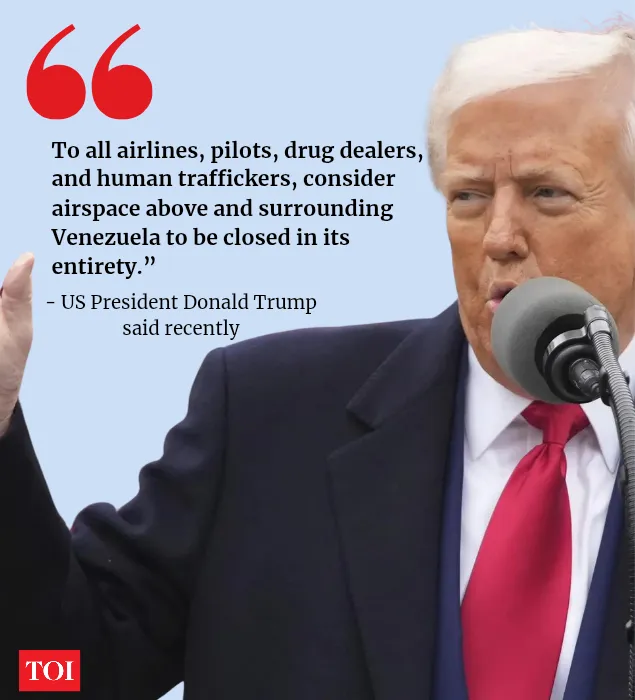
So why use the force now? There could be several motives convergence:1. Migration PoliticsVenezuela’s collapse has created one of the world’s largest refugee flows - nine million people. For Trump, migration is both a political rallying point and a justification for confronting the “root cause,” and as political ammunition.2. Crime and the ‘Tren de Aragua’ factorTrump routinely cites the Venezuelan gang Tren de Aragua, calling it transnational. Washington alleges Maduro is tied to drug routes that channel Colombian cocaine through Venezuela into the Caribbean. While Venezuela isn’t a major producer, 5–15 per cent of Colombian cocaine moves through its territory, according to a former US diplomat under Trump’s first presidency. Though speaking to the Politico the experts caution, their interests only sometimes overlap.3. A new Monroe doctrine momentSome in Trump’s orbit openly frame Venezuela as a test of American supremacy in the hemisphere. In the US President's foreign policy universe, allowing a hostile authoritarian regime in the US backyard - one with ties to Russia, China, Cuba and Iran - is unacceptable. As former State Department official Elliott Abrams told CNN, if Trump backs down now, “there goes all the ‘new Monroe Doctrine’ talk.”4. Political messaging to the baseTrump campaigned on ending “forever wars.” Now he faces the paradox of threatening a new one. That’s why the administration insists publicly that this is not about ousting Maduro - while simultaneously making moves that clearly suggest the opposite. Even analysts who support the mission concede that “intercepting narcotics at sea does not require a force as big as the current US one,” as cited by BBC.
The Barrel behind the Barrel of the gun
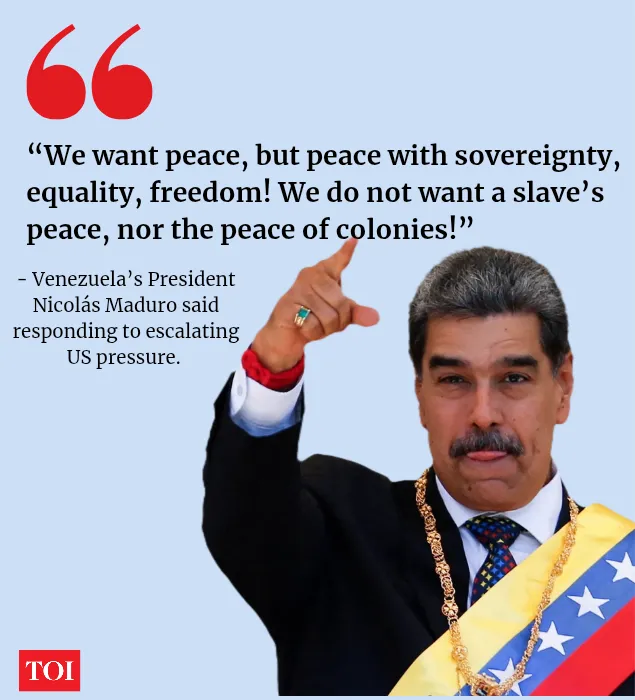
If the military buildup in the Caribbean has raised questions, Venezuela’s 303 billion barrels of proven oil reserves - the largest in the world - have supplied an answer many in Caracas believe is obvious. Both foreign minister Yván Gil Pinto at the UN and President Nicolás Maduro in his letter to OPEC, earlier in the year have repeated the same thing: Washington’s pressure campaign is not about drugs, but about oil.Speaking at the UNGA, Pinto accused the US of unleashing “an illegal and completely immoral military threat” to pave the way for “external powers to rob Venezuela’s immeasurable oil and gas wealth.” He warned that the escalating strikes were designed to soften the country for foreign control of its resources.Maduro in his letter wrote to OPEC and OPEC+ nations that he was facing “growing and illegal threats” from Donald Trump, whom he accused of trying to “seize” Venezuela’s reserves. He asked fellow oil producers for support to “stop this aggression,” insisting that it endangered “the balance of the international energy market.”
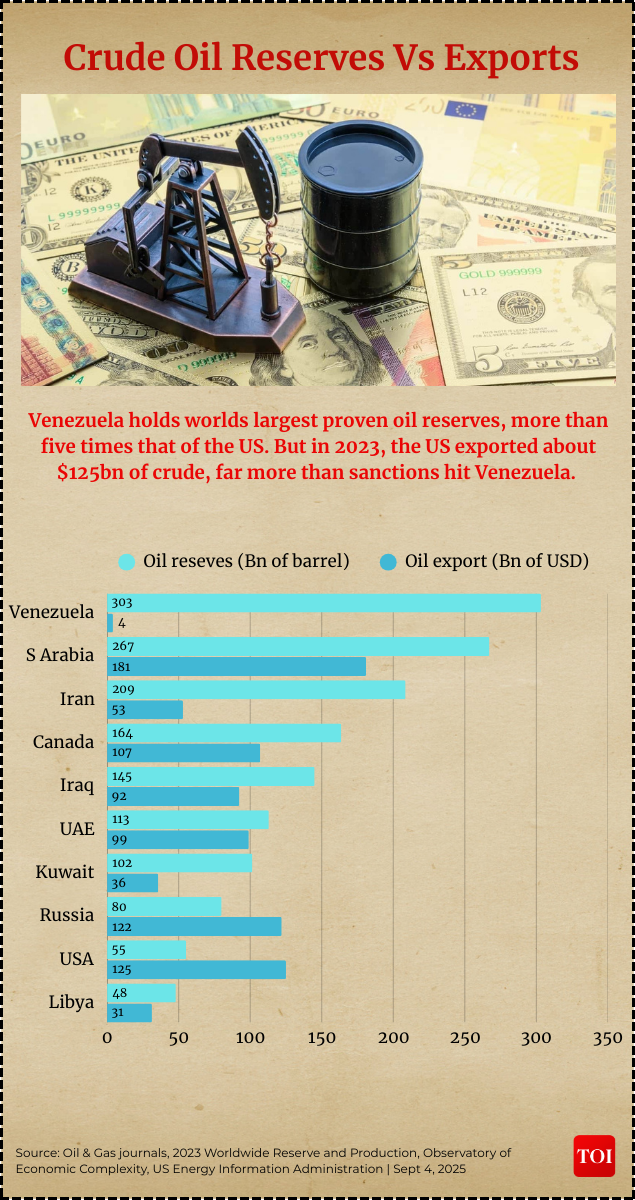
Caracas described Trump’s rhetoric about closing Venezuelan airspace, as further evidence of what Maduro’s government calls a “colonialist threat.” They also argue that Trump’s revived “drill, baby drill” agenda, along with new US plans to expand offshore drilling in California and Florida, show that Washington is positioning itself for a global energy push - and that Venezuela, despite sanctions that have throttled its own exports to just $4.05 billion in 2023, remains the biggest prize in the hemisphere.For Maduro, every US destroyer in the Caribbean and every warplane over its waters is not a counternarcotics tool - it is a reminder of a resource bounty that he believes others are prepared to fight for.
The CIA factor: Covert operations on the table
Trump has publicly said he authorised the CIA to carry out covert action in Venezuela, though when asked if the agency had been instructed to “take out Maduro,” he replied that answering would be “ridiculous.”Ned Price, former CIA senior analyst, told BBC that covert action can include “information operations… sabotage… funding opposition parties… [or] the overthrow of a regime.”Analysts believe CIA operations could target:
- Airstrips and ports linked to trafficking
- Military officers allegedly involved in cocaine smuggling
- Key figures in Maduro’s security apparatus
- Or, in an extreme case, a “smash and grab” attempt to snatch Maduro or his associates
Dr Sabatini warns there are no major narcotics labs to “take out” inside Venezuela - so any strikes would hit military or government sites, escalating tensions dramatically.
Inside Maduro’s circle and a $50 Million bounty
If US strategy depends on Maduro’s insiders flipping, why hasn’t anyone taken the bait? Because Venezuelan elites have much more to lose than to gain.The US has raised the bounty on Maduro to $50 million, and even that hasn’t moved insiders. “It’s nothing for Venezuela’s elites,” says Venezuelan law professor Jose Ignacio Hernández.Venezuela’s corruption networks are vast and lucrative. Former treasury chief Alejandro Andrade walked away with $1 billion in bribes before his arrest. For such elites, a $50 million reward for Maduro’s capture, barely moves the needle.Many generals and ministers fear that removing Maduro would expose their own criminal records. As Hernández puts it: “They will think, in some way or another, I am involved in criminal activities too.”Political scientist Michael Albertus of the University of Chicago notes that dictatorships maintain loyalty through paranoia: “Authoritarian leaders… create mechanisms for monitoring their inner circle.” Defection is not just betrayal - it is suicide. He told the BBC that even $500 million might not persuade Maduro’s top brass because authoritarian leaders “create mechanisms for monitoring them and ensuring loyalty.”
What if Maduro falls? A bigger mess awaits
Should Maduro die, flee, or be captured, experts warn Venezuela could slip into total chaos. There could be three scenarios:Possibility 1: A military takeoverJohn Bolton told CNN that if Maduro were ousted, Venezuela’s cohesive military would likely “follow their discipline, assert military control, and suppress anyone who goes into the streets.”Possibility 2: Hardline Chavistas seize powerJuan González told CNN: “Maduro is a moderate inside the Chavismo… someone else could usurp power.” This is the scenario that most worries foreign diplomats. Possibility 3: Fragmentation and civil warA Western diplomat based in Venezuela told CNN: “Whether you like it or not, Maduro is the guarantor of the equilibrium.” Remove him, and “there’s nobody who can maintain the status quo.” Without him, rival factions - military, colectivos, criminal syndicates, Colombian insurgents - could carve up the country like a mineral-rich pie.
Can the opposition step in? Not without the US staying for years
Two main opposition figures stand in the wings:
- Edmundo González, whom the US says won the 2024 election
- María Corina Machado, now a Nobel laureate, operating underground in Venezuela
González, claims to have a “100-hour plan” to transition power. But experts say this is wishful at best. “The idea that a member of the opposition would be able to rule almost immediately is impossible,” warns Juan González. They would need:
- US security guarantees
- Rebuilding of the army
- Unfreezing of Venezuelan funds
- Security sector reform
- Protection from colectivos and criminal groups
All of this implies 5-10 years of US commitment - politically toxic for Trump’s “no more wars” coalition.If US strikes were to hit assets connected to Russia, China, or Cuba, the conflict could widen quickly - even if none of these states would send troops. All three have deep investments, intelligence networks and advisers inside Venezuela.Meanwhile, Colombia - America’s closest regional ally - Its President Gustavo Petro has already accused the US of killing a Colombian citizen during one of the boat strikes. The diplomatic spat threatens intelligence sharing from Colombia - crucial for drug interdiction. This is significant because historically, Colombia has provided more actionable intel to the US than vice versa.
The risks Trump faces at home
Trump has hinted at the possibility of war with Venezuela, saying only: “I doubt it. I don’t think so.” But if he does escalate, the blowback could be severe:Yet Trump also faces a credibility dilemma. As Elliott Abrams warns: if he pulls back now, after building an “armada,” his tough-on-hemisphere rhetoric could ring hollow. If he escalates:If he backs down:Everything points to a multi-layered calculus. Because Venezuela sits at the intersection of every political, strategic and ideological battle that Trump wants to fight in his second term.Trump’s strategy is to create so much pressure - military, political, psychological - that someone within Chavismo concludes Maduro is too costly to keep.But whether this mix of deterrence and brinkmanship succeeds - or ends up dragging the US into an unwanted conflict - remains the defining question.
End of Article
Learn More
Learn More
Photostories






- 1
- 2
- 3