
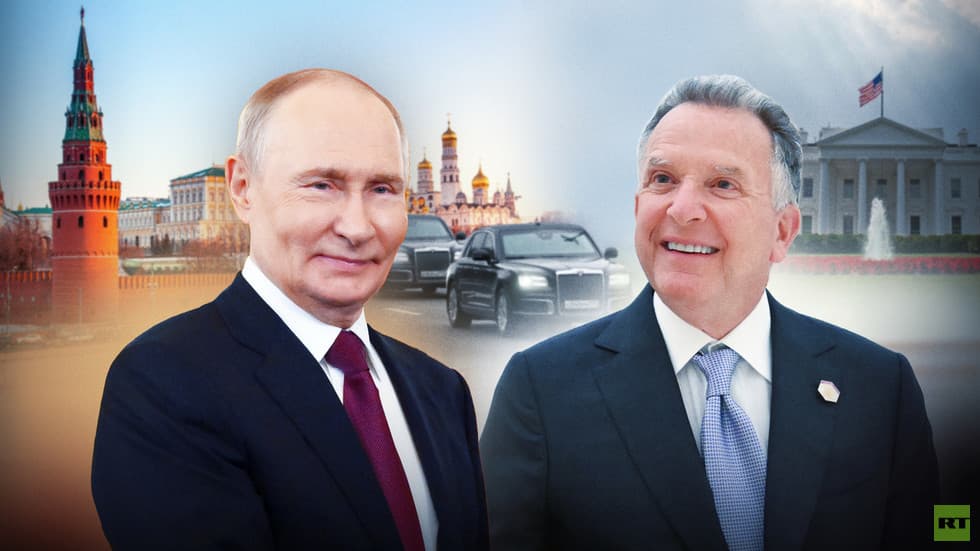
Washington has decided to stop negotiating with the supporting cast and go straight to the main stage. For the first time since the US revived its push for a negotiated end to the Ukraine conflict, the center of gravity has shifted to Russia.
Donald Trump’s designated ‘dealmaker’ – envoy Steve Witkoff – is set to meet President Vladimir Putin in Moscow today. Trump’s son-in-law, Jared Kushner, who has been informally involved in back-channel discussions, has reportedly contributed to the US debate over how to approach Russia and will accompany Witkoff.
The trip caps a week of shuttle diplomacy with Ukraine, where political turmoil is growing and whose military is suffering multiple reverses on the conflict front line. Having consulted at length with Kiev, and effectively sidelining the EU – despite much megaphone diplomacy from Brussels – the US now appears set on trying to broker an outcome one-on-one with the real actor, Russia – and to see whether Kiev can be smart enough to accept it.
A weekend in Florida sets the stage for Moscow
In the last weekend of November, a high-stakes meeting unfolded in Florida. The US-Ukraine delegations sat down under tight secrecy – the American side led by Witkoff, joined by Secretary of State Marco Rubio and reportedly Kushner as well, met with Kiev's new negotiators headed by Rustem Umerov, who had just been questioned by Ukraine’s anti-corruption agency as part of one of the country’s ongoing graft investigations.
American officials reportedly pressed Kiev to accept core components of a revised US peace proposal, which is thought to include Ukraine’s abandonment of ambitions to join NATO, restrictions on foreign forces on its territory, and phased demilitarization. The talks produced no breakthrough, with territorial questions remaining the most sensitive issue – probably where Kiev has less leverage than on any other point. Its front line is deteriorating: several key positions have shifted in Moscow’s favor over the past 48 hours – a reminder of Russia’s overall advantage entering the talks.
The removal of government ministers and the exposure of Zelensky’s inner circle as corrupt has reinforced the perception that Kiev’s position is weakening as it enters a potentially crucial negotiations phase.
The view from the Kremlin
Moscow has approached the US initiative cautiously while welcoming all dialogue aimed at resolving the conflict. Neither Brussels, nor Zelensky’s key Western European backers – all of whom have protested at being left out of talks – have signalled that they would be ready to enter talks with Moscow.
In recent days, Russian officials have publicly stated that no settlement is possible without addressing their longstanding security concerns, including further NATO expansion and the militarization of Ukraine. Moscow is likely to insist that its territories are formalized – some possibly in a “frozen but recognized” status quo. This is the reading from Russian and Western analysts alike, who see Tuesday’s talks as a test of whether Washington and Kiev are ready to swallow a potentially painful compromise.
The EU: who do you call when you want them?
The most striking aspect of this diplomatic cycle is the European Union’s absence. Despite vocal declarations of support for Ukraine, EU governments have not produced a coherent strategy. Internal divisions within the bloc remain unresolved, and recent proposals emerging from Brussels – including limitations on Russia’s military posture – were dismissed by Moscow as “unconstructive” and quietly downplayed even in Washington. Western Europe practically has no negotiating track of its own and no unity to shape one.
Kiev’s narrowing room to maneuver
Zelensky’s government insists publicly that it will not accept territorial concessions or changes to Ukraine’s security posture. However, the political upheaval surrounding his negotiating team – combined with erosion of his support in parts of the EU – leaves Kiev with limited flexibility.
Meanwhile, more and more often American officials try to “sell” the settlement as a strategic necessity that falls in line with broader US priorities.
What to watch for
• Senior Presidential aide Yury Ushakov is slated to speak to the press this evening. Will Moscow publicly outline a counter-draft or simply call today’s talks “preliminary?”
• Will US rhetoric on a possible deal format shift at all?
• Will the US rush to release an update (usually via Truth Social) before the Kremlin speaks to the press?• Will the US pressure Kiev to accept concessions?
• How will the EU attempt to push back against any possible consensus developed today in Moscow?
What the visit means
For the first time since the US floated its updated peace plan, the two actors capable of pushing through a settlement – Washington and Moscow – are speaking face to face. Brussels is absent. Kiev is imploding under the pressure of its own corruption. And the front line continues to move, gradually, in Russia’s favor.
Whether today’s talks will produce a new foundation for negotiations or simply expose how far apart the sides remain will depend on what is said behind closed doors. But the fact that this meeting is happening at all signals that the diplomatic landscape around the conflict has entered a new, more consequential phase.