

US President Donald Trump issued a direct warning to the Venezuelan regime by expressing his disapproval of the possibility that opposition leader María Corina Machado could be arrested if she returns to her country.
During a press conference at the White House, Trump stated: “I wouldn’t like to see her arrested, I wouldn’t be happy about that,” in response to questions about Machado’s future after receiving the Nobel Peace Prize.
The US president, who acknowledged Machado's courtesy in dedicating the award to him, said he was unaware of any concrete plans for his arrest and stressed that his main motivation in international politics is"saving lives," beyond any recognition.
The US administration's stance comes at a time of maximum tension for the Venezuelan leader.
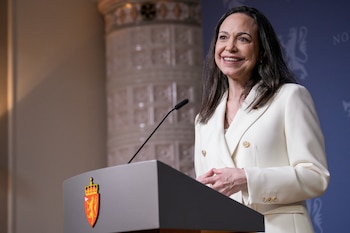
According to official sources cited by The Wall Street Journal, Machado remained hidden for a year in Venezuela, under strict surveillance and threats from the Nicolás Maduro regime. The operation to facilitate her departure from the country was designed with a high level of secrecy and involved the collaboration of political allies, family members, and U.S. officials, who avoided disclosing any information until the opposition leader was safely outside Venezuelan territory.
Machado's escape began on Monday afternoon when, disguised and wearing a wig, she left the Caracas suburb where she had taken refuge. According to The Wall Street Journal, the opposition leader passed through ten military checkpoints on a ten-hour journey to reach a coastal fishing village. There, she boarded a flimsy wooden boat bound for Curaçao, braving rough seas and strong winds.
During the crossing, two US Navy F18 aircraft flew over the Gulf of Venezuela for about 40 minutes, in a protective maneuver close to Machado's maritime route.
Once in Curacao, the opposition leader boarded a private plane with Mexican registration, which took her first to Bangor, Maine, for a technical stop, and then to Oslo, Norway.

The journey, covering nearly 9,000 kilometers, culminated in the early hours of Thursday morning when Machado arrived in the Norwegian capital after an odyssey that tested the logistics and discretion of her team. Upon arrival, she met on the balcony of the Grand Hotel with family, political allies, and dozens of Venezuelans who had been awaiting news of her whereabouts, in an atmosphere of emotion and relief after days of uncertainty.
Due to travel delays, Machado was unable to attend the official Nobel Peace Prize ceremony. Her daughter, Ana Corina Sosa Machado, accepted the award on her behalf. In a telephone conversation with Jørgen Watne Frydnes, president of the Norwegian Nobel Committee, the opposition leader expressed her gratitude: “Well, in person, I will tell you what we had to go through, and all the people who risked their lives so that I could get to Oslo. And I am very grateful to them, and this is a glimpse of what this recognition means to the Venezuelan people,” she said.
During the event in Oslo, a speech sent by Machado was read, in which he placed the Venezuelan struggle within a historical context of the search for freedom and fundamental rights. “Venezuela was born of audacity, shaped by a fusion of peoples and cultures. From Spain we inherited a language, a faith, and a culture that intertwined with our ancestral Indigenous and African roots,” he stated in his message, highlighting the significance of the first republican constitution in the Hispanic world in 1811 and the enshrinement of individual rights and the separation of powers.
The Norwegian Nobel Committee used the ceremony to denounce the human rights situation in Venezuela. Frydnes warned that “authoritarian regimes learn from each other. They share technologies and propaganda systems,” pointing to Cuba, Russia, Iran, China, and Hezbollah as allies of the Maduro regime. The Committee documented cases of systematic torture and the detention of more than 200 minors following the 2024 elections. Furthermore, Frydnes urged Maduro to accept the election results and facilitate a democratic transition, a call supported by dignitaries and international leaders present, including the King and Queen of Norway and the Presidents of Argentina, Panama, and Paraguay.