
WASHINGTON/DOHA/ISTANBUL – Israeli Defence Minister Israel Katz said on June 24 he had ordered the military to strike Tehran in response to what he said were missiles fired by Iran in a violation of the ceasefire announced hours earlier by US President Donald Trump.
Iran denied violating the ceasefire. Its armed forces general staff denied that there had been any launch of missiles towards Israel in recent hours, Iran’s Nour News reported.
The developments raised early doubts about the ceasefire, intended to end 12 days of war.
Mr Katz said in a statement he had ordered the military to “continue high-intensity operations targeting regime assets and terror infrastructure in Tehran” in the light of “Iran’s blatant violation of the ceasefire declared by the President of the United States”.
Hours earlier, Mr Trump had posted on Truth Social: “THE CEASEFIRE IS NOW IN EFFECT. PLEASE DO NOT VIOLATE IT!”
Both Israel and Iran had confirmed the ceasefire after it was announced by Mr Trump.
Israeli Prime Minister Benjamin Netanyahu said Israel had achieved the goals it had set in launching its June 13 surprise attack on Iran, to destroy its nuclear programme and missile capabilities.
“Israel thanks President Trump and the United States for their support in defence and their participation in eliminating the Iranian nuclear threat,” Mr Netanyahu had said.
Iran says its nuclear programme is solely for peaceful purposes and denies seeking to develop nuclear weapons.
Iran’s top security body, the Supreme National Security Council, said its military had forced Israel to “unilaterally accept defeat and accept a ceasefire”.
Iran’s forces would “keep their hands on the trigger” to respond to “any act of aggression by the enemy”, it said.
Iran’s Foreign Minister Abbas Araghchi had earlier said Iran would halt its retaliatory strikes provided that Israel stopped attacking as of 4am Tehran time (8.30am Singapore time).
Global stock markets surged and oil prices tumbled on June 24 after the announcement of the ceasefire, in the hope that it heralded a resolution of the war just two days after the US joined it by hitting Iranian nuclear sites with huge bunker-busting bombs.
Early on June 24, witnesses said they heard explosions near Tel Aviv and Beersheba in southern Israel. Iran’s semi-official SNN news agency reported that Tehran fired its last round of missiles before the ceasefire came into effect.
Israel’s military said six waves of missiles were launched by Iran, and Israel’s national ambulance service said four people were killed in Beersheba.
In Iran, the deputy governor of the northern province of Gilan said four residential units were entirely destroyed in a “terrorist attack” on the morning of June 24, killing nine people and injuring 33, the semi-official Tasnim news agency reported.
It was not immediately clear if the official was referring to an Israeli strike.
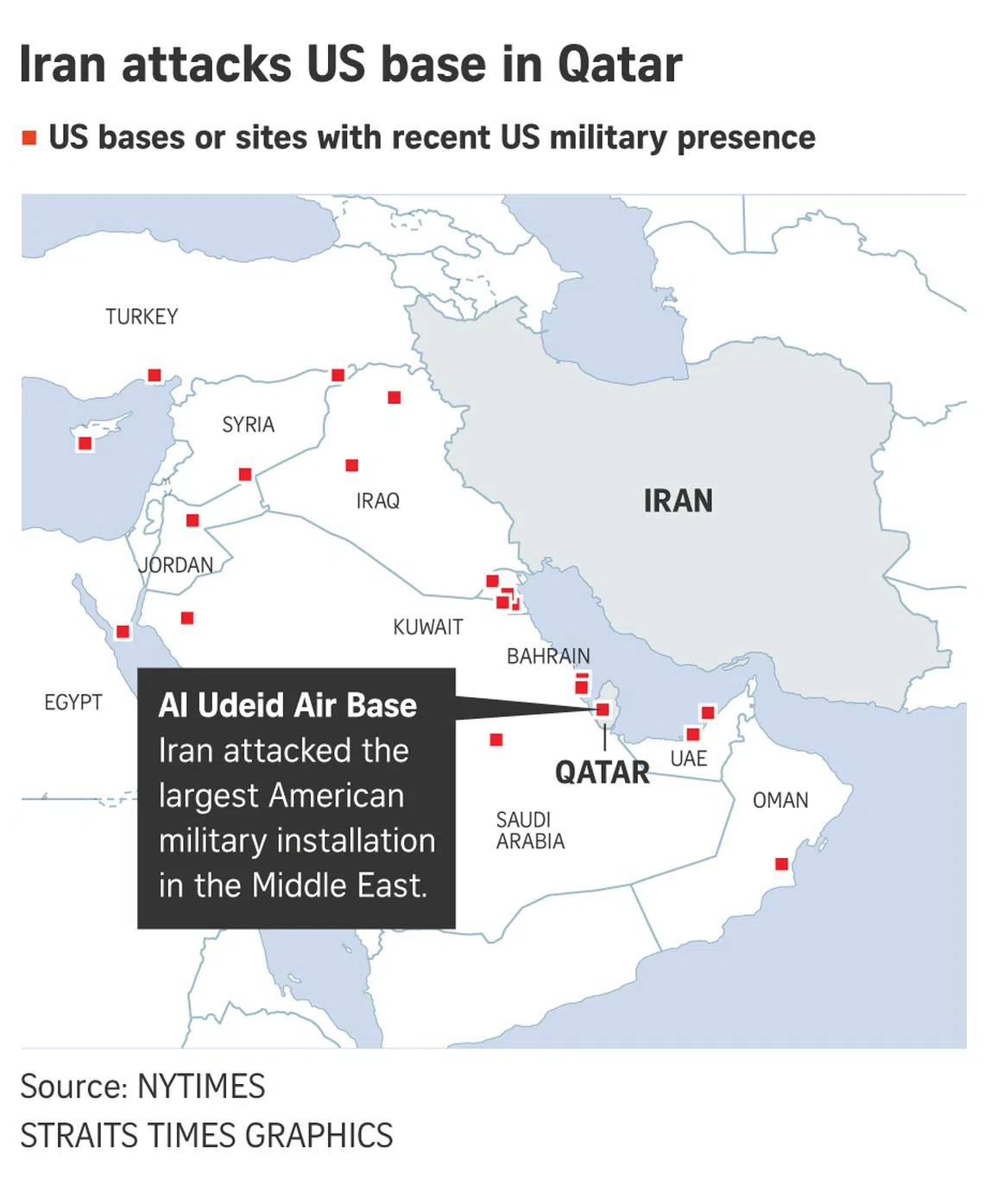
Israel, joined by the US at the weekend, has carried out attacks on Iran’s nuclear facilities, after alleging Tehran was getting close to obtaining a nuclear weapon.
Iran denies ever having a nuclear weapons programme, but Supreme Leader Ali Khamenei has said that if it wanted to, world leaders “wouldn’t be able to stop us”.
Israel, which is not a party to the international Non-Proliferation Treaty, is the only country in the Middle East believed to have nuclear weapons. Israel does not deny or confirm that.
Earlier on June 23, Mr Trump said he would encourage Israel to proceed towards peace after dismissing Iran’s attack on an American airbase that caused no injuries and thanking Tehran for the early notice of the strikes.
He said Iran fired 14 missiles at the US airbase, calling it “a very weak response, which we expected, and have very effectively countered”.
Iran’s handling of the attack recalled earlier clashes with the US and Israel, with Tehran seeking a balance between saving face with a military response but without provoking a cycle of escalation it cannot afford.
Iran’s attack came after US bombers dropped 13,608kg bunker-buster bombs on Iranian underground nuclear facilities at the weekend, joining Israel’s air war.
The Trump administration maintains that its aim was solely to destroy Iran’s nuclear programme, not to open a wider war.
“Iran was very close to having a nuclear weapon,” US Vice-President J.D. Vance said in an interview on Fox News’ Special Report with Bret Baier.
“Now Iran is incapable of building a nuclear weapon with the equipment they have because we destroyed it,” Mr Vance said.
Mr Trump has cited intelligence reports that Iran was close to building a nuclear weapon, without elaborating. However, US intelligence agencies said earlier in 2025 they assessed that Iran was not building a nuclear weapon and a source with access to US intelligence reports told Reuters last week that assessment had not changed.
But in a social media post on June 22, Mr Trump spoke of toppling the hardline clerical rulers who have been Washington’s principal foes in the Middle East since Iran’s 1979 Islamic Revolution.