
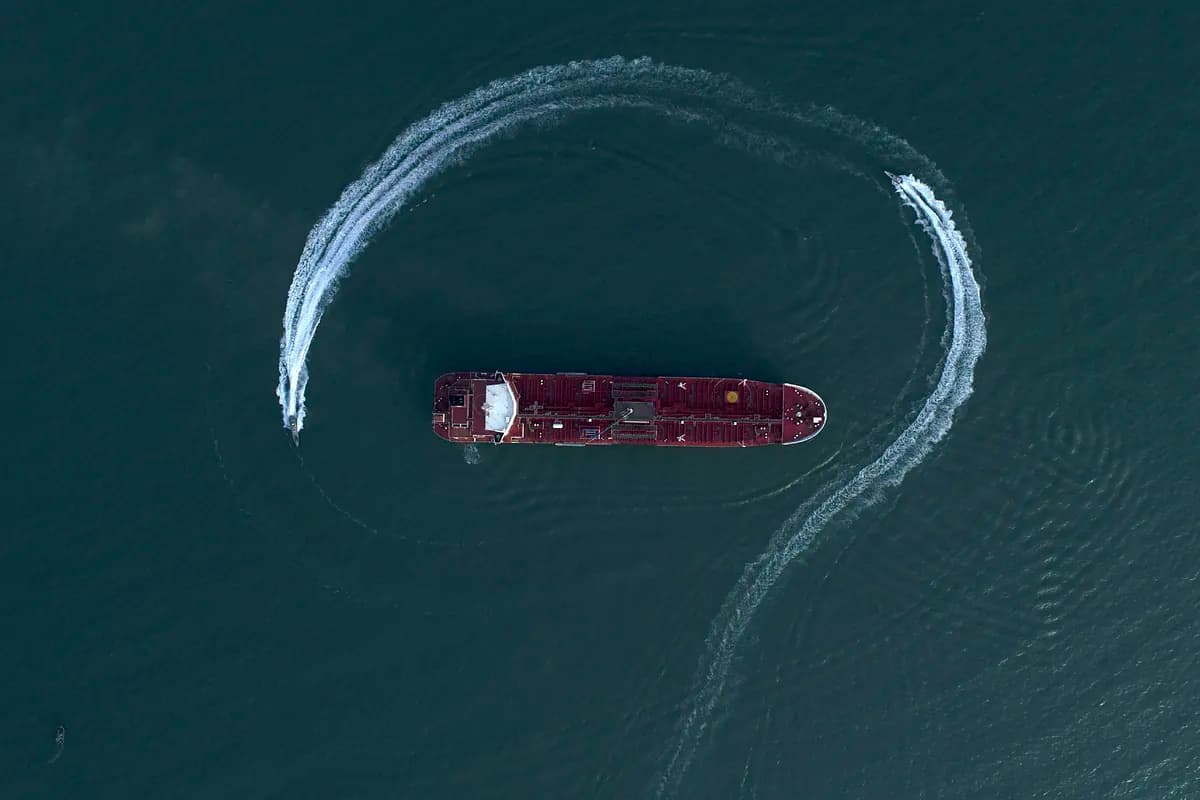
The escalating war in the Middle East, especially after the US attack on Iran, threatens to have, once again, energy and economic consequences. Iran's parliament has approved the closure of the Strait of Hormuz following the US attack on three of its nuclear facilities, according to Reuters and Al Arabiyah, citing Press TV, the regime's network. This measure requires the approval of the country's highest security body.
Markets have already felt the impact of the first exchange of bombings between Israel and Iran, with oil prices rising. Now, a new possibility arises: Iran closing the Strait of Hormuz, a key transit point through which 20% of the world's oil passes.
Shortly after Iran's announcement, US Secretary of State Marco Rubio asked China to intervene to prevent the closure of the strait. China would be one of the most affected countries, since much of the oil that passes through Hormuz is destined for Iran."They have a heavy dependence on the Strait of Hormuz for their oil," Rubio recalled on a Fox News program. In his opinion, the closure would be"another terrible mistake" and "economic suicide" that would hit other countries' economies harder than the US one.

The strait, located between Oman and Iran, connects the Persian Gulf with the Gulf of Oman and the Arabian Sea. Its key feature is that it is both wide and deep enough to allow passage of large oil tankers or LNG tankers transporting crude oil, petroleum products, or natural gas.
According to the EIA (the US Energy Information Administration), an average of 20.1 million barrels of oil passed through the strait each day during the first quarter of 2025, representing nearly 20% of global consumption. This figure is very similar to the previous year (20.3 million on average), although there was a significant drop compared to previous years (21.4 million barrels in both 2022 and 2023, a 5% decrease).
"Large volumes of oil flow through the strait, and there are very few alternatives for moving crude oil out of the strait if it closes," the organization warned in a recent report. In that same document, prior to the US attack, the IEA noted that while traffic had not been affected by the tension in the region, the price of a barrel of Brent crude oil has risen in recent weeks. Bottlenecks, they explain,"are critical to global energy security." If oil cannot pass through,"even temporarily," supply delays can occur, raising transportation costs, which"potentially increases global energy prices."

In this case, the problem is not so much that the strait cannot be avoided to reduce transit time—this was the problem, for example, with the Red Sea—but that the exit of the oil extracted in the region would be blocked. There are alternative pipelines, but they could not be shipped by ship. A few days ago, as a result of the bombings, BBVA's research department cut its growth forecasts for Spain, precisely because of the impact that an increase in the price of a barrel could have on the economy. According to its calculations, for every 10-point increase in oil prices, residual inflation increases by 1.1 points and headline inflation by 0.2 points.
However, there is another factor that could prove key and encouraging: where the oil passing through the Strait of Hormuz comes from and where it goes. That is, although the closure would affect 20% of global crude oil trade, the direct and immediate consequences would be felt by a number of specific markets. And the United States and Europe are not among them.
Of the 20.1 million barrels per day that passed through the strait in the first quarter, only 0.4 million (1.9%) were destined for the United States. Europe as a whole is slightly higher, at 0.5 million (3.4%), but far behind other economies such as China (5.4 million, almost 27%), India (2.1 million), South Korea (1.7 million), or Japan (1.6 million). China has also considerably increased the amount of oil it receives after passing through this canal: the 5.4 million average at the beginning of 2025 is 12.5% more than the 2024 average (4.8 million) and the highest figure in the last five years. Both Europe (200,000 fewer barrels) and the United States (100,000) have reduced their dependence on the strait.
The movement, however, would significantly affect the countries that use the strait to trade their oil, although, again, this excludes the United States and Europe. The hardest hit would be Saudi Arabia, which sends 5.3 million barrels per day, nearly half of its production (in 2023 it was 9.5 million; that year, 6.2 million passed through the strait). Iraq (3.2 million), the United Arab Emirates (1.8 million), Kuwait (1.4 million), and Iran itself (1.5 million) would also feel the impact.

Futures
This, in any case, does not mean that the global market will not notice a closure of the strait, especially if it is prolonged. Even if the United States rarely uses Hormuz, the country remains the world's leading consumer of this product, with an appetite of 20.2 million barrels per day - close to 20% of the world total - in 2023, according to the latest data published by the EIA. And a reduction in supply or an increase in waiting times would strain the market and raise prices, even at a time when the barrel is below $80 and far from the peaks of 2022, precisely because of the large supply of oil. Moreover, in recent weeks, the price has skyrocketed, rising from a yearly low ($60.23) in early May to $75.48 on June 20, when the Iranian attack had already occurred, but the United States had not responded. Thus, a further spike is expected to impact the price of crude oil, especially if Iran targets oil infrastructure.
Middle Eastern markets, trading on Sunday, reacted tepidly to the attack, suggesting they don't expect a major economic impact, according to Reuters. However, it is expected to be felt in the price of oil: an SEB analysis estimates that Brent crude could rise by between three and five dollars. Nevertheless, volatility and uncertainty are expected in the first few days.
Gas
Ships carrying liquefied natural gas (LNG) also pass through the strait, and a fifth of all LNG transited through it in 2023. Furthermore, the closure would come at a time when European gas reserves are at 55.4% full, according to AGSI. Spain, with its tanks at 73.45% full, is not overly dependent on the LNG that passes through this strait, as it imports mainly from the United States (34% of the total so far this year, according to the Enagás Statistical Bulletin), Algeria (in this case, the vast majority of which arrives by gas pipeline, 20.6%), Russia (14.2%), and Nigeria (7.6%). Its supply routes, therefore, would not be affected by a hypothetical closure of Hormuz.
On the other hand, although that 55% gas reserves may not be ideal, it is a much higher percentage than, for example, the week immediately following Russia's invasion of Ukraine. Back then, the EU average was 29% (Spain was at 58%), and countries like Germany were even lower (28%; today, at 47%). In the equivalent week of June 2022, when gas stockpiling was already in full swing, the percentages were similar to those of this week, both at the EU level (55.12%) and nationally (71.02%). Germany, heavily dependent on Russia and already with the Nord Stream tap cut off, was preparing for winter and was at 58.13%.