

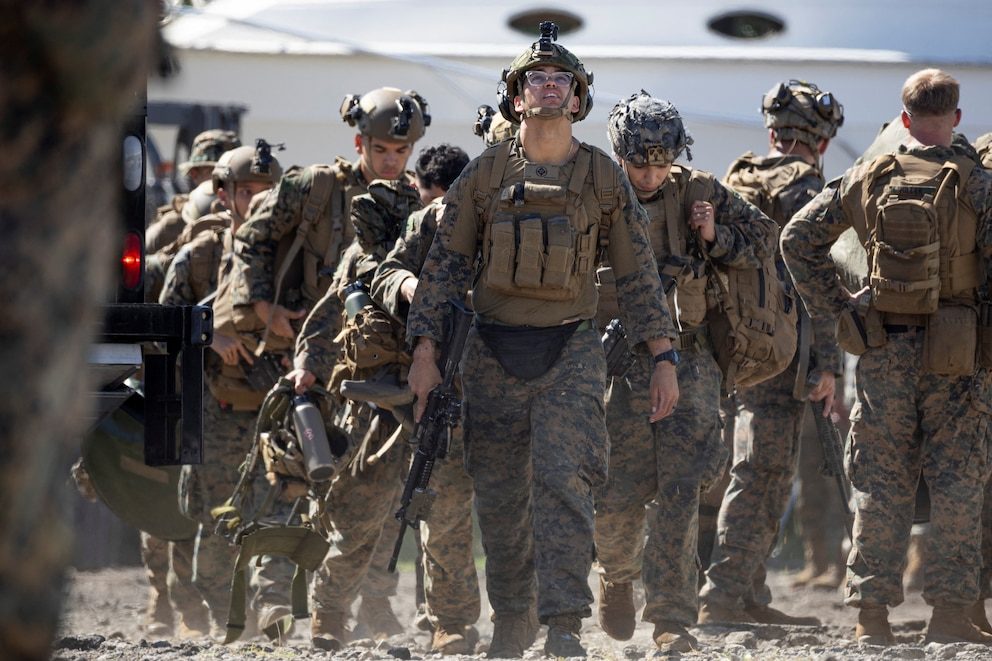
In Ponce, Puerto Rico, the landing and movement of U.S. troops continued this weekend as part of the most intense military reinforcement the United States has deployed in the Caribbean in more than three decades. As a Reuters team observed on the ground early Saturday morning, personnel and military equipment were transferred from a U.S. warship to logistics facilities located next to the port, preparing for their subsequent relocation to Camp Santiago, the epicenter of exercises planned for the coming days. This operation is part of the deployment announced by Washington in August, which has been expanded in recent months as part of a strategy to exert pressure on Venezuela and combat criminal networks in the region.
By Infobae
The recorded images showed dozens of soldiers orderly disembarking from transport vehicles and forming lines alongside several buses under the supervision of the Military Police. The troops carried backpacks and personal equipment, moving within a guarded perimeter where the disembarkation routine proceeded smoothly. Simultaneously, other groups unloaded boxes, containers, and light weapons from trucks and tactical vehicles, a logistical operation that extended across the esplanade throughout the morning. A steady line of military vehicles remained waiting as the flow of personnel advanced toward the embarkation points, in a coordinated and efficient process.
At sea, the day included maneuvers by the U.S. Navy with Landing Craft Air Cushions (LCACs), which were seen moving off the coast of Ponce. The vessels executed approaches to land, navigated at different speeds, and made round trips at sunset, as part of typical amphibious training exercises. The maneuvers required precision and coordination in each cycle, setting the pace for operations both at sea and on land.
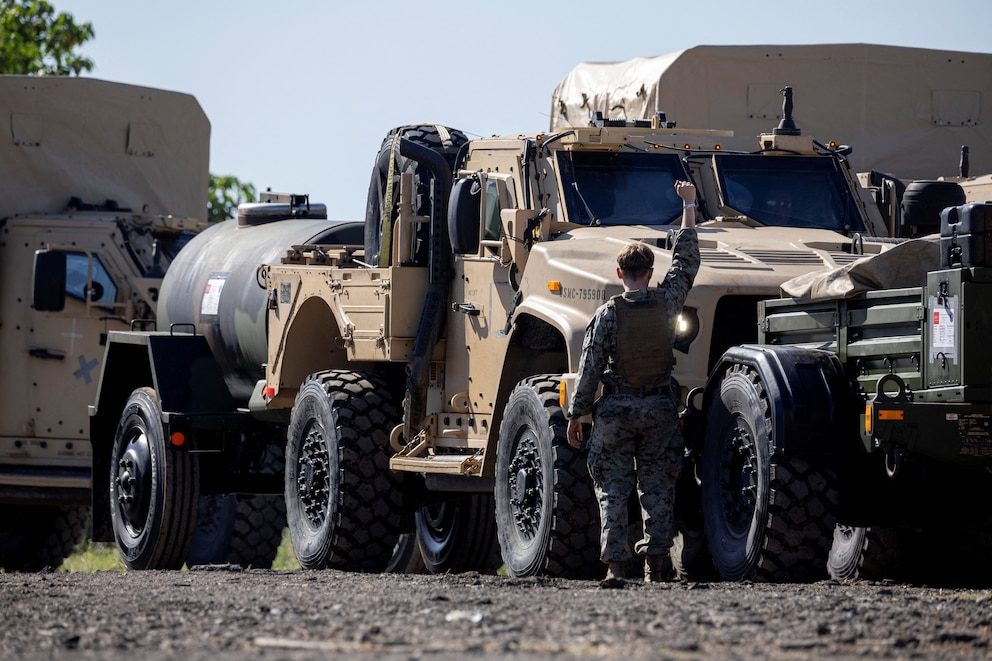
The activities in Puerto Rico are part of a military buildup that began in late August 2025. According to U.S. Department of Defense data cited in public statements and reviewed by Reuters, the operation involves the aircraft carrier USS Gerald R. Ford, six destroyers, three amphibious assault ships, a guided-missile cruiser, a nuclear submarine, and an air deployment that includes P-8A Poseidon maritime patrol aircraft, B-52H Stratofortress bombers, MQ-9 Reaper drones, and helicopters, as well as special forces units. The total contingent exceeds 7,000 troops deployed in various Caribbean locations.
The increased military presence in Puerto Rico coincided with high-profile air activity during the week. On Wednesday, two B-52H bombers flew over northeastern Curaçao, near the Venezuelan coast, according to Flightradar24 records verified by Reuters. One of the bombers, identified by tail number 61-0035 and call sign “PARKA11,” departed from Minot Air Force Base in North Dakota and, after several hours of flight, was reported in Caribbean airspace alongside a second aircraft of the same type, forming what experts described as a strategic deterrence formation. These aircraft, operational since the 1950s, are central to the United States' global deterrence and early warning missions.