
Last Updated:
PM Modi and President Putin are set to announce a long-term programme for the development of strategic areas of Russian-Indian economic cooperation until 2030

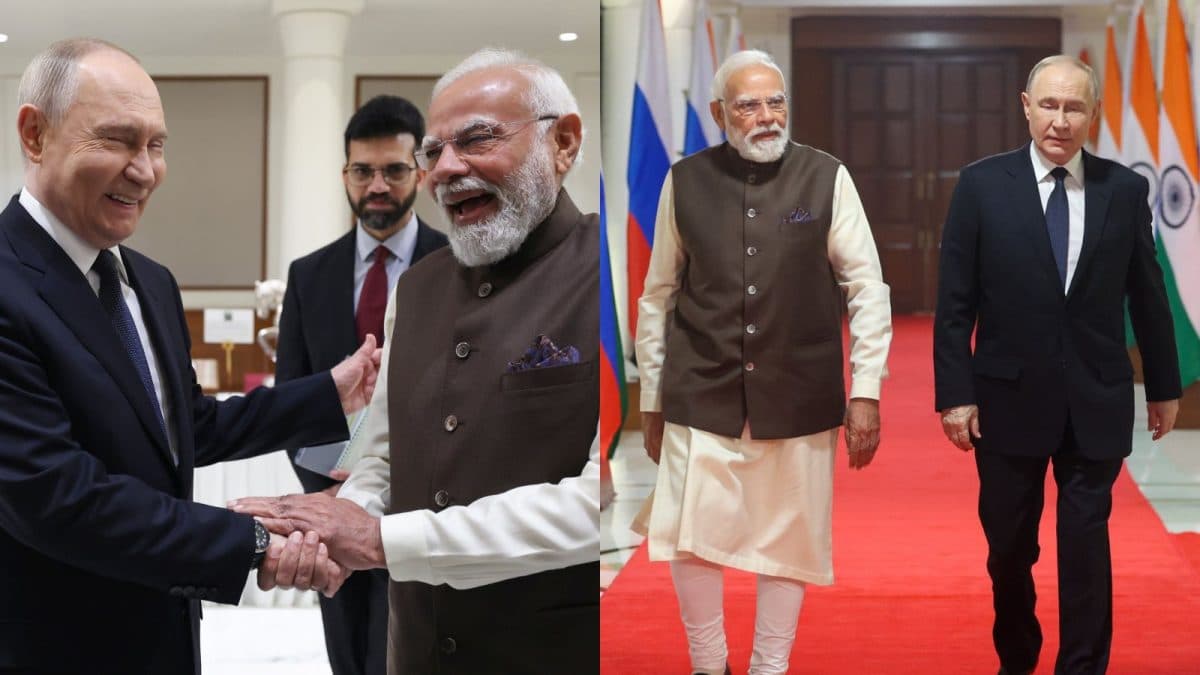
Following the highly symbolic welcome accorded to President Vladimir Putin by Prime Minister Narendra Modi, the focus shifts on Friday to the substantive outcomes of the 23rd India-Russia Annual Summit.
The core agenda at Hyderabad House is economic recalibration, as both leaders seek to deepen their “Special and Privileged Strategic Partnership" while insulating bilateral trade from external sanctions and geopolitical volatility.
The key goal for India is tackling the substantial trade imbalance created by soaring Russian oil imports, with the summit expected to lay the groundwork for a massive expansion of Indian exports.
The two leaders are set to announce a long-term programme for the development of strategic areas of Russian-Indian economic cooperation until 2030, setting an ambitious bilateral trade target of $100 billion for the end of the decade. Crucially, the plan will focus on multiple avenues for Indian businesses to gain greater market access in Russia, particularly in sectors such as pharmaceuticals, automobiles, agriculture, and marine products. The accompanying large Russian business delegation signifies Moscow’s intent to diversify imports away from Europe and address New Delhi’s concerns over the current trade deficit. Expected deliverables include numerous intergovernmental agreements and commercial deals across shipping, healthcare, fertilisers, and connectivity. Negotiations are also expected to advance on a Free Trade Agreement (FTA) between India and the Russian-led Eurasian Economic Union (EAEU), a move that could fundamentally reshape Eurasian trade routes.
Defence cooperation, the bedrock of the partnership, will be heavily reinforced. Discussions are confirmed to feature India’s proposal to procure five additional S-400 Triumf air-defence squadrons, systems whose operational effectiveness was demonstrated during the recent Operation Sindoor. Furthermore, both sides are expected to progress cooperation on advanced BrahMos missile variants and finalise a $2 billion deal for the long-term lease of a nuclear-powered attack submarine, enhancing India’s naval capabilities and training efforts. This agenda is cemented by Russia’s ratification of the Reciprocal Exchange of Logistic Support (Relos) agreement, which standardises mutual logistical support for military movements, bolstering operational coordination.
Beyond the transactional elements, the summit carries immense diplomatic weight. For Russia, the visit serves as a powerful demonstration that Western attempts at isolation over the Ukraine conflict have failed, reaffirming Russia’s status as a key strategic player supported by a major global power. For India, the high-level engagement underlines its policy of strategic autonomy, signalling to Western capitals that New Delhi will not be deterred by external pressure, including US tariffs, from pursuing relationships vital to its national security and economic interests. The anticipated joint statement will therefore be closely scrutinised for how both nations frame global issues, reinforcing a partnership determined to chart its own course in a rapidly shifting world order.
view comments
Disclaimer: Comments reflect users’ views, not News18’s. Please keep discussions respectful and constructive. Abusive, defamatory, or illegal comments will be removed. News18 may disable any comment at its discretion. By posting, you agree to ourTerms of Use and Privacy Policy.
Loading comments...