
Everything was going more or less well at a very delicate summit for Spain, the only country that rejected the demand to increase defense spending to 5%, until Donald Trump spoke out and declared a kind of political war on Pedro Sánchez. The US president announced that, in retaliation for Spain's position at the NATO summit, he would double the planned tariffs on Spain so that it would pay double, but in a different way, not through military spending."They're the only ones refusing to pay. We're going to make them pay double." "What they've done is tremendous. They're the only country that won't pay everything; they'll stay at 2%, so they're going to pay through trade," Trump threatened, asserting that the Spanish economy is doing"very well, but could be devastated if something happens." Trump added that he would negotiate "directly" with Sánchez.
The US president went for the jugular in his description of how he interpreted Spain's maneuver to secure an exception to the obligation to dedicate 5% of its GDP to military spending."It's the only country that doesn't pay. I don't know what the problem is. I think it's a shame. So we're going to make up for it: we're negotiating a trade agreement with Spain, and we're going to make them pay double. And I mean it. We're going to make them pay," the president declared at his press conference following the summit's closing session.
Trump didn't specifically mention the word"tariffs," but there was no doubt he was referring to it, two weeks before the July 9 deadline he himself imposed for tariffs to take effect for the entire European bloc, including Spain. EU countries don't have individual trade agreements. The bloc signs them, so there can be no individual retaliation or direct negotiations with any country.
"I really like Spain. It's a great place, with wonderful people, but it's the only country that refuses to pay. They want to take a little free ride, but they're going to have to pay us back through trade, because I'm not going to let that happen," the president insisted at a press conference. In a subsequent statement, he specified that he himself will lead those trade negotiations."And then they're going to have to pay more," he maintained.
US Secretary of State Marco Rubio had also been highly critical of the Spanish government's stance in an interview published by the online Politico at the start of the meeting in the World Forum pavilions. After stating,"I don't think the agreement Spain has reached is sustainable," the US Foreign Minister opined that Pedro Sánchez's position was due to domestic political reasons.
“Spain is now facing serious internal political challenges. They have a center-left government that basically wants to invest very little or nothing in military spending. And they've been recalcitrant,” Rubio declared. “It's a shame. Spain is a capable country, and a taxpayer that sends troops and trains soldiers.”
In The Hague, Spain has been the absolute center of attention for this refusal to adopt the 5% defense spending target. The images portrayed a somewhat isolated Sánchez. But the Spanish president appeared at a press conference seemingly pleased because, as he explained, he had managed to avoid an enormous extra expense that would put the Spanish welfare state at risk. And he took advantage of this, at a moment of extreme weakness due to corruption cases within his inner circle in the PSOE, to launch an attack against the leader of the opposition, Alberto Núñez Feijóo: Sánchez came to say that if the PP were governing, Spain would have accepted this US imposition, which all other European countries have assumed.
"If we had accepted the 5%, Spain would have had to allocate an additional €300 billion to defense by 2035. Where would that money come from? From cuts in healthcare and education," explained the president, who seemed very satisfied with the outcome of a summit where, at least in the corridors and in the international press, he received much criticism, topped off by Trump's final intervention.
Shortly before the US president spoke, the PP and Podemos harshly criticized the Spanish president for signing a declaration that agreed to the 5% spending target (though without stating that all allies would comply). This is exactly the opposite of what Trump reproached him for. After the US leader spoke, the PP corrected itself and said it was neither"with the president who lies nor with the one who threatens."
Within the summit, according to sources from the Spanish delegation, things had been much smoother. No one had specifically mentioned Spain except Lithuania to thank it for the presence of Spanish soldiers in that country, and only Trump had indirectly mentioned Sánchez's resistance to committing to the spending. The Spaniard had also not mentioned his opposition to the 5% target. Also according to these sources, the US president said within the summit:"Most allies are committed to reaching 5%. Not all allies. I can't understand why." But then, at the press conference, he lashed out at Sánchez twice, and in a vicious manner.
In reality, apart from Trump, who was completely unleashed against Spain, most countries believe that, in the end, Sánchez has signed the declaration, and that's enough for them, and they're not getting involved in the separate agreement Sánchez and Rutte reached so that Spain doesn't have to commit to going to 5%, only 2.1% for now. Italian Giorgia Meloni, who has committed to 5% despite having a more delicate financial situation than Spain, with more debt and a larger deficit, joked when asked why she didn't do like Sánchez."Actually, Sánchez did like Italy; he signed," she laughed.
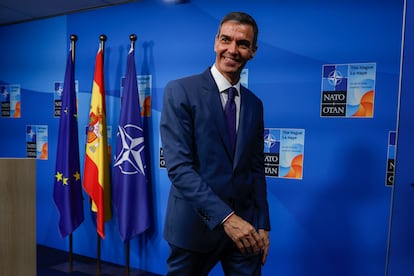
The Spanish president has launched a direct attack on Feijóo:"What I'm clear about, listening to the opposition leader, is that if there were another president here today, Spain would have signed the 5% defense agreement, and that would be a complete mistake for Spain, and that's why we didn't do it. We've decided to go down the path of [military] capabilities," Sánchez asserted.
The distance between Trump and Sánchez was very evident at this summit. They didn't even greet each other, as the Spaniard acknowledged. The head of government maintains it was a coincidence, but the reality is that he avoided that possibility by quickly sitting down in the plenary session. Sánchez preferred to show his rejection of Trump's demand on paper, in his exchange of letters with Rutte, but he avoided the appearance of a clash and stayed away from most of the leaders when the cameras were on. And he didn't address the clash with Trump in his press conference prior to the American's.
"I haven't had the opportunity to greet him [Trump] or exchange a few words with him. But all the member states know of Spain's guarantee and trust in NATO," Sánchez insisted. Regarding the US president's statements on Tuesday, in which he asserted that Spain was a"problem" for the NATO agreement, Sánchez retorted:"Spain is always the solution, never the problem."
"After this summit, NATO wins, Spain wins, and security and the welfare state win," the Spanish president asserted."NATO is united and emerges from this summit stronger in the face of the challenges facing Europe and the transatlantic relationship."
In response to the doubts of many leaders and the opposition in Spain, who believe that Sánchez will ultimately have to comply with the 5% threshold, the president read Rutte's letter:"The declaration we have approved today will give Spain the flexibility to determine its own path to achieving its capacity targets and to determine the annual resources needed as a percentage of GDP; that's very clear," he explained.
Until Trump spoke, everyone else seemed to want to put the controversy with Spain behind them, including Rutte himself, who has expressed his conviction that Spain is"serious" in its spending commitment, despite continuing to maintain that it does not need to reach the 3.5% target set at The Hague (the other 1.5% is earmarked for infrastructure to strengthen the security of allies) to meet its agreed military capability targets."We can agree to disagree; they believe they can reach their capability targets with 2.1% spending. NATO says it has to be 3.5%, as it is for all other allies," Rutte recalled at the final press conference, in which he explained that, in any case, the targets and compliance will be reviewed in 2029.
Corruption in the PSOE Sánchez also delved into national policy issues and admitted that last week's images of the Civil Guard entering the PSOE headquarters on Calle Ferraz were shocking. However, he believes that despite these scandals, he still has a parliamentary majority—"otherwise, I wouldn't be here," he said—and can continue in government. Once again, he compared himself to the PP and its reaction to the Gürtel case."We have acted decisively; corruption embarrasses us, but this is a clean government that has acted in unprecedented situations, and we have given our all. I am ashamed of these cases, but we have been relentless. I wish other parties with evidence would do the same. It is true that the UCO (National University of Catalonia) entered Ferraz and recorded Santos Cerdán's device. Computers were found destroyed in other raids on other parties."