

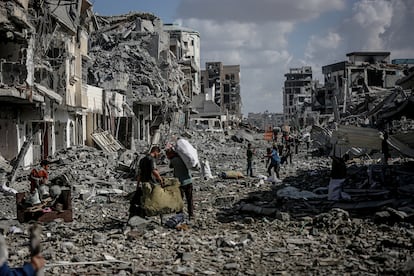
It was almost immediate. Thousands of Gazans (aerial photographs show a mass on Rashid, the coastal highway), displaced time and again during two years of Israeli invasion, began returning to their homes this Friday, after the ceasefire went into effect. The army announced this at 12:00 local time (11:00 in mainland Spain), although according to the text of the agreement, it happened automatically this morning, when Benjamin Netanyahu's government gave the green light by a large majority to the first phase of Donald Trump's peace plan. The troops have already completed, in fact, their partial withdrawal, from where they will still control half of Gaza, in view of the next challenge: the exchange, in the coming days, of the last 48 hostages for almost 2,000 Palestinian prisoners. And Netanyahu warned in a defiant message that Hamas will be disarmed"by fair means or foul."
An army spokesperson told Gazans that they would "allow movement from south to north" via the two routes that cross the Strip, Rashid and Salahedinne, inside the Strip, but warned them not to approach the troops, reminding them that"they will remain present in various areas of Gaza." "Approaching them puts their lives at risk," he said.
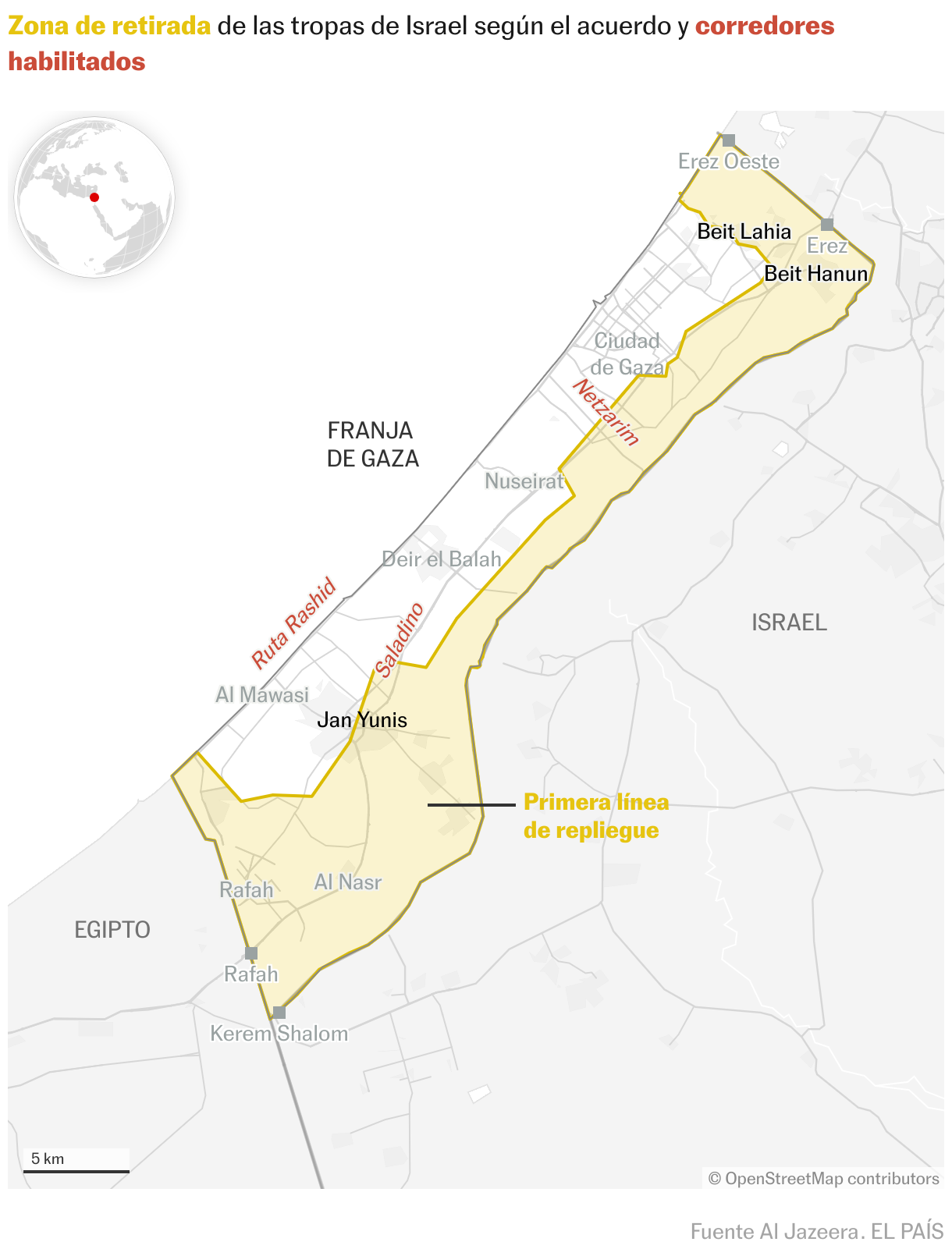
In particular, he has defined as"extremely dangerous" the approach to "the areas of Beit Hanoun, Beit Lahiya, Shejaia, and any area with troop concentrations"; the Rafah crossing, the border with Egypt; the so-called Philadelphia Corridor; and parts of Khan Yunis. He has also prohibited anyone, including fishermen, from"entering the sea in the coming days."
Shortly after the ceasefire began, Netanyahu addressed the nation in a pre-recorded speech in which he presented himself as the captain of a ship that has overcome all kinds of"internal and external pressures," guided solely by Israel's security. He claimed credit for securing the release of the remaining 48 hostages without requiring troops to completely withdraw from Gaza and presented the ceasefire as the result of a combination of"massive military pressure" over two years and "massive political pressure" from US President Donald Trump."We promised and we delivered," he boasted.
But above all, he has made it clear that if Hamas does not disarm “by good means,” as stipulated in the second phase of Trump’s plan, Israel will do so “by bad means.” The message, directed positively at its ultra-nationalist partners (who voted against the agreement), opens the door to a Lebanese-style scenario (with almost daily bombings against Hezbollah targets, despite the existence of a ceasefire since last year).
Israel has also published a list of the 250 Palestinian prisoners it will release that are the most public-savvy: those serving at least a life sentence for participating in or organizing attacks against Israelis. It received the green light from the executive branch early Friday morning, following several hours of meetings to discuss the first phase of Trump's agreement.
All ministers voted in favor of the text, except for those of Jewish Power and Religious Zionism (with one exception). These two religious ultranationalist parties aspire to annex Gaza and rebuild Jewish settlements.
Trump's special envoy for the Middle East, Steve Witkoff, and his son-in-law and advisor, Jared Kushner, participated in the meeting, in a demonstration of Israel's dependence on its great ally and of Trump's level of involvement in the Gaza agreement, which is reminiscent of the photograph, released by the White House, of the moment in which the US president holds Netanyahu's phone while he reads a written apology to the Prime Minister of Qatar, Mohamed bin Abdulrahman Al Thani, for having bombed his country.
The text of the agreement, revealed by Israeli public broadcaster, clearly states that the executive branch's approval implies"the immediate end of the war." In fact, Jalil al-Hayya, the head of the Hamas negotiating team, whom Israel had attempted to assassinate weeks earlier in Qatar, stated on Thursday afternoon that he had"guarantees from the United States and the mediating countries [Qatar and Egypt] and Turkey that the war is completely over."
Netanyahu's office, however, limited itself to announcing the approval of the"framework for the release of all hostages, both living and dead." He also made no mention of the "end of the war" in his speech on Friday.
All this in just 36 breathtaking hours, during which Trump announced the agreement on the first phase of his plan; the parties and mediators signed it without media coverage in Egypt; the Israeli army halted its bombing and retreated at full speed (it had more time, up to 24 hours) to facilitate the swap, which still has no set date. Netanyahu was also ambiguous in his remarks ("in the coming days"). Trump placed it around Monday (when he will address the Israeli Parliament) or Tuesday.